
DMK President M K Stalin has resigned as Tamil Nadu Chief Minister following his party's defeat in the recent Assembly elections. The resignation letter has been sent to the state Governor. DMK secured 59 seats and will serve as the principal opposition party.
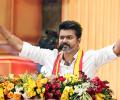
AIADMK MLA Leemarose Martin claims that Edappadi K Palaniswami is in talks to support actor Vijay's TVK to form a stable government in Tamil Nadu. TVK, despite a strong debut, needs additional support to secure a majority.

Vijay's TVK party is on the verge of forming a government in Tamil Nadu, drawing parallels to NTR's earlier success in Andhra Pradesh. Both achieved electoral success shortly after forming their parties, highlighting the potential for film popularity to translate into political gains.

Political circles in Tamil Nadu are rife with speculation about a potential alliance between rivals DMK and AIADMK to prevent the TVK from forming a government. This comes after the Congress party joined forces with TVK, further complicating the political landscape.

The AIADMK has stated it will not support the TVK in forming a government in Tamil Nadu, dismissing reports of a potential post-poll alliance.
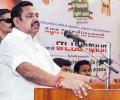
AIADMK general secretary Edappadi K Palaniswami met with new district secretaries to discuss the party's future strategy amid an ongoing internal rift. The meeting follows the removal of senior leaders and cross-voting during a recent confidence vote.

C Joseph Vijay was sworn in as the Chief Minister of Tamil Nadu at a gala event attended by prominent personalities including Rahul Gandhi. The swearing-in ceremony saw the presence of Vijay's parents and actress Trisha, while former CMs M K Stalin and Edappadi K Palaniswami were absent.

As results of the Assembly elections in West Bengal, Tamil Nadu, Kerala, Assam and Puducherry are declared, here's how the big names fared.
Vijay's TVK is poised to win its debut Assembly polls in Tamil Nadu, drawing parallels to Arvind Kejriwal's AAP's rise in Delhi. Both parties capitalised on public disenchantment with established political structures, promising change and fighting corruption.

The AINRC-led NDA has won the Puducherry Assembly elections and is set to form the government. Chief Minister N Rangasamy won both seats he contested.

The DMK has criticised its ally Congress for supporting Vijay's Tamilaga Vettri Kazhagam (TVK) to form the government, calling the decision a 'backstab'. DMK spokesperson Saravanan Annadurai accused Congress of being an 'unstable partner' and betraying the INDIA alliance.

In Puducherry, where constituencies have fewer than 30,000 electors on average, it is usual for N Rangaswamy to call out people he knows by name during his roadside election meetings.

Actor Vijay has been sworn in as the Chief Minister of Tamil Nadu, marking a significant shift in the state's political landscape. His party, Tamilaga Vettri Kazhagam (TVK), secured a notable victory in its debut election, ending the dominance of DMK and AIADMK.

The AIADMK is grappling with a deepening internal rift as factions vie for leadership, threatening the party's stability and future in Tamil Nadu politics.
Actor Vijay's newly formed party, TVK, has achieved a significant victory in the 2026 Tamil Nadu Assembly elections, securing a commanding vote share and disrupting the state's traditional bipolar political system.

One of the standout stories of the TVK victory was that of 30-year-old R Sabarinathan, the son of Vijay's driver from Virugambakkam.

Amid the arithmetic of subsidies, consumption and capacity, whichever government assumes office in Tamil Nadu after May 4 is likely to inherit a growing debate over how far the state can continue to expand welfare promises without placing additional strain on public finances and the power sector.

JCD Prabhakar of the TVK party has been unanimously elected as the Speaker of the Tamil Nadu Assembly. Chief Minister C Joseph Vijay emphasised the Assembly's role in transforming public expectations into effective policies and laws.

Sukesh Chandrasekhar, accused in multiple cases, has been granted bail in the AIADMK 'two leaves' money laundering case, but will continue to be in jail in connection with other cases.

Former AIADMK Chief Minister O Panneerselvam, expelled from the party in 2022, has joined the ruling DMK in Tamil Nadu, marking a significant political shift.

Tamil Nadu Minister S Keerthana was unable to take her oath of office as an MLA in the State Assembly because she did not present her Certificate of Election, a necessary document for the oath-taking process.

Launched in 2024, the TVK has Vijay's shift into politics was not sudden as he had been doing groundwork since 2009, when he launched his fan club, the Vijay Makkal Iyakkam.

C Joseph Vijay, leader of the TVK, was sworn in as the Chief Minister of Tamil Nadu, with the oath of office administered by Governor Rajendra Vishwanath in a ceremony held at Nehru Stadium. The event was attended by Congress leader Rahul Gandhi.

Dravida Munnetra Kazhagam and Opposition All India Anna Dravida Munnetra Kazhagam have allowed their allies in a direct duel in 21 constituencies in the April 23 assembly election to prove their strength in their respective strongholds.
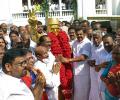
The AIADMK is facing a deeper crisis as factions clash over the floor test of the TVK government, with accusations of defying party directives and demands for disqualification under the anti-defection law.

Actor Vijay, president of Tamilaga Vettri Kazhagam (TVK), was sworn in as the Chief Minister of Tamil Nadu. The ceremony included a selfie with Rahul Gandhi and a 360-degree video of the cheering crowd. Vijay's party achieved a historic debut, ending the duopoly of DMK and AIADMK.

The Tamil Nadu Congress Committee and the Congress Legislature Party have decided to extend its full support to the TVK to form the government, AICC Tamil Nadu in-charge Girish Chodankar said in a statement citing TVK chief Vijay's request seeking support.

Members of lottery 'king' Santiago Martin's family are contesting in the Tamil Nadu and Puducherry Assembly elections through three different political parties.

By asking Vijay to produce letters of majority support before inviting him to form the government, the governor risks overstepping established Constitutional principles, notes Harishchandra.

Actor-politician Vijay's newly formed party, Tamilaga Vettri Kazhagam (TVK), has made a surprising and strong showing in the Tamil Nadu Assembly elections, leading in nearly 100 constituencies and leaving established Dravidian parties like DMK and AIADMK trailing.

Exit polls suggest significant shifts in Indian state assembly elections, forecasting BJP gains in West Bengal and Assam, a DMK comeback in Tamil Nadu, and a tight race in Kerala.

A look at the profiles of the ministers in the new Tamil Nadu government led by Joseph C Vijay of the Tamilaga Vettri Kazhagam (TVK).

The AIADMK has released its final list of candidates for the Tamil Nadu Assembly elections, including nominees to contest against prominent DMK leaders. The party is contesting in alliance with the BJP, AMMK and PMK.

Actor Vijay's journey from a shy film star to a political leader is explored, highlighting his unconventional methods and the key moments that shaped his transformation.

Chief Minister C Joseph Vijay-led TVK government successfully won the trust vote in the Tamil Nadu assembly, securing 144 votes in favour, with support from the Congress, VCK, and an AIADMK rebel faction.

The BJP is showing strong leads in West Bengal and Assam, while actor Vijay's party is making a significant debut in Tamil Nadu. The Congress is ahead in Kerala, offering some consolation amid the changing political landscape in the state elections.

A review of the accuracy of various exit polls in predicting the outcomes of recent assembly elections in West Bengal, Assam, Kerala, Puducherry, and Tamil Nadu, highlighting the performance of different pollsters.

The Vanniyar vote can tip the balance in 70 to 75 assembly constituencies of the 234 in the state, mainly in the Ranipet, Vellore, Thiruppathur, Krishnagiri, Dharmapuri, Tiruvannamalai, Arani, Villupuram and Kallakurichi districts.

Counting of votes begins in Tamil Nadu, Assam, Kerala, Puducherry, and West Bengal, with significant implications for regional and national parties.

If current trends persist, the Congress risks becoming increasingly regionally concentrated, dependent on a handful of states rather than functioning as a truly pan-India political force.
 © 2026 Rediff.com - Advertise with us - Disclaimer - Privacy Policy - Sitemap - Feedback - About us - Terms of use - Grievances