
US President Donald Trump on Friday (local time) said that he has "left instructions" to launch a massive military action against Iran, if Tehran succeeds in the plan of assassinating him, while stressing that the country would be bombed "at levels they have never seen before", New York Post reported.
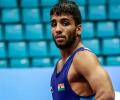
Indian wrestler Sujeet Kalkal secured a gold medal at the Asian Games, overcoming an Olympic champion and a significant deficit in the final bout. His victory, marked by an extraordinary comeback, has fueled his belief in contending for an Olympic medal in 2028, showcasing his fearless mindset and determination.

India's men's and women's kabaddi teams have both secured their spots in the finals of the Asian Games, continuing their unbeaten run. The women's team defeated Nepal 48-24, while the men's team triumphed over Thailand 66-28 in their respective semi-final matches, setting the stage for a potential double gold medal defence.

The US Central Command (CENTCOM) has launched extensive precision strikes across multiple Iranian military installations, deploying both one-way attack aerial and sea drones for the first time, to degrade Tehran's ability to disrupt international maritime trade in the Strait of Hormuz.

The US House of Representatives has advanced a bill that would empower President Donald Trump to impose 100 per cent tariffs on countries, including India, that purchase oil and gas from Russia, and also extend sanctions on Iran. The legislation, which previously passed the Senate, aims to curb Russia's energy revenue amidst the Ukraine conflict.

The United States has launched a fresh wave of precision strikes, hitting approximately 90 Iranian military targets deep inside Iran, further intensifying a rapidly expanding regional conflict, with Tehran warning of severe retaliation.

Following a successful campaign at the 2026 Asian Games, India women's boxing head coach Santiago Nieva is prioritising securing as many Olympic quotas as possible at the earliest for the Los Angeles 2028 Olympic Games, starting with the World Championships 2027 in Kazakhstan.

India's Asian Games gold medalists in kabaddi and shooting received a grand welcome at the IGI Airport.

The United States on Saturday (local time) launched a third round of strikes against Iran after alleging that Iran's Islamic Revolutionary Guard Corps (IRGC) attacked the Cyprus-flagged container vessel M/V GFS Galaxy in the Strait of Hormuz.

The Indian men's recurve archery team secured a silver medal at the Asian Games after a 1-5 defeat to defending champions Korea in the final. Despite a strong start, the Indian trio of Dhiraj Bommadevara, Yashdeep Bhoge, and Neeraj Chauhan couldn't maintain their lead.

Tajinderpal Singh Toor secured a silver medal in shot put at the Asian Games, marking his third consecutive medal at the event. Despite aiming for gold and a new personal best, Toor faced challenging wet conditions and minor injuries, finishing behind Iran's Mohammadreza Tayebise who set a new Games record. Toor expressed disappointment but acknowledged the significance of winning a medal for India.

'Thank you Los Angeles for your hospitality'

India remains one of the Hyundai Motor group's most important and strategic markets globally. The initiative positions India as a strategic core market for the group's growth, emerging market expansion, and next-generation automotive innovation.

Olympic bronze medallist Aman Sehrawat and Antim Panghal have secured their spots in the men's 57kg and women's 53kg finals, respectively, at the Asian Games in Nagoya. Both wrestlers, who previously won bronze at the 2023 Hangzhou Asian Games, are now poised to compete for gold.

This article provides the updated medals tally after Day 8 of the Asian Games, showing China in the lead with 205 medals, followed by Japan and South Korea. India is currently ranked 12th with a total of 37 medals.

India-US ties may be strained, but abandoning the relationship is not the answer; India must deal with Washington firmly without becoming either servile or hostile, asserts Ambassador T P Sreenivasan.

Prime Minister Narendra Modi hosted Iranian President Masoud Pezeshkian in New Delhi for talks focusing on the West Asia situation, bilateral relations, and BRICS cooperation. The meeting, Pezeshkian's first visit to India as president, comes amidst heightened tensions in West Asia due to new US sanctions on Iran and concerns over global oil supplies from the Strait of Hormuz. Both leaders emphasised regional stability and economic resilience.

A senior Pakistan Army general has confirmed the presence of Pakistani troops in Saudi Arabia, operating in "multiple capabilities" and "domains" amidst escalating Houthi attacks. This deployment is linked to the Makkah defence pact, a trilateral agreement with Turkiye and Saudi Arabia for collective deterrence, though specific details remain classified. Both Pakistan and Turkiye emphasise the defensive nature of their involvement.

'Elevated crude prices and unchanged domestic fuel prices would put pressure on the profitability and cash flows of OMCs.'

Jude Bellingham has lauded Harry Kane as England's 'greatest-ever player' after the captain marked his record-equalling 125th appearance with two goals and an assist in a 3-0 Nations League victory over the Czech Republic.

Thousands of mourners and international delegates gathered as Iran paid its final respects to its late supreme leader Ayatollah Ali Khamenei, who was killed in an Israeli strike on February 28, in Tehran.

Pakistan's Prime Minister Shehbaz Sharif used his UN General Assembly address to thank former US President Donald Trump for his "timely intervention" in the 2025 conflict with India, a claim India consistently denies. Sharif also raised the Kashmir issue and discussed the Indus Waters Treaty, while touting Pakistan's role in mediating US-Iran peace.

Foreign Portfolio Investors (FPIs) became net sellers in September, withdrawing Rs 35,860 crore from Indian equities due to global uncertainties, high US interest rates, and elevated crude oil prices, with outflows continuing into October.

New Delhi was told it had given something up; in reality it had stopped talking about it, notes Dr Abhishek Puri.

Former Spain defender Joan Capdevila has appealed to President Donald Trump for help after being denied permission to enter the United States for Sunday's World Cup final between Spain and defending champions Argentina.

Hours after US President Donald Trump on Wednesday said that the ceasefire deal with Iran was "over", the US President indicated that Washington could launch another round of strikes against the Islamic Republic, following strikes on Tuesday, saying it had already hit Tehran "very hard" and warning of further attacks.

Following the death of Ayatollah Ali Khamenei, his son and successor, Mojtaba Khamenei, issued a "revenge list" featuring 13 world leaders, including Donald Trump and Benjamin Netanyahu, with a graphic depicting them as targets, amidst escalating regional hostilities and US reports of an Iranian assassination plot against Trump.
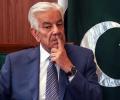
Pakistan's Defence Minister Khawaja Asif has reiterated the nation's unwavering commitment to the Makkah Joint Defence Agreement, underscoring its role in regional security following an attempted drone attack near the holy city of Mecca. The pact, signed by Pakistan, Turkiye, and Saudi Arabia, establishes a framework for collective deterrence against armed attacks.

The US forces conducted strikes against Iran, on Friday, as a powerful response to Thursday's attack on a commercial ship that was transiting the Strait of Hormuz, said Central Command (CENTCOM) in a statement.

Indian benchmark indices, Sensex and Nifty, saw declines in early trade due to escalating crude oil prices and ongoing US-Iran hostilities, which subdued investor risk appetite.

India's kurash contingent experienced a disappointing outing at the Asian Games, with all four participating athletes losing their respective bouts.

Iran's football coach, Amir Ghalenoei, has strongly criticised the United States for imposing travel restrictions on his team during the World Cup, claiming it unfairly hampered their preparation and performance.

India has expressed serious concern over Houthi attacks on Saudi Arabia's civilian infrastructure and economic assets, stating that such actions threaten regional stability and freedom of navigation through the Bab-el-Mandeb strait. External Affairs Minister S Jaishankar discussed the issue with his Saudi counterpart. India also condemned the targeting of commercial shipping after an Indian national went missing following an attack on a Panama-flagged ship off Oman.

The US House of Representatives has passed the Lindsey O Graham Sanctioning Russia and Iran Act of 2026, authorising President Trump to impose sanctions on Russia's energy sector and tariffs on countries like India and China that purchase Russian oil and gas. The legislation aims to curb Russia's ability to evade existing sanctions and reduce global dependence on its energy exports, despite some Democratic opposition to increased tariff authority for the President.

Indian benchmark indices Sensex and Nifty experienced a downturn in early trade, primarily influenced by a dip in HDFC Bank shares, persistent outflows from foreign funds, and escalating geopolitical tensions between the US and Iran. Track Sensex, Nifty performance.

India has condemned the attack on the Cyprus-flagged container ship M/V GFS Galaxy in the Strait of Hormuz, which resulted in one Indian crew member going missing. The United States responded with a third round of retaliatory strikes against Iranian targets, further escalating tensions in the Gulf.

Indian-American Congressman Raja Krishnamoorthi voted in favour of a Russia sanctions act in the US House, diverging from his Democratic party and other Indian-American lawmakers. The bill, which passed, imposes tariffs on Russian oil and gas buyers, potentially impacting India and China, and exempts US uranium purchases from Russia.

This article details the quarter-century journey of BRICS, from its inception as an economic acronym by a Goldman Sachs economist to its current status as an expanded eleven-member international bloc. It highlights its growth, key historical moments, and the significance of its upcoming summit, particularly with Iran's renewed importance in discussions.
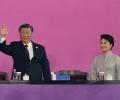
China leads the medal tally at the Aich-Nagoya Asian Games after the fourth day of competitions, securing 78 medals including 48 gold. Japan and South Korea follow, while India is currently placed 13th with 12 medals.

Fighting in Yemen has intensified as Houthi rebels advance on strategic government-held areas like Marib and Taiz, putting pressure on Saudi Arabia to respond. The conflict is also linked to wider US-Iran tensions affecting shipping in the Strait of Hormuz, with former US President Trump commenting on the situation.
