
Officials say the move represents the species' return after nearly a century, filling a long-standing ecological void. The animals, transported under strict veterinary supervision in specially designed crates, will initially be kept in soft-release enclosures to help them adapt before being fully released into the wild.

Ramgopal Varma: 'Even if they think it's a horrible film, it'll do 2,000 crores'.

Donald Trump shared a video on Truth Social purportedly showing explosions in Isfahan, Iran, following reports of attacks in Tehran. The authenticity of the video is unverified, but reports suggest a joint US-Israeli strike on an ammunition depot.

Delhi Police have arrested three alleged robbers who used chokehold techniques to overpower victims before robbing them at knifepoint. The arrests followed an incident on April 30 near Pul Paharganj.

A 27-year-old man in Hyderabad has been arrested for allegedly impersonating a police official and uploading fabricated videos on social media platforms using AI to gain followers.

The Karnataka State Cricket Association's request for additional complimentary tickets led to the shifting of IPL final and playoff matches from the M Chinnaswamy Stadium in Bengaluru, according to a BCCI source.

The Archaeological Survey of India (ASI) has informed the Madhya Pradesh High Court that a massive structure dating back to the Parmar kings existed at the Bhojshala temple-Kamal Maula mosque complex, and the current structure was built from the remains of temples.

Thirteen children from the Baiga tribe were rescued from bonded labour in Chhattisgarh's Kabirdham district. Eight people have been arrested, including two alleged traffickers and six employers.

Following a collision between a private car and a cab on Sohna Road in Gurugram, a group of taxi drivers allegedly harassed a girl travelling in the car and assaulted its driver. The girl's mother claimed that even after police arrived, they failed to take action, and the victim was forced to reach a compromise.

Yuvraj Sandhu finished T-31 at the Estrella Damn Catalunya Championship after a final round of 3-under 69. Yurav Premlall of South Africa won the tournament with a record-breaking 14-stroke lead.

Boman Irani started Spiral Bound in 2020, a platform to mentor budding writers and directors, and the project now reportedly has more than 2,000 members with 865 sessions, both online and offline. On May 1, film folk got together to celebrate its sixth anniversary in Mumbai.

West Bengal minister Dilip Ghosh attended a fish festival, refuting claims that the BJP would restrict fish and meat consumption if it won the assembly elections. He accused former Chief Minister Mamata Banerjee of spreading false narratives during the campaign.

The OnePlus Nord CE6 features a 6.78-inch 1.5K AMOLED display with a 144 Hz refresh rate, a Snapdragon 7s Gen 4 chipset, a 50MP main camera, and an 8,000 mAh battery with 80W SUPERVOOC charging.
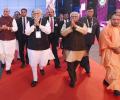
A police constable in Lucknow has alleged corruption in the deployment of personnel, claiming IPS officers are running a 'corrupt feudal system'. An inquiry has been ordered into the allegations.

A Delhi court has convicted two CBI officers for assaulting and trespassing into the residence of an Indian Revenue Service officer during a raid over two decades ago.

Former IRS officer Ashok Kumar Aggarwal has challenged a three-month jail term awarded to two CBI officers in an assault and trespass case, seeking a harsher sentence and higher compensation.
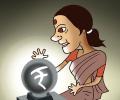
Unified Payments Interface (UPI) has reached a record Rs 314 lakh crore in transaction value in FY26, representing more than a 4,000-fold increase since inception.
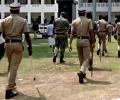
A Delhi court has sentenced two CBI officers to three months' imprisonment for assaulting and trespassing into the residence of an IRS officer during a raid two decades ago.

As David Dhawan hints at potential retirement after Hai Jawani Toh Ishq Hona Hai, we revisit his iconic Bollywood comedies that defined an era of entertainment.

Three milestones in three days signal India's growing mastery in next-generation strategic technologies spanning nuclear deterrence, hypersonic propulsion and precision stand-off strike capability.

Gautam Adani emphasised the importance of energy security and digital infrastructure in shaping geopolitical power, urging India to develop sovereign capabilities across the AI value chain.
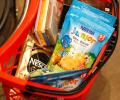
"Our strategy has always been to focus on volume-led penetration growth," said Manish Tiwary, chairman and managing director, Nestle India.

The Delhi Police have arrested a 54-year-old man in connection with a 1995 kidnapping and murder case. The accused had been living under a false identity as a social activist and YouTuber.

YouTuber Salim Wastik, known as 'Ex-Muslim' on social media, has been arrested by Delhi Police in connection with a 31-year-old kidnapping and murder case from 1995. Wastik, who had been evading arrest for over two decades, was apprehended in Loni, Uttar Pradesh.

Abhishek Sharma smashes a record 15-ball fifty against CSK, breaking his own SRH mark and becoming the third-fastest in IPL history while crossing 2,000 career runs.

The Indian Air Force conducted a day-and-night exercise on the Purvanchal Expressway in Sultanpur, Uttar Pradesh, activating an emergency-landing facility with fighter jets, helicopters, and transport aircraft to demonstrate operational readiness and validate standard operating procedures.

Faridabad Police have arrested a man for allegedly murdering a woman whose body was discovered in Ballabgarh last week. The accused, Beeru, confessed to the crime, citing the victim's repeated demands for money and threats to report him to the police.
Kerala SSLC examination results will be announced on May 15, according to General Education Minister V Sivankutty. Revaluation applications will be accepted immediately after the results are published, with the outcome expected by the end of May. The results of the Higher Secondary and Vocational Higher Secondary examinations will be published on May 22.
Preferential equity listings in India reached an unprecedented 1,307 in FY26, marking a 33% increase from the previous year and reflecting a strategic choice for companies during market volatility.

Airfares to Southeast Asia have surged 25 to 30 per cent, driven by high demand and limited airline seat capacity.

A college student in Dharwad, Karnataka, allegedly died by suicide after being detained during an anti-drug drive. His family alleges police harassment and demands for money led to his death, resulting in the suspension of three policemen.

Five Indian relay teams are set to compete in the World Athletics Relays in Gaborone, Botswana, aiming to secure qualification for the 2027 World Athletics Championships in Beijing.

Sunrisers Hyderabad's star opening batter Abhishek Sharma shattered multiple records as he slammed his second-highest score in the Indian Premier League.

Jharkhand police have uncovered an interstate cyber fraud network and arrested four individuals involved in fraudulent transactions across 24 states. The investigation was initiated following inputs from the Union Home Ministry's 'Samanvaya portal', leading to the discovery of a bank account in Ramgarh district used for the illicit activities.

B Sai Sudharsan's magnificent century propelled Gujarat Titans to a competitive total against Royal Challengers Bengaluru in their IPL match. His innings defied T20 conventions, proving runs can be made without aggressive hitting.

The government is identifying households with both liquefied petroleum gas (LPG) and piped natural gas (PNG) connections to enforce a ban on dual ownership, aiming to curb misuse and better target subsidies amid global energy supply disruptions.
A man in Bijnor, India, has been arrested for allegedly murdering an elderly woman after offering her a lift, robbing her of Rs 2,000 and a mobile phone. He was injured in retaliatory police firing during his arrest.

The Maharashtra government is nearing the acquisition of the Air India building in south Mumbai after the Finance Department transferred Rs 1,600 crore to the Public Works Department. The agreement with Air India Assets Holding Limited is expected to be signed within two weeks, providing much-needed office space for state government departments.

The Bihar government, led by Chief Minister Samrat Choudhary, has renamed the Sanjay Gandhi Biological Park as 'Patna Zoo' and the Sanjay Gandhi Institute of Dairy Technology as 'Bihar State Institute of Dairy Technology'. The cabinet also approved significant allocations for electricity subsidies, college establishments, and infrastructure projects.

The Left Democratic Front's defeat in Kerala marks a historic moment as Left parties are without power in any state for the first time in decades, highlighting their diminishing political influence across India.
 © 2026 Rediff.com - Advertise with us - Disclaimer - Privacy Policy - Sitemap - Feedback - About us - Terms of use - Grievances