
Dagi Ngomdir is all set for her debut as Rebecca in the folk supernatural horror film Bokshi. When it comes to her real life, though, there is nothing spooky about her style.

75% of India's 60 million digital-payment merchants have never recorded a transaction above 2,000.
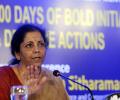
Finance Minister Nirmala Sitharaman has strongly refuted Opposition allegations that the decision to levy a 0.4 per cent Merchant Discount Rate (MDR) on specific UPI transactions above Rs 2,000 was influenced by external pressure. She clarified that the decision was a professional one made by the payment ecosystem, not a government imposition or a tax on consumers, with collected funds distributed among banks and UPI entities to ensure a sustainable digital payments framework.

Former India cricketer Vinod Kambli has released a video from an elderly care centre in Thane, Mumbai, assuring fans about his health and recovery and expressing gratitude for their support.

Wadhwa Group Holdings Ltd, the holding company of real estate developer The Wadhwa Group, has filed preliminary papers with markets regulator Sebi for an Initial Public Offering (IPO) using the confidential route, keeping offer details private for now.

The NCP (SP) has demanded a complete rollback of the 0.4 per cent Merchant Discount Rate (MDR) on UPI transactions above Rs 2,000, effective October 15. The party termed the move a "direct assault" on small traders and shopkeepers, accusing the Modi government of "double standards" by burdening small merchants while large industrialists benefit from loan write-offs.

India-Pakistan clashes in cricket and hockey drew big audiences at the Aichi-Nagoya Asian Games, helping fuel stronger viewership and a 20% revenue rise.

Roughly 340-350 such rakes remain to be converted out of around 2,000 rakes.
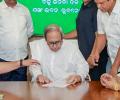
BJD chief Naveen Patnaik has voiced concerns over the Centre's decision to introduce Merchant Discount Rate (MDR) charges on UPI transactions above Rs 2,000 from October 15, urging protection for small traders and common people. This move has sparked a political debate, with the BJP defending the charges as beneficial for digital infrastructure and largely not impacting consumers, while the Congress and traders' associations criticise it as an additional burden.

It was beautiful to watch two successful actors speak about their career and personal journeys -- the highs and lows -- with such mutual admiration, notes Divya Nair.

Fuel pump dealers in Madhya Pradesh plan to stop accepting UPI payments exceeding Rs 2,000 for petrol and diesel from October 16, citing concerns over the proposed Merchant Discount Rate (MDR). The Confederation of All India Traders (CAIT) has urged the government to reconsider the MDR imposition, warning it could hinder digital payment adoption and impact traders' profits.

Trade and business associations across India are organising a 'No UPI Day' on October 2 to protest the upcoming 0.4 per cent merchant discount rate (MDR) on Unified Payments Interface (UPI) transactions exceeding 2,000, effective from October 15.

Canadian author Anne Carson has been awarded the 2026 Nobel Prize in Literature for her "bold and inventive oeuvre" that blends classical tradition with contemporary forms. The Swedish Academy highlighted her distinctive work spanning poetry, translation, and literary scholarship, noting her unique approach to language and ancient texts. Carson's career is marked by her ability to create new literary forms by placing classical authors alongside modern writers and transforming mythological figures into contemporary narratives.

BJD MP Santrupt Misra has voiced strong concerns over the Centre's decision to impose a 0.4 per cent Merchant Discount Rate (MDR) on UPI transactions above Rs 2,000, arguing that the government or large financial institutions could easily absorb the costs of maintaining the digital payment network instead of burdening merchants and consumers.

The Indian government has ordered the removal of Jack Dorsey's Bitchat app from app stores, citing law-and-order concerns due to its ability to bypass communication restrictions. The Ministry of Electronics and Information Technology (MeitY) issued the takedown demand under Section 69(A) of the IT Act, 2000. The government also addressed the issue of banning minors from social media, indicating a search for a better solution than outright bans.

Union Minister Ashwini Vaishnaw announced that the Indian government will release a draft consultation paper on Artificial Intelligence (AI) regulations within the next 30 days, focusing on safety, a human-first approach, skilling, inclusivity, and harm restriction.

The Delhi High Court on Monday turned down the Enforcement Directorate's plea to maintain a status quo on properties attached in the National Herald money laundering case involving Congress leaders Sonia Gandhi and Rahul Gandhi. Justice Sachin Datta stated he would not pass an interim order and would decide the agency's petition challenging a trial court's refusal to take cognisance of its chargesheet. The ED argues that the accused are using the trial court order to release properties, while the Gandhis contend the ED's plea is an "abuse of process of law."

Former NITI Aayog vice-chairman Rajiv Kumar has urged the government to maintain zero-fee UPI transactions for several more years, arguing that the benefits of UPI as a public good outweigh the costs. This comes amidst the government's recent decision to introduce a 0.4% fee on person-to-merchant UPI transactions above Rs 2,000 from October 15, a move that has drawn criticism.

West Indies all-rounder Shamar Springer discussed his team's "Plan B" to contain India's Abhishek Sharma, who scored a rapid 69 runs, leading India to a 14-run victory in the third T20I. Springer acknowledged Sharma's world-class performance and the difficulty of bowling on good wickets. He also reflected on the West Indies' chase, noting missed opportunities and the impact of the pitch conditions, while praising Roston Chase's underrated bowling.

From Shahid to Prahaar: The Untold Story of Ujjwal Nikam, these films bring real-life lawyers, landmark courtroom battles and extraordinary fights for justice to the screen.
State Bank of India (SBI) anticipates that the newly introduced Merchant Discount Rate (MDR) on person-to-merchant (P2M) UPI transactions above 2,000, effective October 15, will enable it to recover the costs incurred in processing and facilitating these transactions, potentially even generating a small surplus.

A member of the National Traders' Welfare Board (NTWB) has urged the central government to withdraw its decision to impose a 0.4 per cent Merchant Discount Rate (MDR) on UPI transactions exceeding Rs 2,000, effective from October 15. He warned that the new charge, which will be borne by merchants, could negatively impact business growth and lead to higher prices, contradicting the government's 'ease of doing business' policy.

The Indian government has approved the sale of a 60.72 per cent stake in IDBI Bank Ltd to Canadian billionaire Prem Watsa's Fairfax Financial Holdings Ltd for approximately 52,878 crore, a move that reflects improving India-Canada ties and marks a significant turning point for the bank.

Jammu and Kashmir Chief Minister Omar Abdullah introduced a resolution in the assembly demanding the urgent restoration of full statehood for the union territory. The resolution, which referenced previous autonomy resolutions, led to intense protests and "ugly scenes" from opposition BJP members, resulting in the adjournment of the House. Abdullah highlighted the unfulfilled promise by the Government of India regarding statehood after delimitation and elections.

Opposition MPs have voiced strong concerns regarding the government's decision to levy a 0.4 per cent fee on UPI payments above Rs 2,000 made to merchants, effective October 15. They argue that this "anti-people" move will negatively impact a large segment of the population, despite the finance ministry clarifying that the charge is on the merchant ecosystem and not directly on customers for P2P or small payments.

Apple has removed the offline messaging app Bitchat from its India App Store following a demand from the Ministry of Electronics and Information Technology (MeitY). Developed by Jack Dorsey, Bitchat faced scrutiny under Section 69(A) of the IT Act, 2000, due to concerns about its potential misuse by anti-national elements and for evading lawful surveillance, especially during public disorder. This marks the second time the app has faced government action in India.

A new Merchant Discount Rate (MDR) on UPI transactions above Rs 2,000, effective October 15, could force small merchants and price-sensitive consumers to revert to cash, according to economic think tank GTRI. The move, which introduces a 0.4 per cent MDR with a Rs 300 cap and concessional rates for specific categories, is questioned by GTRI founder Ajay Srivastava, who suggests it's not a revenue issue for the government but potentially a response to US pressure regarding UPI and RuPay's preferential market position.
A trade body in Jharkhand, FJCCI, has urged the Union Finance Minister to withdraw the proposed 0.4% Merchant Discount Rate (MDR) on UPI transactions above Rs 2,000 for merchants. The body argues that this charge will significantly increase operating costs for businesses, especially MSMEs and retailers, who rely on the current zero-MDR regime for digital payments.
The BJP has accused the Congress of spreading "fake news" regarding UPI transaction charges, asserting that the government has clarified that consumers will not be levied merchant discount rate (MDR) charges. This comes after the Congress criticised a government notification, alleging it paves the way for imposing fees on UPI transactions. The BJP has strongly refuted these claims, highlighting that most UPI transactions remain free and the government provides incentives to maintain a charge-free ecosystem for users.

The Jammu and Kashmir Legislative Assembly has passed a resolution demanding the urgent restoration of full statehood, a move that saw the opposition BJP stage a walkout. Chief Minister Omar Abdullah moved the resolution, which also referenced previous calls for greater autonomy and special status. The BJP vehemently opposed the resolution, calling it an insult to the Constitution.

The Delhi High Court has ruled that a private company's provision of email services does not, by itself, make it amenable to writ jurisdiction, even if the account is crucial for a user's business. This decision came as the court dismissed a petition by a media company seeking restoration of access to its Gmail account.

'UPI has been free since Covid, so why is the government charging us now?'

Samajwadi Party president Akhilesh Yadav has criticised the BJP government's proposed Merchant Discount Rate (MDR) on high-value UPI transactions, calling it a "chungi" (tax) on digital payments. He alleged the move was an attempt to extract money from people's transactions, contradicting the government's goal of a trillion-dollar economy. The new UPI framework will impose a 0.4% MDR on person-to-merchant transactions above Rs 2,000 from October 15, with certain sectors having a flat Rs 5 MDR.

Experts laud the decision to impose a 0.4 per cent Merchant Discount Rate (MDR) on UPI transactions exceeding Rs 2,000, effective October 15. This move, along with a dedicated fund for small merchants, is seen as crucial for creating a sustainable digital payments ecosystem, incentivising expansion in rural areas, and funding innovation while keeping most transactions free for users.

Alpine managing director Steve Nielsen, a veteran of Formula 1 since 1985, shares insights into his four-decade career, the sport's evolution from a niche interest to a global powerhouse, and the roles of Bernie Ecclestone and Liberty Media in its growth. He also discusses the potential return of the Indian Grand Prix, highlighting India's significant F1 fanbase.
The Indian government has introduced a 0.4 per cent Merchant Discount Rate (MDR) on UPI payments exceeding Rs 2,000 made to merchants, effective from October 15, with a comprehensive framework set to take full effect by October 15, 2026. This policy aims to regulate transaction fees while protecting small merchants and person-to-person transactions.

The Indian government has introduced a 0.4% transaction fee on UPI payments above Rs 2,000 for merchants, effective October 15, sparking a political row. The Congress party has labelled it a "Modi tax" and accused the government of succumbing to US pressure, while the BJP has defended the move, clarifying that consumers will not be charged and small vendors are protected. The finance ministry reiterated that the charge is on merchants, not customers.

The Indian government has made Bureau of Indian Standards (BIS) certification compulsory for smartphone screen protectors, effective April 1, 2027. This move aims to ensure product quality, curb low-quality imports, and significantly boost domestic manufacturing, creating a substantial industry and job opportunities.
The Indian government has introduced a 0.4% transaction fee on Unified Payments Interface (UPI) payments exceeding Rs 2,000 for merchants, effective October 15, marking the end of nearly six years of free service. Person-to-person transfers and small-value transactions below Rs 2,000 remain free. The new Merchant Discount Rate (MDR) is capped at Rs 300 for transactions above Rs 75,000, with differentiated rates for essential sectors and investments, and safeguards to prevent costs from being passed to consumers.

Karl Deisseroth, Peter Hegemann, and Georg Nagel have been jointly awarded the 2026 Nobel Prize in Physiology or Medicine for their groundbreaking discoveries in light-gated ion channels and optogenetics, a method revolutionising the study of brain function.
