
Iran has strongly criticised US plans to impose a blockade on its ports, warning that maritime security across the Persian Gulf region would be jeopardised if its own security is threatened.

Iran on Monday formally rejected a US-proposed ceasefire deal amid the escalating conflict in West Asia, instead unveiling its own 10-point plan aimed at permanently ending the ongoing war, as reported by the Iranian state news agency Islamic Republic News Agency (IRNA).

Hours after ceasefire, US President Donald Trump on Wednesday warned against any country supplying military weapons to the Islamic Republic, stating that he would impose a 50 percent tariff on all goods exported to the United States.

'On behalf of the Islamic Republic of Iran, I express gratitude and appreciation for my dear brothers HE Prime Minister of Pakistan Sharif and HE Field Marshal Munir for their tireless efforts to end the war in the region.'

US President Donald Trump on Monday confirmed that his administration has received a proposal from Iran aimed at ending the ongoing conflict in West Asia, but described the offer as insufficient.

Iran on Monday described the 15-point proposal from the United States to end the conflict in West Asia and reopen the strategic Strait of Hormuz as 'excessively demanding', stating that it has prepared its own set of demands to end hostilities, which have now entered their second month.

Pakistan's Prime Minister Shehbaz Sharif has welcomed the ceasefire between the US and Iran and invited delegations from both countries to Islamabad for peace negotiations.

The statement comes even as Tehran links the issue to ongoing efforts to bring a complete end to hostilities in West Asia involving the United States and Israel.
Following a US agreement to a ceasefire, Iran claims victory and outlines conditions for a lasting peace deal, including control over the Strait of Hormuz and the removal of sanctions.

Trump's message, posted on his Truth Social platform, is a reminder of his 10-day ultimatum given to the Islamic Republic earlier to make progress toward a deal or reopen the vital shipping lane.

The Israel Defence Forces (IDF) confirmed the missile launches in a statement on Telegram, noting that defensive systems were actively operating to intercept the threat.

Israel will continue its offensive in South Lebanon aimed at neutralising the threat from Hezbollah, which is backed by Iran.

The central headquarters of the Iranian armed forces has issued a stark warning to the United States and its regional partners following recent threats made by President Donald Trump, state broadcaster Press TV reported.

Iran's foreign ministry spokesperson Esmaeil Baqaei on Sunday said that the recent meeting with US officials was the longest round of negotiations they have had in the past year.

Media reports based on intelligence sources say nearly half of Iran's missile launchers remain intact, while thousands of one-way attack drones are still part of its arsenal even after continuous strikes targeting military infrastructure over the past five weeks.

The United States and Iran concluded the first phase of in-person talks in Islamabad, with both delegations exchanging written texts to formalise areas of understanding. The discussions, involving key representatives from both sides, are aimed at reducing tensions and exploring possibilities of a structured understanding.

US President Donald Trump said on Wednesday that Washington is considering a "joint venture" with Iran to secure the Strait of Hormuz, following his announcement of a two-week ceasefire.

A second United States fifth-generation F-35 fighter jet was struck and downed over central Iran by a modern air-defence system of the Islamic Republic's Islamic Revolutionary Guard Corps (IRGC), with officials saying the pilot is unlikely to have ejected, Iranian state media reported on Friday.

Iranian President Masoud Pezeshkian has confirmed Tehran's participation in Pakistan-facilitated peace talks with the US in Islamabad, according to Prime Minister Shehbaz Sharif. This development follows a conditional ceasefire agreement and aims to address regional tensions.

The fragile ceasefire in West Asia between the US and Iran to halt the hostilities in the region for two weeks faces renewed uncertainty as Tehran reportedly moved to block the strategic Strait of Hormuz once again due to Israel's intensified offensive against Hezbollah in Lebanon, according to Iranian state media Islamic Republic News Agency (IRNA), which US President Trump says was "not included" as part of the ceasefire deal.

Pakistan has announced its commitment to continue facilitating talks between the United States and Iran, urging both nations to uphold the ceasefire agreement. Deputy Prime Minister Ishaq Dar highlighted Pakistan's role in mediating recent discussions and expressed hope for durable peace and regional stability.

The diplomatic intervention follows various media reports which attributed comments to Iranian lawmaker Alaeddin Boroujerdi, suggesting that merchant vessels were being charged USD 2 million for safe passage through the "conflict-hit Hormuz."

An Iranian state television presenter has labelled the women's national soccer team as "wartime traitors" after the players did not sing their national anthem before their Asian Cup opener against South Korea in Australia earlier this week.
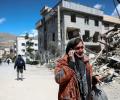
Fleur Hassan-Nahoum, special envoy, foreign ministry of Israel, has asserted that the situation has effectively been a "multi-front regional conflict" since its inception, while claiming significant military and strategic gains against adversarial forces.

Iran has confirmed its participation in peace talks hosted by Pakistan, aimed at resolving the conflict with the US and Israel, despite concerns over ceasefire violations.

'In such a scenario, Iran could proclaim itself victor, rebuild, re-enforce its diminished regional proxies to further destabilise neighbouring nations and take control of the Persian Gulf and Strait of Hormuz.'

In a post on Truth Social, Trump used unusually harsh language to convey his message, reminding Tehran of his deadline to 'make a deal' or 'open the Strait'.

The US Central Command (CENTCOM) announced the start of operations to clear mines in the Strait of Hormuz, a claim swiftly denied by Iran, leading to increased tensions in the region amidst stalled negotiations between the two countries.

Trump seems to have estimated that Ghalibaf is a pragmatic politician who is receptive to close relations with the US and is enthusiastic about fostering business and economic ties in particular, points out Ambassador M K Bhadrakumar.

Trump added that the United States would assist in managing the traffic buildup in the Strait of Hormuz.

The Congress party has criticised the Indian government's diplomatic efforts, questioning how Pakistan was able to secure a role as a mediator between the US and Iran despite India's attempts to isolate it after the Pahalgam attack. The party also raised concerns about India's standing on the global stage and its relationship with the US and China.

The operation reportedly extended to American assets, with the IRGC claiming that "US military bases in the region, namely Ali al-Salem in Kuwait, as well as al-Minhad and al-Dhafra in the United Arab Emirates, were also targeted."

According to Iranian state media, Islamic Republic of Iran Broadcasting (IRIB), the threat was articulated by Ebrahim Zolfaghari, spokesperson for Iran's Khatam al-Anbiya Central Headquarters.

US President Donald Trump on Wednesday backed Israel's ongoing military operation in Lebanon, stating that Hezbollah "was not included" in the recent ceasefire deal between Washington and Tehran, which halted the conflict in West Asia for two weeks.

US President Donald Trump has shared an article suggesting that the option of enforcing a naval blockade was available in the context of Iran, as peace talks ended in a stalemate in Islamabad after differences of opinion arose between the two parties on the Strait of Hormuz and Iran's nuclear capacities.

An Iranian missile strike on Haifa has resulted in casualties and intensified conflict between Iran and Israel, prompting search operations and ceasefire discussions.

Government officials are reportedly apprehensive that the 30,000 to 40,000 US troops currently deployed within the region could serve as the primary target of the Islamic Republic in the event of an all-out war.

Iran has put forward a comprehensive 10-point framework that it says forms the basis of a complete resolution.

A senior Iranian legislator has suggested that Tehran could further escalate pressure on its adversaries by targeting the Bab el-Mandeb Strait, raising concerns about global supply chain vulnerabilities.

As Iran heads into crucial peace talks with the United States of America, here are the six men who decide the Islamic Republic's course.
 © 2026 Rediff.com - Advertise with us - Disclaimer - Privacy Policy - Sitemap - Feedback - About us - Terms of use - Grievances