
The 'rescue' operation occurred within kilometres of Iran's underground tunnel complex at Isfahan, assessed by the IAEA and US intelligence as holding a substantial portion of the country's 60 per cent enriched uranium stockpile. Retired senior US military officers have highlighted that the mission's footprint -- hundreds of special operators, multiple heavy-lift aircraft deep inside Iran -- appears outsized for recovering a single airman. Prem Panicker continues his must read blog on the Iran War.

Amidst escalating tensions in West Asia, Russian President Vladimir Putin is actively calling for de-escalation and political resolution, engaging with Iranian and US counterparts to navigate the complex conflict landscape.

The pause gives the US time to breathe, to regroup, to move its expeditionary force into position without risk of interception along the way. It gives Iran nothing -- on the ground, attacks against its infrastructure continue apace. Prem Panicker in his must read daily blog on the Gulf War.

Kolkata Knight Riders have signed Zimbabwe fast bowler Blessing Muzarabani as a replacement for Mustafizur Rahman for IPL 2026, which is scheduled to start on March 28.

Trump said that the strait will be "open very soon" if ongoing negotiations with Tehran continue successfully.
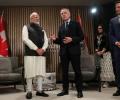
The statement suggests that Canadian authorities do not see ongoing foreign interference or violent activity tied to India at present.

By all available indications, the White House drafted a face-saving note and handed it, ready-made, to Islamabad. Pakistani Prime Minister Shehbaz Sharif was supposed to then post it in the guise of a plea urging Trump to extend the deadline by two weeks 'to allow diplomacy to run its course'. Trump would then graciously accept Pakistan's 'request' and declare a ceasefire. Sharif dutifully posted the message on X. Except that he, or whoever was handling the account, forgot to delete the tell-tale first line visible in the edit history: 'Draft - Pakistan's PM Message on X'. Prem Panicker's must read blog on the Iran War.

A senior Pakistani official has affirmed Pakistan's commitment to supporting Saudi Arabia, even before assistance is explicitly requested, amidst ongoing conflict in West Asia. This pledge underscores the close ties between the two nations and Pakistan's role in regional stability.

A US Congressman has introduced a resolution urging the US government to recognise the 1971 atrocities committed against Bengali Hindus in Bangladesh by the Pakistani Army as a genocide, seeking justice and historical acknowledgement.

External Affairs Minister S Jaishankar addressed the Rajya Sabha on India's position regarding the escalating conflict in West Asia, emphasising the need for peace, dialogue, and the safety of civilians, while also prioritising India's energy security and trade interests.

The threat has raised concerns about possible asymmetric attacks outside the region. Iran has also stepped up attacks on energy infrastructure in Gulf countries.

India has categorically rejected allegations of its involvement in transnational violence or organised crime in Canada, following a media report linking Indian officials to the killing of Sikh extremist Hardeep Singh Nijjar.

Ali Mousavi stated that such cooperation is essential for maintaining stability in the strategic waterway.

A Delhi court has criticized the conduct of Indian Youth Congress workers who protested at the AI Impact Summit venue, stating their actions were not legitimate dissent but a 'blatant assault on public order' that also harmed the country's diplomatic image.

Since June, India's ministry of external affairs has intensified its diplomatic calendar, hosting several heads of state and government, foreign ministers, and key trade delegations.

'India is at a critical juncture in this century. I want to be a part of the diplomatic team that works to make India great.'

India and the United Kingdom have agreed to enhance cooperation in counter-terrorism and organized crime, including addressing pro-Khalistani extremists in Britain, during the sixth India-UK Home Affairs Dialogue.

Israeli Ambassador to India, Reuven Azar, has refuted rumours circulating about Prime Minister Benjamin Netanyahu's death, attributing the disinformation to Iran and its allies.

Based on figures currently listed on the ministry of external affairs web site, a large number of Indians reside across West Asia.

The US President clarified that these negotiations do not involve the new Supreme Leader, Mojtaba Khamenei.
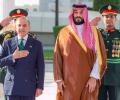
Prime Minister Shehbaz Sharif met with Saudi Crown Prince Mohammed bin Salman to express Pakistan's support for the Kingdom amidst escalating tensions in West Asia, reaffirming their mutual defence pact and commitment to regional stability.

The US Embassy acknowledged the attack in a post on X, urging Americans to avoid the facility 'until further notice' and announcing that all appointments had been cancelled.

The London High Court has rejected Nirav Modi's petition to reopen his extradition case, citing the Indian government's assurances regarding his treatment in India as a key factor in their decision.

Prime Minister Narendra Modi held a virtual meeting with chief ministers to review preparedness and plans in light of the West Asia conflict, emphasising the importance of national unity and enhanced security measures.

Analysts predict a surge in gold and silver prices as investors seek safe-haven assets due to escalating tensions in the Middle East. The impact on domestic prices will depend on the conflict's duration, with geopolitical factors and macroeconomic data also playing a role.

The Ministry of External Affairs (MEA) has stated that Prime Minister Narendra Modi and External Affairs Minister S Jaishankar are actively engaged with world leaders to promote dialogue and diplomacy for peace in West Asia, while also ensuring the safety and well-being of the Indian community in the region.

A Singapore coroner's inquest has officially ruled the death of Indian singer Zubeen Garg as an accidental drowning, concluding a thorough investigation that found no evidence of foul play and highlighting the role of alcohol intoxication.

India on Tuesday expressed deep concern over the escalating conflict in Iran and the Gulf region, urging all sides to exercise restraint and prioritise civilian safety.
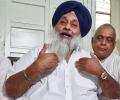
Shiromani Akali Dal president Sukhbir Singh Badal and Punjab Vidhan Sabha Speaker Kultar Singh Sandhwan have appealed to Prime Minister Narendra Modi to take urgent steps for the evacuation of Indian citizens stuck in countries affected by the recent joint Israel-US attack on Iran.

"The US President's statements are within the framework of efforts to reduce energy prices and gain time to implement his military plans," the ministry stated.
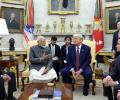
Prime Minister Narendra Modi and US President Donald Trump discussed the Middle East crisis, with a focus on the Strait of Hormuz.
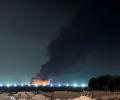
The IRGC said the barrage targeted several US military facilities in the region, including bases at Sheikh Isa in Bahrain, Juffair in Bahrain, Ali al-Salem in Kuwait and Al Azraq in Jordan.

Amid escalating tensions with Iran, President Trump is urging nations dependent on Middle Eastern oil to deploy warships to the Strait of Hormuz to safeguard critical global energy supplies.

Sonia Gandhi has criticised the Modi government's silence on the assassination of Iran's Supreme Leader, arguing it raises doubts about India's foreign policy direction and credibility.

The Ministry of External Affairs informed a parliamentary committee that nearly 1,000 Indians remain in Iran amidst the West Asia conflict, and 23,000 students in the Gulf region missed CBSE exams due to the turmoil.

This weekend, Donald Trump has begun to say the quiet part out loud -- that he wants to take control of Iran's oil, a formulation more in line with his robber-baron style of international relations.

External Affairs Minister S Jaishankar has engaged in multiple conversations with his Iranian counterpart to secure safe passage for Indian merchant vessels through the Strait of Hormuz amidst escalating tensions in West Asia.

The United States, which entered this war in expectation of a short, sharp win along the Venezuela model, is now preparing for deeper involvement in a conflict it does not fully control, without the allies it typically relies on, against an adversary that is not behaving as expected, in a global environment that is already absorbing economic shock. Prem Panicker continues his must read daily blog on the Gulf War.

'We were in a heavily nuclearised environment. China had tested for Pakistan in the 1980s and helped their missile programme stay just one step behind us.'

By appearing to privilege ideological affinity over strategic balance, India risks eroding the trust painstakingly built across West Asia. Once the perception takes hold that India's friendship is conditional and transactional, rebuilding credibility will be difficult, warns Amberish K Diwanji.
 © 2026 Rediff.com - Advertise with us - Disclaimer - Privacy Policy - Sitemap - Feedback - About us - Terms of use - Grievances