

By appearing to privilege ideological affinity over strategic balance, India risks eroding the trust painstakingly built across West Asia.
Once the perception takes hold that India's friendship is conditional and transactional, rebuilding credibility will be difficult, warns Amberish K Diwanji.

Key Points
- Jawaharlal Nehru stabilised post-Independence India and built enduring institutions, but his China policy and the 1962 War dented his legacy.
- Narendra Modi frequently blames Nehru for structural flaws in modern India yet now risks a foreign policy misstep of similar magnitude.
- Escalating tensions involving Iran, Israel and the United States have raised the stakes for India's regional strategy.
Prime Minister Narendra Modi has never concealed his deep antipathy toward India's first prime minister, Jawaharlal Nehru.
In speech after speech, Nehru is invoked as the source of nearly every structural flaw in modern India. Yet history is rarely so simple.
Nehru stabilised a traumatised nation after Independence and laid down an institutional and developmental framework that endures to this day.
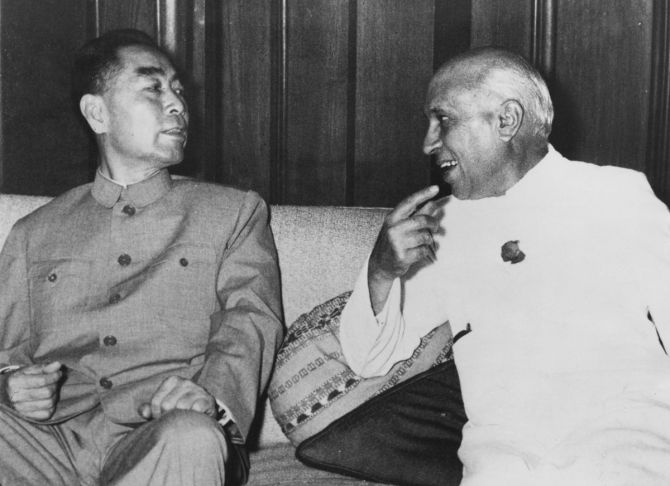
But it is equally true that Nehru's greatest miscalculation lay in his China policy. His belief in Asian solidarity and the rhetoric of 'Hindi-Chini Bhai Bhai' blinded him to the hard realities of power politics, culminating in the 1962 War and a permanent dent in his legacy.
Ironically, in foreign policy today, Modi risks committing a blunder of Nehruvian proportions.
A Region on Fire
West Asia stands on the brink. Israeli and American strikes on Iran and its senior leadership have dramatically escalated tensions.
Tehran has retaliated by targeting American bases in the Gulf, and further escalation appears likely.
The stakes for India are enormous.
Nearly nine million Indians live and work across the Gulf Cooperation Council (GCC) countries -- the UAE, Saudi Arabia, Kuwait, Qatar, Oman and Bahrain.
By contrast, only a few thousand Indians reside in Iran. On the surface, siding with the United States and Israel may seem the pragmatic choice.
Modi's ideological comfort with Israel is no secret. His public warmth toward Israeli leadership -- particularly his embrace of Benjamin Netanyahu -- has symbolised a deepening India-Israeli partnership.
But foreign policy is not about comfort. It is about long-term national interest.
The Iran Factor

Iran has, more often than not, been a quiet strategic partner.
When India sought to bypass Pakistan and access Afghanistan and Central Asia, it turned to Tehran.
The development of the Chabahar port was meant to provide India a gateway into Afghanistan and beyond, circumventing Pakistan entirely. That project represented years of careful diplomacy.
Yes, Iran has occasionally taken positions uncomfortable to India, including rhetorical support for Pakistan on Kashmir.
But so have several Arab States -- and that never prevented New Delhi from building productive ties across the region.
India's strength has always been its ability to engage adversaries simultaneously -- to maintain ties with Washington, Moscow, Tehran, Riyadh, and Tel Aviv without being trapped in anyone's camp.
That delicate balancing act is now under strain.
The Afghanistan-Pakistan Flashpoint

Meanwhile, closer to home, tensions simmer across the Durand Line. Pakistan has struck inside Afghanistan, alleging cross-border terrorism.
India has traditionally maintained sympathy for Kabul's position, given its own long experience with Pakistan-sponsored militancy.
Yet Washington's strategic calculations often lean toward Islamabad. Should India appear firmly in the US camp on Iran, it may find its leverage reduced when Afghan interests diverge from American priorities.
Strategic autonomy, once compromised, is difficult to reclaim.
Ideology versus Interest
India today enjoys relations with Iran, the Sunni Arab world, Israel, Russia, and the United States -- a diplomatic achievement built over decades by governments of differing political hues.
This multi-vector engagement is not accidental; it is the product of cautious, interest-driven statecraft.
Why then jeopardise that goodwill by appearing to take sides?
The concern is that ideology -- not strategic calculus -- is shaping choices. The notion of a civilisational alignment between a Hindu-majority India and a Jewish State, set against a broadly Islamic adversary, may hold emotional appeal in some quarters.
But foreign policy built on civilisational romance rather than cold national interest is fraught with risk.
Nehru's Asian solidarity proved illusory. Today's imagined ideological axes may prove equally fragile.
India need not endorse Iran's policies. It can -- and should -- insist that Tehran adhere to its international nuclear commitments. It can condemn retaliatory strikes that endanger regional stability.
But it must also assert that unilateral military action, bypassing the United Nations framework, sets a dangerous precedent.
India's interest lies not in joining camps, but in preserving options.
Refusing to criticise escalation may curry short-term favour in Washington and Tel Aviv, but it narrows India's diplomatic space.
A country of India's size and aspirations cannot afford to be seen as an appendage of any bloc.
The Cost of Alignment
Foreign policy blunders are rarely immediate; their consequences surface over time.
By appearing to privilege ideological affinity over strategic balance, India risks eroding the trust painstakingly built across West Asia.
Once the perception takes hold that India's friendship is conditional and transactional, rebuilding credibility will be difficult.
History offers lessons. Leaders who allow idealism -- or ideology -- to cloud judgment often discover that geopolitics is unforgiving.
If Nehru's error was romanticism about China, Modi's risk is ideological alignment at the expense of strategic autonomy.
The price, when it comes, may not be small.
Postscript: Some argue that Iran's domestic policies, particularly regarding women, make it undeserving of diplomatic balance. But Afghanistan has adopted deeply regressive gender policies. Selective outrage is not a strategy.
Feature Presentation: Aslam Hunani/Rediff





 © 2026