
This sharp Iranian response came after a series of uncompromising remarks from the US president.
China has called on Iran to reopen the Strait of Hormuz and expressed appreciation for Tehran's commitment not to develop nuclear weapons, a key demand of the US to end the conflict.

The United States' historical strategic alignment with Pakistan, dating back to the Cold War, has consistently aimed to create a political and military parity with India, despite India's significantly larger size and resources. This long-standing relationship continues to influence regional dynamics, particularly in West Asia and the Indo-Pacific.

US President Donald Trump has rejected Iran's proposal to end the ongoing war, deeming it 'totally unacceptable'. This decision comes amid efforts to negotiate an end to hostilities that began on February 28 and have disrupted global oil supplies.

Purnendu Maji and Srinivas Bhogle present Rediff's Most Valuable Player Index of IPL 2026 after Game 62.

If Trump wants peace with Iran, Pakistan will offer to help. If Trump seeks Pakistan's aid to spy on Iran, then too Munir will not hesitate to chip in. At the same time, the ISI will not hesitate to tip off Iran now and then, points out M R Narayan Swamy.

US President Donald Trump on Thursday said that he has directed the country's Navy to take decisive action against any vessels attempting to lay mines in the strategically vital Strait of Hormuz amid escalating tension over the virtual control of the waterway between Tehran and Washington.
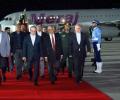
A new report alleges Pakistan shielded Iranian military aircraft from potential US airstrikes, raising questions about its role as a neutral mediator in the ongoing US-Iran tensions.

Punjab Kings will aim to recover from their first defeat of the season when they face Gujarat Titans in the Indian Premier League. Gujarat Titans, on a two-game winning streak, will be looking to continue their momentum.

The United States Central Command (CENTCOM) has announced that American forces are maintaining a strict maritime restrictive operation in the region, continuing to enforce a blockade against Iranian ports.
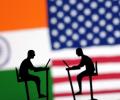
India and the US have reported positive progress in recent trade talks in Washington, agreeing to maintain engagement to finalise a bilateral trade agreement, which now requires recalibration following new US tariffs.

Shubman Gill's explosive 84 and Sai Sudharsan's fluent 55 powered Gujarat Titans to a formidable 229/4 against Rajasthan Royals in their IPL match. Gill's innings, marked by elegant strokeplay and aggressive intent, set the stage for Gujarat's dominance.

Iran's Supreme Leader Ayatollah Ali Khamenei claims a new chapter is emerging in the Persian Gulf due to the 'shameful failure' of the United States in the region, citing shifting regional dynamics and weakening foreign influence.

US President Donald Trump and Chinese President Xi Jinping began a crucial two-day summit in Beijing on Thursday, with both leaders signalling a desire to stabilise relations between the world's two biggest economies despite deep disagreements on trade, Taiwan, technology and security issues.

Gujarat Titans' batting coach Matthew Hayden believes the team has a destructive bowling attack and top-order batsmen, contributing to their recent success in the Indian Premier League.

Former CIA Analyst, Larry Johnson, said on Friday that US President Donald Trump asked US chairman of the joint chiefs of staff, Dan Caine, if they could use the nuclear weapons, but the latter denied.

US President Donald Trump's call to Prime Minister Narendra Modi signals a concerted effort to reset strained Washington-New Delhi ties, with a focus on 'big-ticket' energy and trade deals, including increased Indian imports of US LNG and LPG, and potential cooperation on small modular reactors.

India emerged reasonably well from 2025. But now, the oil shock and war-related supply disruptions have again driven funds out of India and significantly weakened the rupee, points out Ajay Chhibber.

Donald Trump has issued a stern warning to Iran, stating that the US will take a tougher stance if a diplomatic resolution regarding its nuclear programme is not reached soon.

An Iranian tanker successfully bypassed the US Navy to deliver crude oil to the Asia-Pacific region, despite ongoing tensions and a US blockade.

US President Donald Trump met with Chinese President Xi Jinping in Beijing to discuss trade, technology, Taiwan, and the Iran war. Xi Jinping said that 2026 will be a 'historic, landmark year' for China-US relations.

...is a way out, notes Prem Panicker in his must read blog on the Iran War. What the indefinite extension produces is a prolonged condition of not-war-not-peace, in which oil markets cannot stabilise, Asian refineries cannot plan, European governments cannot stop subsidising consumption they cannot afford, and the next flashpoint -- a seized tanker, a miscalculated drone strike, a Truth Social post that claims too much -- is one news cycle away.

President Donald Trump described the chaotic moments after a gunman opened fire at the Washington Hilton hotel during the White House Correspondents' Association dinner, leading to his evacuation by the Secret Service.

Bibiano Fernandes has announced the 23-member Indian squad for the AFC U-17 Asian Cup, set to begin in Jeddah, Saudi Arabia, on May 5. The team is currently in Doha for friendly matches before heading to Jeddah.
Donald Trump has dismissed the ceasefire with Iran as being on 'massive life support', signalling continued tensions between the US and Iran amid ongoing negotiations.

India skipper Suryakumar Yadav did not use Washington mainly because there were too many right-handers in the Australian line-up, but during chase the Tamil Nadu man showed his hitting prowess with four sixes and three fours making a tricky chase look very easy.

Chinese leaders, including its generals, will have to weigh whether they can win a war if they ever attack Taiwan and if at all, can they sustain the subsequent devastation, notes Rup Narayan Das.

Trump was swiftly evacuated from the White House Correspondents' Dinner after a shooting incident near the venue.

Shubman Gill has been instrumental in Gujarat Titans' success, participating in 11 of the franchise's 13 century partnerships since 2022. His recent 70-run innings against Delhi Capitals, coupled with a 104-run stand with Washington Sundar, underscores his importance as a premier batter. Gill is also nearing 4,000 IPL runs.
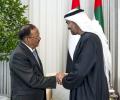
India is the only significant power that all parties trust, or at least do not distrust, notes former defence secretary Ajay Kumar.

Donald Trump has expressed confidence that Tehran will engage in diplomatic talks, warning that the country will 'see problems' should it refuse to cooperate.

President Donald Trump and other top White House officials were evacuated unharmed from the annual White House Correspondents' dinner after a gunman opened fire outside the hotel ballroom. The suspect, identified as Cole Tomas Allen, has been arrested. World leaders have expressed relief that Trump and other guests were unharmed, emphasising that political violence has no place in a democracy.

US President Donald Trump on Friday (local time) touted his claims of ending multiple global conflicts after he took charge of the White House and expressed hope that the ongoing Russia-Ukraine war could become the next one resolved, saying he would "love to" make it the tenth.

Kolkata Knight Riders kept their playoff hopes alive with a commanding 29-run win over Gujarat Titans at Eden Gardens, powered by a blazing batting display from Finn Allen and Angkrish Raghuvanshi, despite strong resistance from GT's top order.

A US trade representative described India as a 'tough nut to crack' during trade agreement negotiations in Washington, highlighting India's protection of its agricultural markets and the ongoing discussions on specific commodities.
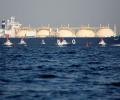
Iranian Deputy Foreign Minister Kazem Gharibabadi has urged India to take the lead in bringing peace to West Asia, highlighting the UAE's role in stalling BRICS consensus on the conflict. Gharibabadi also discussed a new framework with Oman for merchant vessels passing through the Strait of Hormuz.

Gujarat Titans, aiming for consistency, face a tough challenge against the in-form Royal Challengers Bengaluru in their upcoming Indian Premier League match.

Pakistan has intensified its efforts to bring the US and Iran back to the negotiating table to end the war in West Asia, following President Trump's extension of the ceasefire. Pakistani officials have engaged with Iranian, Turkish, and British counterparts to promote dialogue and diplomacy for a peaceful resolution.
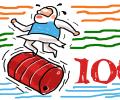
'Once the currency goes out of the hand, then possibly your major challenge is that it will not come back.'

A controversy has erupted over remarks made by Maharashtra MLA Vijay Wadettiwar regarding the shooting incident at an event attended by former US President Donald Trump. The BJP has demanded a condemnation from Congress leader Rahul Gandhi, alleging that Wadettiwar justified the incident and is hoping for a similar attack on Prime Minister Narendra Modi.
