
The Union Culture Ministry is developing an AI-powered "visual library of stolen antiquities" to scientifically compare suspected illegally exported objects with original images. This initiative aims to provide timely evidence for intervention, halt auctions, and facilitate the repatriation of India's cultural heritage. The ministry also launched an AI-powered semantic search engine for Indian culture.

Union Minister Mansukh Mandaviya inaugurated the BRICS Traditional and Indigenous Sports Demonstration Games 2026 in Ahmedabad, emphasising the role of traditional sports in reflecting cultural identity and fostering international cooperation. The one-day event, hosted by the Ministry of Youth Affairs and Sports, brought together delegations from BRICS and partner countries to showcase indigenous sporting practices like Mallakhamb, Yogasana, and Kalaripayattu from India, alongside Wushu from China and Sambo from Russia. Gujarat Deputy Chief Minister Harsh Sanghavi also highlighted India's rich sporting heritage and proposed initiatives for global promotion and preservation of traditional sports.

Prime Minister Narendra Modi inaugurated the first SCO Civilisational Dialogue Forum in New Delhi, emphasising that cultural connections are the strongest guarantee for global peace, especially amidst current global unrest. He highlighted India's ancient trade and cultural routes, stressing that shared civilisational experiences can unite the world. The event, hosted at Purana Qila, showcased India's rich heritage and aimed to foster cultural cooperation among SCO member countries.

The Nagaland Indigenous Tribes Cultural Resource Centre has been inaugurated in Kohima to preserve and promote the cultural heritage of the state's indigenous tribes.

Prasar Bharati Chairman Prasoon Joshi voiced concerns over AI's impact on India's cultural heritage, including music and endangered languages, advocating for human-AI collaboration. Meanwhile, a Spotify report revealed significant growth in royalties for Indian artists, with linguistic diversity driving economic strength in the creative industries, highlighting the platform's role in enabling talent across various Indian languages.

The central government has allotted a bungalow in Lutyens' Delhi to the Gaden Phodrang Trust, which is the office of Tibetan spiritual leader the Dalai Lama, following a request from the Ministry of External Affairs.

Around 149 boats participated in a women's boat race on Dal Lake in Srinagar.

A 700-year-old temple in Srinagar reopened after 37 years, bringing Kashmiri Pandits back to their place of worship and highlighting the spirit of Hindu-Muslim harmony in the Valley.

The SCO Civilisational Dialogue Forum, hosted by India, concluded with the adoption of the Indraprastha Communique. This outcome document advocates for the protection of cultural heritage, combating illicit trafficking, and promoting respect for all civilisations. The three-day forum, inaugurated by PM Modi, saw participation from SCO member countries, including Pakistan, and laid out a roadmap for future cultural cooperation and heritage preservation.

The traditional Dhami stone fair in Himachal Pradesh draws villagers and spectators for a centuries-old post-Diwali ritual steeped in history and culture.

In Pune, 31 prominent Ganapati mandals celebrated a "DJ-free" Dahi Handi, advocating for traditional instruments over high-decibel sound systems for upcoming festivals like Ganeshotsav. This initiative, led by Punit Balan, aims to preserve Maharashtra's cultural heritage and reduce noise pollution, gaining support from around 200 mandals and the Chief Minister.

Cockroach Janta Party (CJP) activist Saurav Das on Monday alleged that he was stopped by the Central government at Delhi Airport from travelling to London, where he was scheduled to deliver a lecture at the University of Oxford.

India has actively engaged in cultural diplomacy over the past 12 years, providing grant assistance and expertise for the restoration and conservation of significant heritage sites, including temples and archaeological complexes, across multiple Asian countries, reinforcing shared civilisational ties.

Sports Minister Mansukh Mandaviya will inaugurate the BRICS Traditional and Indigenous Demonstration Games 2026 in Ahmedabad on Monday. Organised by the Ministry of Youth Affairs and Sports in collaboration with the Gujarat government, the event on 12 October 2026, under India's BRICS Chairmanship, will feature traditional sports like Mallakhamb, Yogasana, and Kalaripayattu from India. The non-competitive Games aim to foster cultural exchange and knowledge-sharing among BRICS and partner countries including Belarus, Bolivia, Brazil, China, Ethiopia, Iran, Kazakhstan, Russia, South Africa, and the UAE.
Experts at a national symposium in Shillong discussed the role of Artificial Intelligence in tourism, emphasising that AI should support human judgment, local knowledge, and cultural values rather than replace them. Discussions highlighted the need for robust policies to address ethical concerns, safeguard livelihoods, and preserve cultural heritage while leveraging AI for innovation and sustainability in the tourism sector, particularly in Meghalaya.

Karnataka Chief Minister D K Shivakumar announced the government's commitment to making the yellow and red Kannada flag the official state flag. He stated that a legal framework would be introduced to allow it to be flown alongside the national flag on government buildings. The matter will be discussed during the winter session of the Legislature in Belagavi. Shivakumar also highlighted the importance of preserving Kannada language and culture, outlining initiatives to strengthen public education and promote the language.

Jitendra Kumar, Vicky Kaushal, Dulquer Salmaan, Ali Fazal, and Diljit Dosanjh have been recognised in Time's 100 Next India 2026 list.

A court in Gujarat's Gandhinagar district has sentenced three individuals to life imprisonment for cow slaughter, citing Hindu scriptures like the Manusmriti and Vedas to emphasise the religious significance of cows and their role in material prosperity and dharma.

Pakistan has indicated it would consider issuing a visa to Punjab Chief Minister Bhagwant Mann if he wishes to visit the country for the World Punjabi Conference in Lahore. While Mann has expressed interest, the decision also hinges on the Indian government's approval. The discussion also touched upon the Kartarpur Corridor, which remains closed, and Pakistan's broader efforts to facilitate religious pilgrims, including Sikhs and Hindus, to various sites.

Ladakh can be as tiring as it is fascinating -- it's not just the high altitude that takes the breath away, but the beauty in every turn of the road.

Maharashtra Chief Minister Devendra Fadnavis, Shiv Sena (UBT) head Uddhav Thackeray, and MNS chief Raj Thackeray shared a stage at a book launch in Mumbai, with Fadnavis asserting that such bonhomie is 'part of Maharashtra's political tradition'. The leaders also discussed the art of cartooning and a proposal for a dedicated cartoonists' gallery.

'Let's preserve our culture. Let's have this couple preserve their decorum.'

'It is the story of hundreds of Eethas who fall, rise and stand back up, never letting their dreams die.'

From an Italian childhood to the heart of India's most consequential political family, Sonia Gandhi's memoir explores how we make a home, what we lose in the making, and what belonging demands of us.

Info Edge (India) Ltd, the parent company of Naukri.com, is undergoing a significant leadership change as founder Sanjeev Bikhchandani prepares to return as managing director and group chief executive officer. This transition follows Hitesh Oberoi's decision to step down from his executive roles after nearly 27 years with the company, though he will remain on the board as a non-executive, non-independent director.

Talks between the Union home ministry and Ladakh leaders ended without a breakthrough in Leh, with the two sides expressing differences over a draft proposal on constitutional safeguards and a legislature for the Union Territory.

The Supreme Court has refused to entertain the Centre's plea challenging the Calcutta High Court's decision to uphold the maintainability of Public Interest Litigations (PILs) against the Great Nicobar Island mega-infrastructure project. The PILs allege violations of the Forest Rights Act and impact on Particularly Vulnerable Tribal Groups. The apex court directed the High Court to proceed with hearing all related petitions.

'I like to make films where I am also conflicted. I don't want to make films with themes that I am sure about because then it easily becomes agenda-driven.'

Haryana Chief Minister Nayab Singh Saini inaugurated the 38th 'Vasant Utsav' in Panchkula, highlighting the state's commitment to culture, nature, and environmental conservation through various initiatives.

The Sports Authority of India (SAI) Bengaluru has introduced Japanese cuisine into its athletes' diet plan to help them adapt to food culture ahead of the upcoming Asian Games in Aichi-Nagoya, Japan. This initiative aims to prevent performance issues caused by dietary struggles, as observed in past international events, and involves a gradual introduction of dishes and strict adherence to nutritional and safety standards.
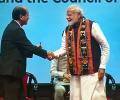
Nagaland Chief Minister Neiphiu Rio has called for strengthening Naga unity across political, cultural and social spheres, emphasising the importance of preserving collective identity.

The UN General Assembly has adopted a resolution, backed by India, to correct the world map for a more accurate representation of continental landmasses. The resolution addresses the distortions caused by the widely used Mercator projection, which minimises the perceived sizes of regions like Africa, Latin America, and South Asia, promoting an unbalanced global view. India supports the move towards more accurate cartographic practices, specifically endorsing broader use of Equal Area map projections.

The Hingorani family's decision to part with the Gandhi archive after generations was guided by a desire to make it accessible to a wider audience and to fund initiatives that would extend its legacy.

Zoho co-founder Sridhar Vembu argues that predictions of AI's catastrophic outcomes are overstated and a global pause in AI development is improbable. He urges India to adopt an independent AI strategy, focusing on extensive foundational R&D across sectors, while remaining wary of market monopolisation attempts by major tech players. Vembu also highlights concerns about AI's impact on human judgment, skill development, and job markets, particularly for junior professionals.

Prime Minister Narendra Modi has praised the traditional Morung learning system of Nagaland, highlighting its role in preserving cultural heritage and fostering interest in subjects like mathematics and science among children. He also lauded the efforts of women in Chizami village for preserving traditional seeds.

Sumit Sarkar was never intellectually dismissive of the Hindutva project. He took it with deadly seriousness for he grasped the challenge it posed to the aspirations and ideals of the anti-imperialist movement that generated multiple imaginings of freedom and ways to attain it, recalls Pradeep Kumar Dutta.

Madhya Pradesh Chief Minister Mohan Yadav has indicated a potential renaming of Orchha's historic Jahangir Mahal to Veer Singh Mahal, honouring Bundela ruler Veer Singh Judeo. Yadav stated that Veer Singh originally built the palace, and the move aims to highlight overlooked historical aspects. Former minister Narottam Mishra supported the proposal, citing a "malicious attempt to erase our historical heritage" by Mughals. The palace, a blend of Bundela and Mughal architecture, was built for Jahangir but he never resided there.

RSS chief Mohan Bhagwat stated that a true Hindu believes in the unity of humanity and that all religious paths lead to the same goal, asserting that 'if any Hindu thinks that there should be no Muslim in Bharat, he will not remain Hindu'.
BRICS leaders, in their New Delhi Declaration 2026, have called for wider access to Artificial Intelligence resources and stronger international cooperation to ensure the technology is safe, secure, inclusive, and reliable. The declaration outlines a broad technology agenda covering AI, cybersecurity, digital public infrastructure, telecom, quantum technologies, and advanced manufacturing, committing to implement the grouping's statement on 'Global Governance of Artificial Intelligence'.

Corporate leaders' half-life has shrunk over the past few decades. That is the Tata experience as well. Over 144 years till 2012, Tata Sons had just five chairmen. However, in the 15 years till 2027, the same group will see three, points out R Gopalakrishnan.
