
On Thursday, September 24, Chinese President Xi Jinping and his wife Peng Liyuan were accorded a warm welcome by President Donald Trump and First Lady Melania Trump at the White House in Washington, DC.

A devastating fire on a foreign-flagged cargo ship undergoing repairs at the Qingdao Beihai shipyard in eastern China has resulted in 20 fatalities. Chinese President Xi Jinping and Premier Li Qiang have issued directives for intensified search and rescue operations, thorough investigations into the cause, and enhanced safety measures across all sectors to prevent future accidents.

Chinese President Xi Jinping called for global collaboration in artificial intelligence development, emphasising a "symphony of global collaboration" over a "solo performance" by any single nation. Speaking at the World Artificial Intelligence Conference in Shanghai, Xi highlighted the need for ethical AI governance, shared prosperity, and addressing challenges like the widening digital divide. He also announced China's commitment to support developing countries with 5,000 AI research projects and training programmes. The event also saw 29 countries sign an agreement to establish the World Artificial Intelligence Cooperation Organisation (WAICO) in Shanghai.

Chinese President Xi Jinping has called for global collaboration in Artificial Intelligence development, stating it should be a "symphony" rather than a "solo performance." His remarks came at the World Artificial Intelligence Conference (WAIC) in Shanghai, where 29 countries also signed an agreement to establish the World Artificial Intelligence Cooperation Organisation (WAICO), an independent intergovernmental body headquartered in Shanghai. China also pledged 5,000 AI research projects and training for developing nations.

China on Tuesday listed out the four-point proposal given by President Xi Jinping for lasting peace in the Middle East.
'For the first time in a hundred years, the army has been taken out of the political equation. And for the first time ever, there is only one man who calls the shots. Not even Mao had this kind of power.'

National Security Advisor Ajit Doval is in Beijing for the 25th round of Special Representatives talks on the India-China boundary issue with his Chinese counterpart Wang Yi. These crucial discussions precede Chinese President Xi Jinping's anticipated visit to India for the BRICS summit, offering a potential opportunity for a meeting with Prime Minister Narendra Modi. The talks aim to address the long-standing border dispute and recurring tensions, with both sides emphasising the importance of peace and tranquillity for bilateral relations amidst recent reports of aggressive Chinese posturing in Arunachal Pradesh.

Chinese President Xi Jinping has arrived in Pyongyang for his first official visit in seven years, meeting with North Korean leader Kim Jong-un to reaffirm their long-standing friendship and pledge further development of bilateral relations amidst Pyongyang's deepening military ties with Moscow and China's assertions against Japan's 'new militarism'.

Chinese President Xi Jinping warned US President Donald Trump that mishandling the Taiwan issue could trigger conflicts between the two countries during wide-ranging talks on trade, Iran, and energy security.

Protesters gathered outside the San Francisco hotel where China's President Xi Jinping was to have dinner on the sidelines of the Asia-Pacific Economic Cooperation summit on Wednesday, November 15, 2023.
The Chinese Communist Party reaffirmed President Xi Jinping's leadership and backed a major purge of top military officials during a key meeting. The meeting also endorsed a new 5-year plan focused on domestic market resilience and self-reliance.

Chinese President Xi Jinping has called for the Strait of Hormuz to remain open for normal passage of ships, describing it as an 'international waterway' amid rising tensions between the US and Iran.

US President Donald Trump and First Lady Melania Trump welcomed Chinese President Xi Jinping and his wife Peng Liyuan at Joint Base Andrews, Maryland, on September 23, 2026, marking the start of Xi's state visit to Washington. The arrival featured an honour guard review, a flower presentation, the US national anthem, and a warm exchange between the two leaders before Trump and the First Lady returned to the White House.
If Xi Jinping is dethroned in the future, the instrument for that may well be embedded within the PLA, notes former foreign secretary Shyam Saran.

Members of the Tibetan community in exile held a symbolic protest march in Delhi's Majnu Ka Tila ahead of Chinese President Xi Jinping's visit to India for the BRICS 2026 Summit, voicing opposition to Beijing's policies in Tibet.

US President Donald Trump is set to visit China for talks with President Xi Jinping on trade, global issues, and the Gulf war. The visit aims to address trade frictions and other key issues, with high expectations for progress.

US President Donald Trump and First Lady Melania Trump hosted a lavish state dinner for Chinese President Xi Jinping and his wife Peng Liyuan at the White House on September 24, 2026. The guest list featured a who's who of American tech and business leaders, including Jensen Huang, Tim Cook, Sundar Pichai, Elon Musk, Satya Nadella, Sam Altman, Mark Zuckerberg, Jamie Dimon and Jeff Bezos, alongside senior US officials.

From his first summit appearance in Durban in 2013 to the bloc's landmark expansion and renewed diplomacy in recent years, Xi Jinping's speeches and initiatives have reflected China's evolving priorities within BRICS.

On Thursday, May 9, 2024, Hungarians in Budapest used the beloved children's book character Winnie The Pooh to protest against Chinese President Xi Jinping's visit to their country. Over the years Winnie the Pooh has been used to represent -- and criticise -- Xi Jinping.

On Saturday, Prime Minister Narendra Modi and Chinese President Xi Jinping met on the sidelines of the BRICS Summit in New Delhi.
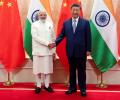
Chinese President Xi Jinping described India and China as "good neighbours, friends and partners", saying that achieving "dragon and elephant dancing together" is the right choice for both countries.
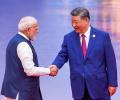
Ahead of Xi Jinping's visit, National Security Advisor Ajit Doval and Chinese Foreign Minister Wang Yi held extensive talks in Beijing on August 25 on the boundary issue and reached an eight-point consensus.

Xi Jinping -- general secretary of the Chinese Communist party and China's president -- has been very busy this week, hosting a likely ally in Africa and leaders from the Arab world.

Chinese President Xi Jinping notably skipped a gala dinner hosted by Prime Minister Narendra Modi for BRICS leaders and other dignitaries, with sources suggesting he returned to his hotel to rest. Meanwhile, a grand cultural performance, 'BRICS Symphony - One Rhythm, Many Cultures', featuring artistes from member countries, was a highlight of the evening.

Chinese President Xi Jinping began his second state visit to the US, meeting President Donald Trump at the White House. Both leaders expressed a desire for a better future for their nations, with Xi emphasising cooperation over confrontation and the avoidance of the "Thucydides Trap." Discussions also touched upon artificial intelligence governance and the extension of a trade truce. The visit was notably marked by a media boycott of White House coverage due to a dispute over press access.

President Donald Trump is hosting a lavish state dinner for Chinese President Xi Jinping at the White House. The event, meticulously prepared by First Lady Melania Trump, features a unique blend of American and Chinese culinary traditions, a historic toast, and a star-studded guest list including top tech and business leaders. The evening will also include musical performances and decor reflecting Chinese cultural significance.

Chinese President Xi Jinping's first visit to India in seven years for the BRICS Summit and bilateral talks with Prime Minister Narendra Modi is set to address crucial aspects of India-China relations, including trade, investment, and persistent border tensions.

Prime Minister Narendra Modi, in bilateral talks with Chinese President Xi Jinping, emphasized that both nations must show sensitivity to each other's core issues and be guided by mutual respect, sensitivity, and interest. Modi highlighted the critical importance of peace and tranquillity along the Line of Actual Control for the development of India-China relations, while also addressing concerns regarding Taiwan and Tibet.

Chinese President Xi Jinping is set to visit the United States from September 23 to 25 for summit talks with US President Donald Trump, with discussions expected to cover critical economic and trade issues, including AI, and the recently signed US sanctions law targeting countries buying Russian oil and gas.

Chinese President Xi Jinping's arrival in Washington marks a pivotal moment for global diplomacy, as he advocates for a "partners, not rivals" approach to US-China relations amidst high-stakes discussions on trade, technology, and international stability.
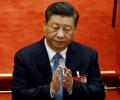
Xi Jinping, general secretary of the Chinese Communist party, attended the opening session of the National People's Congress, his country's parliament, at the Great Hall of the People in Beijing, March 5, 2022.

The National People's Congress -- China's annual political gathering known as the Two Sessions -- brought leaders and lawmakers this week to set the Chinese Communist party's agenda for domestic economic and social development for the year.

Chinese President Xi Jinping concluded his three-day visit to the US, stating that his discussions with President Donald Trump had injected "new substance" into the China-US relationship. Both leaders expressed optimism for future cooperation, with agreements reached on certain trade goods and discussions held on AI capabilities.

Prime Minister Narendra Modi welcomed BRICS leaders, including Russian President Vladimir Putin and Chinese President Xi Jinping, at the 18th BRICS summit in Bharat Mandapam. The leaders were photographed against the backdrop of Tamil Nadu's iconic Ramanathaswamy temple, a significant Hindu pilgrimage site. Modi explained the temple's importance to President Xi, highlighting its unique status as a Char Dham and Jyotirlinga shrine, and its historical and religious significance linked to Lord Ram.

Chinese President Xi Jinping is in New Delhi for the 18th BRICS Summit, where he is scheduled to hold bilateral talks with Prime Minister Narendra Modi. This visit, his first to India in nearly seven years, comes amidst efforts to normalise India-China relations following the 2020 Eastern Ladakh standoff and is expected to have significant implications for bilateral ties and BRICS cooperation.

The 18th BRICS Summit got underway in New Delhi with leaders of partner countries gathering in the capital to discuss the changing global economic and geopolitical landscape.

China's deteriorating economy is a serious concern. Xi Jinping and China's new premier will have a difficult task ahead of them after the 20th party congress, notes Jayadeva Ranade, the retired senior RA&W officer and China expert.

China emphasises proper handling of differences and a long-term perspective for bilateral ties ahead of President Xi Jinping's visit to India for the BRICS summit and talks with Prime Minister Narendra Modi. The visit aims to stabilise relations following the 2020 Ladakh standoff and strengthen BRICS cooperation.

Prime Minister Narendra Modi conveyed to Chinese President Xi Jinping that peace and tranquillity along the frontier remains an "essential" basis for the development of India-China relations, even as the two leaders welcomed "steady progress" in bilateral ties during their talks on the sidelines of the BRICS summit.

Xi brought in asymmetrical power play by stating that India should have 'strategic cognition' and 'strategic judgement made on the basis of the stage of development the two countries are at'. This is a very nuanced way of asserting China's coercive diplomatic posture and reflects Beijing's penchant to unleash border instability at will, restrict rare earth metal exports, exert pressure on India at global and regional orders, asserts China expert Srikanth Kondapalli.
