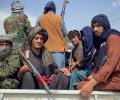
Pakistan confirms its armed forces targeted terrorist hideouts and military installations in Afghanistan's Kandahar province, claiming the action was in response to attacks by the Afghan Taliban. The strikes, part of Operation Ghazab lil-Haq, targeted technical support infrastructure and equipment storage used by terrorists, according to Pakistani officials.
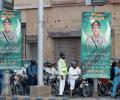
Pakistan has rejected India's criticism of its military campaign in Afghanistan, calling India's statement 'baseless' and 'misleading'.
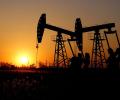
Crude oil prices experienced a sharp decline after US President Donald Trump announced a temporary halt to military strikes on Iran's energy infrastructure, easing geopolitical tensions and supply disruption fears.

The United States has launched a fresh wave of precision strikes, hitting approximately 90 Iranian military targets deep inside Iran, further intensifying a rapidly expanding regional conflict, with Tehran warning of severe retaliation.

Som Kumar Tamang, a 44-year-old Nepalese driver from Terhathu district, was killed in a drone attack in Kuwait. The attack, attributed to Iran, occurred amidst US military action against Iran. The Nepalese Embassy in Kuwait is arranging for the repatriation of his body and has advised Nepalese nationals in Kuwait to observe security protocols.
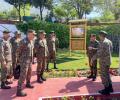
'Surgical strikes or air strikes, or both, are likely on the table.'

United States Central Command (CENTCOM) forces have conducted a 'heavy wave of strikes' against numerous Islamic Revolutionary Guard Corps (IRGC) targets in Iran. This action was a direct response to attempted Iranian missile strikes on US forces in West Asia, which were successfully intercepted. The strikes targeted IRGC military command centres, missile and drone facilities, coastal surveillance, and maritime capabilities, aiming to reduce threats posed by Iran and its proxies. US President Donald Trump also issued strong warnings to Tehran, linking the escalation to a recent drone strike on an LNG vessel in Egypt's Damietta Port.

Former US President Donald Trump reiterated his claim of mediating the India-Pakistan conflict, stating that 11 jets were shot down during the May 2023 hostilities. He also suggested the conflict could have escalated to a nuclear level and claimed credit for averting a major catastrophe, a claim consistently denied by India which maintains no third-party intervention occurred.

We have nothing to gain by raising our concerns internationally as our narrative has got entangled with several controversial concepts in the United Nations, asserts Ambassador T N Sreenivasan.

United States Secretary of War Pete Hegseth has rejected a CNN report claiming that the Pentagon's missile defence stockpiles have fallen to 'dangerously low levels' amid the conflict with Iran.

Indian benchmark indices Sensex and Nifty saw a significant rebound in early trade, driven by a sharp decline in crude oil prices and easing geopolitical tensions in the West Asia, which improved market sentiment and reduced inflation fears. Track Sensex, Nifty on July 27.

The US Central Command (CENTCOM) has launched extensive precision strikes across multiple Iranian military installations, deploying both one-way attack aerial and sea drones for the first time, to degrade Tehran's ability to disrupt international maritime trade in the Strait of Hormuz.

The statement came hours after Prime Minister Narendra Modi on Tuesday told the top defence brass that the armed forces have "complete operational freedom" to decide on the mode, targets and timing of India's response to the Pahalgam terror attack, government sources said.

US President Donald Trump stated that the United States is taking a "low-key" approach towards Iran, focusing on economic pressure rather than military action, amidst ongoing tensions over the Strait of Hormuz. Trump highlighted Iran's worsening economic situation and the impact of the US naval blockade, while negotiations for reopening the Strait remain stalled due to new conditions from Tehran.

Iran's Islamic Revolutionary Guard Corps (IRGC) on Saturday (local time) announced the closure of the Strait of Hormuz "until further notice," stating that the strategic waterway would remain shut until the United States ends its "interference" in the West Asia region, Press TV reported.

US President Donald Trump indicated that a peace deal with Iran is possible, but stressed that military action remains an option if talks fail. He emphasised the need for guarantees against nuclear weapons in any agreement.
United States President Donald Trump has opened a two-week window for diplomacy with Iran before deciding on military action, aiming to restart stalled negotiations amid Israel's bombing campaign, CNN reported.

Prime Minister Narendra Modi on Wednesday asked the Congress to tell the nation who prevented India's military response after the 26/11 Mumbai terror attacks linked to Pakistan, and accused the party of weakening the fight against terrorism when in power.

The latest development comes as diplomatic efforts between Washington and Tehran continue despite renewed hostilities. CNN reported that US and Iranian officials are still working towards a nuclear agreement by mid-August, even as preparations for possible military action have continued in parallel.

Iran's Islamic Revolutionary Guard Corps (IRGC) has launched missile and drone strikes on four US military bases in Kuwait and Bahrain. This action is in retaliation for recent American strikes against targets in Iran, which the IRGC condemned as a "violation of commitments" and an "anti-civilian act." The IRGC has warned of an expanded "crushing response" if US aggression continues.

The US Senate passed a resolution directing then-President Donald Trump to withdraw American forces from the conflict with Iran. This bipartisan vote, though largely symbolic as a concurrent resolution, highlighted congressional concerns over potential escalation and a desire to limit presidential military authority without legislative approval.

Iran's Islamic Revolutionary Guard Corps (IRGC) on Thursday claimed it had struck the US Al-Azraq air base in northern Jordan with 10 ballistic missiles on what it described as an "enemy command and control centre in West Asia" in retaliatory strikes in response to a recent attack on Tehran by Washington.

India has advised its nationals to postpone travel to Iran and urged those already there to consider leaving due to increasing instability and conflict in the region. The advisory from the Indian Embassy in Tehran highlights heightened caution and the need to monitor the security situation.

The United States on Saturday (local time) launched a third round of strikes against Iran after alleging that Iran's Islamic Revolutionary Guard Corps (IRGC) attacked the Cyprus-flagged container vessel M/V GFS Galaxy in the Strait of Hormuz.
US President Donald Trump on Friday (local time) said that he has "left instructions" to launch a massive military action against Iran, if Tehran succeeds in the plan of assassinating him, while stressing that the country would be bombed "at levels they have never seen before", New York Post reported.

US President Donald Trump has sharply criticised Israeli Prime Minister Benjamin Netanyahu over the handling of military operations in Lebanon, expressing dissatisfaction with the pace of the conflict and the escalating civilian death toll.

A senior Pakistani defence official, Lt Gen (retd) Mazhar Jamil, claimed that India's long-range missile development indicates ambitions to become a global nuclear power capable of threatening Western capitals, urging international attention to India's military modernisation. He also reiterated Pakistan's commitment to deterrence stability in South Asia.
Former US President Donald Trump stated that Gulf nations should reimburse the United States for safeguarding maritime traffic through the Strait of Hormuz, while asserting that recent American military interventions have profoundly crippled Iran's military capabilities, claiming Iran has been "brought back to the Stone Ages."

United States President Donald Trump has threatened to resume 'very hard' attacks on Iran, expressing frustration over Tehran's delays in signing a negotiated deal and citing the downing of a US Apache helicopter as grounds for renewed military action. Russia has called for restraint and a return to diplomacy amidst escalating tensions.

US President Donald Trump announced the 'reinstatement' of an 'Iranian Blockade' in the Strait of Hormuz, stating the US would charge a 20 per cent levy on transiting cargo for providing security, while Iran warned against any US interference, reaffirming its authority over the critical waterway.

Iran's Islamic Revolutionary Guard Corps (IRGC) has claimed responsibility for missile and drone strikes on US military installations in Bahrain, describing the operations as the second phase of its retaliatory campaign. This announcement follows US Central Command (CENTCOM) confirming its own large-scale offensive targeting Iranian military infrastructure.

President Trump has been briefed on potential military actions against Iran, including strikes on infrastructure and control of the Strait of Hormuz, even as negotiations continue. He maintains economic pressure is the primary strategy, while legal questions arise over war powers.

Kuwait's air defence systems engaged 'hostile aerial targets', Jordan intercepted four missiles, and Bahrain sounded warning sirens after Iran launched retaliatory strikes targeting US military installations in the region.

Iran's Persian Gulf Strait Authority (PGSA) has declared the Strait of Hormuz closed due to 'recent illegal movements' by the US military, demanding transit permits, while the US Central Command (CENTCOM) insists the strait is 'open to all vessels' and vows to ensure 'freedom of navigation'.

US President Donald Trump has declared the ceasefire agreement with Iran effectively concluded, stating he no longer wishes to engage in diplomatic dealings with Tehran and labelling Iranians as 'liars, cheats and sick people' following recent military actions.

Former Indian Army Chief General Vishwa Nath Sharma, who led the Army from 1988 to 1990 and was a veteran of the 1965 Indo-Pak War, has passed away at the age of 96. He was a highly decorated officer, receiving the AVSM and PVSM, and came from a distinguished military family, being the younger brother of India's first PVC awardee, Major Som Nath Sharma.

Supreme Leader Mojtaba Khamenei has reshuffled Iran's political and national-security establishment, appointing former SNSC Secretary Mohammad Bagher Zolghadr as his political adviser and veteran IRGC commander Mohsen Rezaei as his representative on the Supreme National Security Council, consolidating power amid the West Asia crisis and Strait of Hormuz tensions.
US President Donald Trump has announced the cancellation of a planned attack on Iran, contingent on Tehran agreeing to rapidly open the Strait of Hormuz and end its nuclear programme. This decision follows appeals from Middle Eastern countries and includes Israel's commitment, though Iran had previously warned against any "adventurous action" from the US.

Former US President Donald Trump has issued a stern warning to Iran, stating that "nothing will get through" unless a deal or "total surrender" is achieved, amid escalating tensions and conflicting reports on direct negotiations.

Priyanka Chopra Jonas is poised for another major Hollywood role, joining Oscar-winning actor Russell Crowe in the highly anticipated sci-fi action thriller Bluefly.
