
India has successfully evacuated 59 vessels, including 23 Indian-flagged and 36 foreign-flagged ships carrying cargo for India, from the Strait of Hormuz since March 1, 2026, amid fresh attacks and declining shipping traffic, Shipping Minister Sarbananda Sonowal informed the Rajya Sabha.

'Energy prices would shoot up with the closure of Hormuz again.'

Iran's state broadcaster IRIB reported that the Qatari oil tanker "Al-Raqayat" was targeted in the Strait of Hormuz after allegedly ignoring Iranian warnings and attempting to transit with US Navy support. This incident follows the expiry of a US-Iran agreement to halt strikes and comes amidst escalating tit-for-tat attacks in the vital waterway, raising concerns about maritime security.

US President Donald Trump announced the 'reinstatement' of an 'Iranian Blockade' in the Strait of Hormuz, stating the US would charge a 20 per cent levy on transiting cargo for providing security, while Iran warned against any US interference, reaffirming its authority over the critical waterway.

Despite decades of efforts towards energy transition, oil will remain the critical energy source for all nations for some decades. We can hope for peace opening the Strait of Hormuz, but must prepare for war closing it, points out former foreign secretary Ranjan Mathai.

The Directorate General of Maritime Administration (DGMA) has instructed shipping companies to avoid deploying Indian sailors on vessels transiting the Strait of Hormuz due to the ongoing West Asia crisis, following recent attacks on two vessels carrying Indian seafarers.

India has condemned an attack on a Cyprus-flagged commercial vessel off the coast of Oman, which resulted in one Indian crew member going missing. The incident occurred amidst escalating hostilities between Iran and the US in West Asia, prompting India to call for immediate de-escalation and an end to targeting commercial shipping in the region.

Iranian Foreign Minister Seyed Abbas Araghchi mocked US President Donald Trump's claim of the US being the 'guardian' of the Strait of Hormuz, asserting that Iran has always been and will remain the sole guardian, while also suggesting that any entity providing security should be compensated, though Trump's proposed '20 per cent' levy is 'too much'.
India has lodged a 'strong protest' with Iran over recent strikes on commercial vessels in the Strait of Hormuz, which resulted in the death of one Indian sailor and injuries to several others, calling for an immediate cessation of hostilities and a return to diplomatic engagement.

Iran's Persian Gulf Strait Authority (PGSA) has declared the Strait of Hormuz closed due to 'recent illegal movements' by the US military, demanding transit permits, while the US Central Command (CENTCOM) insists the strait is 'open to all vessels' and vows to ensure 'freedom of navigation'.

Donald Trump announced he is replacing the 20% reimbursement fee for securing the Strait of Hormuz with massive trade and investment deals from Gulf States into the United States, while maintaining a full blockade on Iranian ship traffic.

Herambh Karmarkar, a 30-year-old marine engineer from Pune, was killed in an attack on a Cyprus-flagged commercial vessel off Oman's coast amidst the West Asia conflict, with his family now awaiting the return of his mortal remains.

The United States conducted retaliatory strikes against Iran, targeting over 80 sites, after accusing Tehran of attacking commercial vessels in the Strait of Hormuz, while Iran condemned the US decision to revoke a temporary suspension of sanctions on Iranian oil sales.

Former US President Donald Trump stated that Gulf nations should reimburse the United States for safeguarding maritime traffic through the Strait of Hormuz, while asserting that recent American military interventions have profoundly crippled Iran's military capabilities, claiming Iran has been "brought back to the Stone Ages."
India has condemned the attack on the Cyprus-flagged container ship M/V GFS Galaxy in the Strait of Hormuz, which resulted in one Indian crew member going missing. The United States responded with a third round of retaliatory strikes against Iranian targets, further escalating tensions in the Gulf.
Iran's Islamic Revolutionary Guard Corps (IRGC) on Saturday (local time) announced the closure of the Strait of Hormuz "until further notice," stating that the strategic waterway would remain shut until the United States ends its "interference" in the West Asia region, Press TV reported.
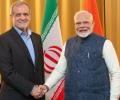
Prime Minister Narendra Modi held a telephonic conversation with Iranian President Masoud Pezeshkian, discussing recent developments in West Asia and reiterating India's emphasis on the importance of freedom of navigation in the Strait of Hormuz. Modi welcomed the recent peace understanding between the US and Iran, stressing dialogue and diplomacy for regional stability. India will also send representatives to the burial ceremonies of Iran's late Supreme Leader.

The US has warned India that any violation of its naval blockade in the Strait of Hormuz and illicit transport of Iranian oil will not be tolerated, a statement made amidst a diplomatic row over the deaths of Indian seafarers in US attacks on commercial vessels off the coast of Oman.

Ebrahim Azizi, Head of the Iranian Parliament's National Security Committee, warned the US against interfering with the Strait of Hormuz, asserting Iran's sovereignty after former President Donald Trump threatened to 'take over' the strategic waterway. Despite the heated rhetoric, Iran and the US have established a direct communication line to prevent incidents during a 60-day negotiation period.

15 ships carrying essential raw materials successfully navigated the Strait of Hormuz, easing concerns over agricultural input availability.

US and Iran officials have reportedly agreed to de-escalate tensions and ensure free passage through the Strait of Hormuz, with technical talks scheduled to continue. This development follows months of conflict, rising gas prices, and strained diplomatic relations, marked by recent retaliatory strikes and threats from both sides. Further discussions on Iran's nuclear program are set to take place in Qatar, highlighting ongoing diplomatic efforts despite recent volatility.

Following a Memorandum of Understanding between the US and Iran to resolve the West Asia conflict, eleven India-bound vessels have successfully transited the Strait of Hormuz. This development signals a positive shift for maritime trade, with more Indian-flagged ships expected to pass through the crucial waterway soon.

India significantly increased its crude oil imports from Russia and the United Arab Emirates in June, securing supplies as the Strait of Hormuz began to reopen, with Russian barrels remaining attractive due to discounts and UAE supplies offsetting earlier uncertainties.

Three Indian-flagged crude oil tankers, Desh Vaibhav, Desh Vibhor, and Sanmar Herald, successfully transited the Strait of Hormuz and are en route to India, even as Iran announced the closure of the critical waterway following Israeli strikes in Lebanon.

The United States on Saturday (local time) launched a third round of strikes against Iran after alleging that Iran's Islamic Revolutionary Guard Corps (IRGC) attacked the Cyprus-flagged container vessel M/V GFS Galaxy in the Strait of Hormuz.

United States President Donald Trump and Iranian President Masoud Pezeshkian have virtually signed a 14-point memorandum of understanding (MoU) to end hostilities, reopen the Strait of Hormuz, and begin a 60-day negotiation process on sanctions and Iran's nuclear programme.
Iran has announced the closure of the Strait of Hormuz, citing Israel's continued strikes in Lebanon and alleged violations of a ceasefire agreement. This move comes as both Israel and Hezbollah accuse each other of breaching the truce, with casualties rising in southern Lebanon.

The reopening of the Strait of Hormuz, following a ceasefire agreement between the US and Iran, is expected to significantly ease India's crude oil supply risks, lower freight costs, and reduce inflationary pressures, as global oil prices have already dropped.

US President Donald Trump has accused Iran of bringing down an American military helicopter near the strategically vital Strait of Hormuz, prompting a strong declaration that the United States 'must' respond to this significant incident.

The US forces conducted strikes against Iran, on Friday, as a powerful response to Thursday's attack on a commercial ship that was transiting the Strait of Hormuz, said Central Command (CENTCOM) in a statement.

Iranian Foreign Ministry spokesperson Esmail Baghaei stated that Iran is instead working with Oman to establish a mechanism for the safe passage of ships through the Strait.

Iranian media reported an exchange of fire between Iranian and US forces near the Strait of Hormuz, amidst a shaky ceasefire between the two countries.

Tensions escalate between Iran and the US over control of the Strait of Hormuz, a crucial shipping lane for global oil supplies, as both sides discuss extending a fragile ceasefire.

US President Donald Trump claimed on Tuesday that Tehran has consented to long-term, comprehensive monitoring of its nuclear infrastructure. Concurrently, Washington will ease shipping constraints in the Strait of Hormuz and release bound financial concessions, subject to stringent American oversight.

A new report suggests China's maritime vulnerability lies in the Strait of Hormuz, not Malacca, creating strategic competition in the Indian Ocean.
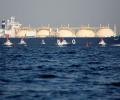
A Liquefied Natural Gas (LNG) carrier, chartered by an Indian firm, safely transited through the Strait of Hormuz -- the first Indian LNG tanker to cross the war-hit narrow shipping lane since the war in West Asia broke out more than three and a half months back.

Is the current rally telegraphing a durable peace plan in West Asia, boosted by United States (US) President Donald Trump's incoherent and contradictory posts on social media?

Iranian Foreign Minister Seyyed Abbas Araghchi stated that the Strait of Hormuz remains open to all commercial vessels, requiring ships to coordinate with Iranian naval forces due to regional tensions and a US blockade.
As tensions in the Middle East approach a critical juncture, reports have surfaced regarding a draft memorandum of understanding between the United States and Iran aimed at de-escalating the ongoing conflict, Iranian state media reported on Wednesday.

A vessel carrying 20,000 metric tonnes of Liquefied Petroleum Gas (LPG) arrived at Deendayal Port Authority in Kandla, Gujarat, after crossing the Strait of Hormuz amid the West Asia crisis.
