
The Trinamool Congress government's massive defeat in West Bengal shows "deep anti-incumbency and unpopularity" as out of 35 ministers who contested the assembly elections, 22 have been defeated, including Chief Minister Mamata Banerjee in her constituency.

Congress leader Rahul Gandhi has launched a scathing attack, calling Prime Minister Narendra Modi, Home Minister Amit Shah, and Chief Election Commissioner Gyanesh Kumar 'deshdrohis' (traitors) for allegedly 'destroying' India's voting system and 'stealing elections'.

The BJP is expected to win the Nagpur Municipal Corporation elections for the fourth consecutive time, owing to its strong organization and the influence of prominent leaders. The party has maintained its dominance in Nagpur since 2007.

Kerala recorded a high voter turnout in the Assembly elections, with over 77 per cent of eligible voters casting their ballots. The election is crucial as it will determine whether the LDF secures a rare third consecutive term, the UDF stages a comeback, or the NDA makes deeper inroads into Kerala's political landscape.

Telangana Forest Minister Konda Surekha was dropped from the state cabinet, leading her to accuse Chief Minister A Revanth Reddy of "blackmail politics." Surekha claims her removal was due to critical remarks made by her daughter against the CM and other party leaders, despite the Congress high command not favouring her ouster. She has written to top Congress leaders seeking intervention.

If the government wishes that protests like the one that took place at Jantar Mantar during the last few weeks should not recur, it must refocus its energies on jobs, not just the examination system, points out A K Bhattacharya.

Political parties in Kerala, including the ruling LDF, opposition UDF, and BJP-led NDA, have reacted to the exit poll predictions for the Assembly elections, with varying degrees of confidence and skepticism.
'When you weigh anti-incumbency against the Centre against anti-incumbency against the state, anti-incumbency against the Centre will triumph as this is a parliamentary election.'

In the throes of a financial crisis, the state's ruling Congress government has little to be triumphant about as Assembly elections approach next year, points out Aditi Phadnis.

Having governed Odisha for 24 uninterrupted years, the BJD now finds itself in the unfamiliar role of Opposition. Its organisational overhaul following the 2024 defeat has yet to produce a recognisable second line of leadership.

Senior Congress leader Ramesh Chennithala expresses confidence in the UDF's victory in the Kerala assembly elections, attributing it to Rahul Gandhi's leadership and a strong anti-incumbency sentiment.

'This is a major rupture in Tamil Nadu's political order.' 'For the Dravidian parties, the message is clear: The old DMK-AIADMK binary is no longer guaranteed a future.'
'98 lakhs in Bengal, 97 lakhs in Tamil Nadu, 2.83 crores in Uttar Pradesh.'

'What we are witnessing is a massive anti-incumbency wave that has cut across all social and political divides.'

Veteran Congress leader P J Kurien stated that the party has several qualified candidates for the Kerala CM post if the UDF wins the upcoming Assembly elections, but only three names are currently under consideration.

Initial vote counting in the Kerala Assembly elections indicates a significant lead for the Congress-led UDF, suggesting a potential shift in power.

'...appearing culturally coercive or administratively vindictive.' 'If it governs as a conquering force, resistance will build.'

The TMC's defeat in West Bengal signals an institutional breakdown, highlighting the collapse of its organisational core and raising questions about its sustainability beyond its top leadership.
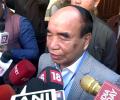
Mizoram's outgoing chief minister and Mizo National Front (MNF) president Zoramthanga on Monday said anti-incumbency was the main factor for his party's debacle in the state assembly polls.

AICC leader Pawan Khera has accused the CPI(M) and BJP of having a tacit understanding in the Kerala Assembly elections, alleging that both parties are deliberately fielding weak candidates to help each other. Khera expressed confidence in the Congress-led UDF's victory due to strong anti-incumbency sentiment.

The LDF convenor T P Ramakrishnan announced that the Left front would seek public input to address shortcomings after their defeat in the Kerala Assembly elections, where they won only 35 out of 140 seats.

'The AIADMK will lose a lot of votes simply because it is aligned with the BJP.'

The BJP's landslide victory in West Bengal has not merely redrawn the electoral map but overturned the operating logic of politics in the state, breaching the TMC's entrenched fortress despite a decade-and-a-half of dominance, minority consolidation, and a sustained "outsider" narrative.
K V Thomas, Kerala's Special Representative in New Delhi, forecasts a third term for the CPI(M)-led LDF government, attributing the UDF's potential failure to internal conflicts and criticising the BJP for introducing 'consumerism' into Kerala politics.

West Bengal's final phase of assembly elections focuses on the TMC's southern stronghold, where the BJP aims to make inroads. The outcome will determine whether Mamata Banerjee's party retains its dominance or if the BJP can secure a path to power.

'It was done with record speed. First, a revolt of the MLAs, which was obviously engineered.' ''No one believed me when I said the MLAs breaking away is not the real issue.' 'It is like a comet. The head doesn't matter, the tail matters.' 'And the tail is Parliament. Suvendu has gifted the prime minister 20 MPs.'
Senior Congress leader Ramesh Chennithala criticises the CPI(M)'s treatment of former leader G Sudhakaran and discusses the UDF's support for him as an independent candidate.

'It is going to be a negative vote against the government rather than a positive vote for the UDF.'

'The AIADMK and DMK have 75% of the total votes. 25% of the voters do not support the two majors,' says DMK spokesperson Saravanan Annadurai.

The TMC has refuted Prime Minister Modi's claim that high voter turnout in the first phase of the West Bengal Assembly polls indicates a mandate for change, asserting it reflects support for Mamata Banerjee and her government's development agenda.

If West Bengal does not begin to reclaim its lost pride, the state would have lost -- perhaps irreversibly, this time, notes Vice Admiral Biswajit Dasgupta (retd).

The extent of doubts over the fairness of this election can be assessed by juxtaposing two figures: Total votes polled by the two principal parties and the number of people who were disallowed from voting this time, observes Nilanjan Mukhopadhyay.
NSS general secretary G Sukumaran Nair stated that the UDF's victory in the Kerala assembly polls was due to public dissatisfaction with the government, not individual efforts. He also mentioned ongoing differences with Congress leader V D Satheesan but denied issuing directions on whom to support in the elections.
'Unfortunately the treasury is empty, in zero. So we have to first make money for the development activities of the state, and also to continue the welfare measures.'

The electorate did not vote for the BJP as much as they voted against the TMC. This is an important distinction that the new government will ignore at its own peril, points out Vice Admiral Biswajit Dasgupta (retd).

'Among the leaders whose names are going around, V D Satheesan is the leader who will fit this kind of situation.'

If current trends persist, the Congress risks becoming increasingly regionally concentrated, dependent on a handful of states rather than functioning as a truly pan-India political force.
Congress leader P T Ajay Mohan has discouraged discussions on who should be the CM before the Assembly poll results, expected on May 4.

The Bharatiya Janata Party has surged past the halfway mark in the West Bengal assembly elections, leading in 185 seats against the Trinamool Congress's 91, signalling a potential political shift in the state. Early trends suggest a geographically split mandate, with the BJP gaining in border, tribal, and industrial regions, while the TMC holds ground in parts of Kolkata and select rural strongholds.
Himanta Biswa Sarma's return as Assam's Chief Minister underscores the BJP's increasing dominance in the northeast, marked by both development and divisive policies.
