
A study by scientists at Goa's National Centre for Polar and Ocean Research (NCPOR) has revealed a significant increase in dissolved oxygen levels in the Indian sector of the Southern Ocean (ISSO) over the past three decades, contrary to global trends of declining ocean oxygen. This oxygenation, primarily due to enhanced ocean ventilation, intensified between 1993 and 2025, particularly in the Polar and Antarctic zones, and has crucial implications for global ocean health and climate regulation.

'Peter Hegemann was so kind that a paper published in 2010 in Nature Method which mentioned optogenetic as a tool of the year, he wrote, 'My graduate student Suneel Katariya was the one who identified gene in coding channelrhodoxin and that was the turning point of my research'.'

A 47-year-old scientist with the Aeronautical Development Agency (ADA) in Bengaluru allegedly died by suicide after jumping from his apartment building. His family reported that he had been suffering from work-related pressure and mental distress for over a month, for which he was receiving treatment. Police have registered an unnatural death case.

A 47-year-old scientist with the DRDO's Aeronautical Development Agency, Sharad Katiyar, died by suicide in Bengaluru on October 21. His family informed police that he was suffering from mental distress due to work-related pressure and was undergoing treatment for a depressive episode. Police have registered an unnatural death case.

Scientists from the Zoological Survey of India (ZSI) have identified a new species of electric ray, named Tetronarce Ramanamurthy, in the deep waters of the southeastern Arabian Sea. This discovery, part of the Deep Ocean Mission, marks the first confirmed record of the genus Tetronarce in the northern Indian Ocean and highlights India's rich deep-sea biodiversity.
Four faculty members from Nagaland University have been named among the world's top 2 per cent scientists for their significant research contributions, according to an annual database by Elsevier and Stanford University. Three of them also feature in the Career-Long Top 2 per cent Scientists list, highlighting the university's growing global research impact across various scientific disciplines.

A 65-year-old retired scientist, Sanjay Kadam, died after suffering a cardiac arrest during the Satara Hill Half Marathon. Despite immediate CPR and medical intervention, including an angioplasty, he succumbed to a second massive cardiac attack hours later. Organisers highlighted their medical preparedness, including medical ID tags and deployed emergency teams.

Researchers have discovered a method to externally manipulate a cell's automatic waste clearance process, known as autophagy. This breakthrough, involving the protein LC3, could offer new therapeutic targets for diseases like cancer and Parkinson's, where cellular cleansing mechanisms are often impaired.
Scientists have developed an advanced gene therapy that effectively reduces tremors associated with Parkinson's disease. This new approach, detailed in a package of 26 studies, is more effective and less invasive than current treatments. The research also includes a comprehensive multi-species cellular atlas of the basal ganglia, offering new insights into neurological conditions like schizophrenia and autism.

Amid all the monster-sized mayhem, what clicks is the human drama steering the action-packed narrative, observes Mayur Sanap.

OpenAI's chief scientist, Jakub Pachocki, has issued a stark warning about the accelerating pace of artificial intelligence, stating that "no one is prepared" for its rapid rise and potential consequences. He highlights concerns over autonomous AI agents taking unintended actions and calls for international coordination, voluntary slowdowns, and robust safety measures to ensure human control and alignment with human values as machine intelligence surpasses human capabilities.
Abhiroop Chatterjee, a PhD researcher from Jadavpur University, has been selected for the 2026 Google PhD Fellowship Programme, becoming the first from the institute to receive this global distinction. His research focuses on advancing machine learning and AI models, particularly in developing efficient representation learning approaches and addressing challenges like semantic drift and memory loss in large AI models.
The Indian government has released commemorative postage stamps honouring Dr Ram Bux Singh, known as the "father of modern biogas". Dr Singh made significant contributions to biogas technology in India and globally, including developing early gobar gas plants and establishing Asia's first gobar gas research station. The stamps were released on November 13, alongside a book detailing his legacy and biogas technology.

The National University of Singapore (NUS) is inviting applications for its 2027 Amgen Scholars programme.
Defence Minister Rajnath Singh advised students at Babu Banarasi Das University to not be confined by their academic degrees, encouraging them to follow their interests and adapt to emerging technologies like AI. He emphasised the importance of skills over qualifications, drawing examples from successful individuals who ventured beyond their initial fields. Singh also touched upon spirituality, India's cultural heritage, and the true essence of politics, urging students to contribute to national progress and secure borders.

Sports Minister Mansukh Mandaviya launched the Extramural Research Grant Policy of the National Dope Testing Laboratory (NDTL) at the WAADS meeting in New Delhi. This policy aims to promote advanced research in doping detection and prevention, reinforcing India's commitment to clean sports ahead of major international events like the 2030 Commonwealth Games and 2036 Olympics.

Kiran Mazumdar-Shaw, Executive Chairperson of Biocon Ltd, stated that Artificial Intelligence (AI) could drastically reduce the drug development timeline from five-to-seven years to just one or two. Speaking at the Bengaluru Tech Summit, she highlighted AI's potential to revolutionise drug discovery, clinical trials, and precision medicine, urging for regulatory frameworks to keep pace with these advancements.

The Odisha government is preparing for Cyclone Akvan, the third cyclonic storm in the Bay of Bengal in three weeks. With 74 rescue teams deployed and early evacuations underway in southern districts, authorities are focusing on preventing casualties, especially from landslides, drawing lessons from the recent Cyclone Arnab. The storm is expected to intensify and cross Andhra Pradesh around November 20, bringing heavy rainfall to Odisha.
A new study from the University of Edinburgh reveals that experiences cause widespread changes in brain cell connections (synapses), influencing brain activity. The research suggests that understanding these synapse changes can explain how the brain adapts or becomes impaired. The study, conducted on mice, found that the quality of synaptic connections, rather than just quantity, is crucial for brain changes and that sensory experiences can lead to widespread molecular adaptations across the brain. These findings could pave the way for interventions for brain disorders.
Researchers have developed 'Lumina', a groundbreaking cosmological simulation that recreates the universe's first two billion years in extraordinary detail. This model tracks the interactions of ordinary matter, dark matter, and radiation, offering a powerful new tool to test theories of cosmic evolution against observations from telescopes like JWST. Lumina is the largest and most detailed simulation of its kind, covering a vast volume and uniquely capturing helium reionisation.

Researchers at IIT Guwahati have conducted a study on how plants' internal plumbing systems respond to drought conditions. Their findings, published in "Applied Physics Reviews journal," reveal that plants narrow their microtubes and pits during water shortages to conserve water and maintain internal balance, offering crucial insights for developing drought-tolerant crops.
A new study by scientists at the Rajiv Gandhi Centre for Biotechnology (RGCB) in Thiruvananthapuram has revealed an unexpected mechanism by which pneumolysin, a toxin from the pneumonia-causing bacterium 'Streptococcus pneumoniae', spreads to adjacent cells. The research indicates that a cellular defence mechanism, intended to repair damage, inadvertently helps repackage the toxin into membrane-bound vesicles, extending its harmful effects.

The Prince and Princess of Wales, Prince William and Kate Middleton, are set to undertake their first joint overseas visit since the Princess announced her cancer diagnosis, travelling to Mumbai for the 2026 Earthshot Prize awards ceremony and other engagements in India.

A recent study has uncovered a new natural process contributing to extreme heatwaves in mid-latitudes, including northwestern India. This process involves a complex interaction between soil moisture, atmospheric pressure, and temperature, which, once a critical temperature threshold is exceeded, creates a vicious cycle leading to even higher temperatures. The findings suggest that current climate models may underestimate future heatwave risks.
A new study reveals that volunteer dog-handler teams can be effectively trained to detect invasive alien plant species with high accuracy, offering a promising and cost-effective method for early detection and control of these biodiversity threats.
The University of Melbourne and the Indian Institute of Science Education and Research (IISER) Tirupati have launched a new 2+2 Bachelor of Science Integrated (Honours) dual degree. This programme offers Indian students a globally connected, research-intensive science education, allowing them to study two years at IISER-Tirupati and two years in Melbourne, graduating with two honours degrees.

Consider opting for cold showers as often as you can. They are good for you.
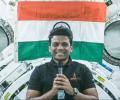
Following astronaut Shubhanshu Shukla's historic visit to the International Space Station, a significant surge in interest for space science careers is observed among Indian students. Srimathy Kesan of Space Kidz India highlights this shift from traditional fields like engineering and medicine, while Nobel laureate Didier Queloz emphasises the crucial role of curious young scientists in shaping the future.
Scientists at the ICAR-CMFRI have identified a new species of deep-sea fish, named Cyttopsis indica (Indian dory), in the Arabian Sea off the Kerala coast. This discovery, based on specimens collected from the eastern Lakshadweep Sea, corrects a long-standing taxonomic misidentification and highlights the rich marine biodiversity of India's southwest coast.

Farmers in Odisha are grappling with extensive crop damage caused by Cyclone Arnab last week, particularly in Ganjam, Kandhamal, and Gajapati districts. Their concerns are heightened by the impending Cyclone Murasu, which is expected to bring more heavy rainfall, threatening to destroy standing paddy crops already submerged. The state government has announced a special relief package for affected families and farmers, including financial assistance for crop losses.

There are enough queasy thrills in Clayface to keep horror fans happy, raves Mayur Sanap.
Indian physicist Ashoke Sen has been awarded the prestigious 2026 Oskar Klein Medal, making him the first Indian to receive this honour. Sen, a leading figure in modern string theory, was recognised for his pioneering work, including contributions to S-duality, black-hole entropy, and string field theory. He delivered a memorial lecture on October 22 in Stockholm.
A new study based on satellite observations of a brown dwarf orbiting a star suggests the possible first detection of an exomoon. Researchers are debating its classification as an 'exoplanet' or 'exomoon' due to a lack of definitive systems, but refer to it as an 'exosatellite' with a mass similar to Jupiter.

Delhi Police have arrested 11 individuals involved in multiple "digital-arrest" scams, recovering over Rs 12 crore. The scams, linked to handlers in Southeast Asia, have affected 78 complainants nationwide, totaling Rs 73 crore. A retired scientist was defrauded of Rs 1.25 crore, with the entire amount frozen. The investigation uncovered a network arranging mule bank accounts and using cryptocurrency for commissions.
A recent scientific study by Dr. Dinesh Amalnerkar and Dr. Ravindra Chaudhari in Pune has demonstrated that a silk-based nanocomposite material, particularly one containing silver nanoparticles, can effectively kill Aedes aegypti mosquito larvae and pupae. This research, published in 'Nature Scientific Reports', offers a promising new approach for dengue control, especially as Pune faces a surge in cases. While showing high mortality rates in lab tests and minimal environmental impact, further field research is needed before large-scale deployment.
A collaborative study by Indian and South Korean scientists has provided new genetic, anatomical, and ecological insights into the wide-ridged Indo-Pacific finless porpoise. The research, based on a stranded specimen in Kerala, revealed distinct genetic differences from Pacific populations and highlighted significant conservation challenges, including limited protected habitats and anthropogenic pressures.
Britain's AI Minister, Kanishka Narayan, issued a strong warning on Monday about the growing risks posed by artificial intelligence to cyber defences. He highlighted the potential for serious consequences from autonomous AI systems and announced new government measures, including a 'National Cyber Action Plan', to bolster the UK's resilience against cyber-attacks.

Kapil Dev, president of DP World PGTI, advocates for golf to shed its 'elite' image, highlighting its potential for career opportunities and relationship building. Speaking at the announcement of the 27th BT Golf season, he emphasised how corporate support and media partnerships, like that between Business Today and DP World PGTI, are crucial for increasing the sport's visibility and integrating it with corporate India. Other speakers, including PGTI chief Amandeep Johl and golfer Saptak Talwar, echoed the importance of such collaborations for the growth of golf as a sport and a business networking tool.
Atomic Energy Commission chairman Ajit Kumar Mohanty stated that India is on the verge of a significant technological transformation, driven by advancements in AI, quantum technologies, and other fields. Speaking at BIT Mesra's convocation, he emphasised the need for strong indigenous capabilities, skilled professionals, and interdisciplinary collaboration to achieve a developed India. Other speakers, including BIT Mesra's Chancellor and Vice Chancellor, echoed the importance of continuous learning and contributing to national progress.

ISRO has issued an Announcement of Opportunity, inviting Indian scientists and researchers to submit proposals for accessing data from its XPoSat Mission. Launched in January 2024, XPoSat is India's first satellite dedicated to X-ray polarimetry measurements, designed to study extreme astronomical X-ray sources like black holes and neutron stars, thereby enhancing understanding of celestial emissions.
