
IndiGo will have 74 of its 224 weekly international departures affected while Air India will relocate 33 of its 100 departures.

Indian skeet shooter Anantjeet Singh Naruka has positioned himself strongly for the Asian Games final, tying for the lead after four qualification rounds. While other Indian male shooters struggled, Naruka's performance offers hope. In women's skeet, Raiza Dhillon and Parinaaz Dhaliwal are also in contention for individual medals, and the women's team holds a bronze medal position, though facing tough competition. The final qualification rounds are crucial for India's medal aspirations.

India's Russian crude oil imports reached a five-month low in September, dropping to 1.75 million barrels per day, as Indian refiners strategically diversify their energy supplies amidst evolving geopolitical landscapes and robust domestic demand, according to ship tracking data.

An Indian worker was killed in an attack on a power and water desalination plant in Kuwait, according to Kuwait's Ministry of Electricity, Water and Renewable Energy.

India's skeet shooting teams secured two bronze medals at the Asian Games, with both the men's and women's teams reaching the podium. This achievement provided a much-needed boost to India's shooting campaign, despite individual shooters Anantjeet Singh Naruka and Raiza Dhillon narrowly missing out on individual medals, finishing fourth in their respective events.

Indian athletes are set for a busy day at the Asian Games on September 30, with competitions across various disciplines including archery, boxing, cycling, golf, judo, sailing, shooting, squash, tennis, and wrestling. Several medal opportunities and crucial semifinal matches await the contingent.

India's Ministry of External Affairs spokesperson Randhir Jaiswal stated that India desires positive, constructive, and forward-looking ties with Bangladesh and is ready to discuss all bilateral issues. This comes amidst queries regarding the state of relations following a change in Bangladesh's government and upcoming international engagements.

An Indian national has been killed in Kuwait following Iranian strikes on a power and water desalination plant. The Indian Embassy is providing assistance and coordinating with Kuwaiti authorities.

There are only bad and worse options before him, points out Aakar Patel.

East Bengal FC is set to face Kuwait's Al-Arabi SC in a pivotal AFC Champions League Two preliminary-stage match at Salt Lake Stadium, with tickets starting from Rs 149. This high-stakes fixture will determine the Indian Super League champions' continental future, offering a chance to secure a spot in the ACL Two 2026-27 group stage or drop into the AFC Challenge League.

The United States Central Command announced strikes against Iranian military targets, including air defence and communication sites, in retaliation for alleged attacks on commercial shipping and US personnel. However, Iran's Foreign Ministry claims these strikes caused over 50 civilian casualties at a wedding and vowed a firm response. Iran's state media also reported retaliatory ballistic missile and drone attacks on US bases in Jordan and Bahrain, claims which were partially corroborated by Kuwait and Jordan reporting intercepted drones and missiles.

The Kuwaiti Defence Ministry said all crew members of the crashed aircraft ejected safely and were taken to a hospital for medical check-ups.

India's international football friendly against Panama in Bengaluru has been advanced by a day to September 25 due to the Bengaluru Marathon. The match at Sree Kanteerava Stadium will be a significant test for the Blue Tigers against a 2026 World Cup participant, preceding other high-profile friendlies against Brazil and Uruguay.

A question has been raised whether the Mecca Pact will have a negative impact on our doctrine that the Operation Sindoor has only been suspended and that it would be resumed if Pakistan engages in terrorism in the future. But the Mecca Pact only speaks of aggression, not defence against terrorism, points out Ambassador T P Sreenivasan.

Both the Indian men's and women's junior squash teams have successfully advanced to the quarterfinals of the World Junior Squash Team Championship in Ontario. The men's team overcame Kuwait in a hard-fought 2-1 victory, while the women's team secured a dominant 3-0 win against South Africa. The men are set to face England, and the women will compete against USA in their respective quarterfinal matches.
An Indian national has been killed in Kuwait following Iranian strikes on a power and water desalination plant, bringing the total number of Indian fatalities in the West Asia conflict to eight.

Gold futures experienced their seventh consecutive daily decline, falling to Rs 1.5 lakh per 10 grams, driven by escalating military exchanges between the US and Iran which have pushed oil prices higher and intensified concerns over inflation and potential interest rate hikes.

The Indian senior men's football team will play an international friendly against Panama at the Sree Kanteerava Stadium in Bengaluru on September 26. This match against a FIFA World Cup-playing nation will be a significant test for the Blue Tigers, marking their return to Bengaluru after their SAFF Championship 2023 victory.

India has been drawn into Group E of the AFC U-17 Men's Asian Cup Qualifiers, alongside hosts Malaysia, Palestine, Singapore, and Guam. The qualifiers will take place in Malaysia from November 11 to 20, with India aiming for their 11th appearance in the main tournament, scheduled for Uzbekistan in 2027.

Non-resident Indians are increasingly investing in luxury homes in India, driven by geopolitical uncertainties, particularly the Iran war. This trend is observed across major cities like Mumbai, Bengaluru, and the National Capital Region, with developers noting a significant rise in NRI pre-sales. While some see it as a temporary shift, others believe India is becoming a stable, long-term investment destination for NRIs, especially those from West Asia.

East Bengal staged a stunning comeback from 0-1 down to beat Al Arabi SC 4-1 in extra time and seal their place in the AFC Champions League Two group

The United States has launched a fresh wave of airstrikes against Iran's Islamic Revolutionary Guard Corps (IRGC) in response to a deadly attack in Jordan that claimed the lives of two American service members, aiming to curb Tehran's maritime threats.

Pakistan, Turkiye, and Saudi Arabia have signed a trilateral defence pact, agreeing to treat an attack on one as an attack on all. Analysts suggest this alliance could significantly diminish the United States' strategic influence in West Asia and elevate Pakistan's geopolitical standing, potentially acting as a deterrent in regional conflicts.
Defending champions India have been drawn into Group B of the SAFF Championship 2026 alongside Maldives and Pakistan. The tournament, hosted in Dhaka from November 4-17, will see India begin their quest for a record 10th title against Maldives on November 5, followed by a clash with Pakistan on November 11.

FIFA has vehemently denied a report claiming President Gianni Infantino sought assistance from the U.S. President Donald Trump's administration following the collapse of a multi-billion dollar plan to sell a stake in World Cup commercial rights, calling the allegations 'pure fiction'.

'It will take a long time to recover from the impact of this war.'

Since the outbreak of conflict in the Middle East, 16 Indian nationals, including 10 seafarers, have lost their lives, and 75 have been injured. Separately, 30 Indian nationals were among 52 individuals arrested and deported by US Border Patrol during 'Operation Checkmate' for allegedly being in the United States illegally.

Iranian Foreign Minister Abbas Araghchi has revealed the intense psychological pressure faced by Tehran's diplomatic delegation during peace negotiations with the United States, recalling a direct exchange with US President Donald Trump's Middle East envoy, Steve Witkoff, where he questioned the envoy about the constant military threats.

Iran's Islamic Revolutionary Guard Corps (IRGC) on Thursday claimed it had struck the US Al-Azraq air base in northern Jordan with 10 ballistic missiles on what it described as an "enemy command and control centre in West Asia" in retaliatory strikes in response to a recent attack on Tehran by Washington.
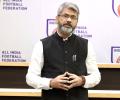
West Bengal Chief Minister Suvendu Adhikari has assured the All India Football Federation of full government support to host India's biggest-ever international football fixture against five-time World Cup champions Brazil in Kolkata on October 3. This historic match will be India's first against a top-five FIFA-ranked nation, offering crucial exposure to the national team despite initial concerns over crowd management.

Hours after US President Donald Trump on Wednesday said that the ceasefire deal with Iran was "over", the US President indicated that Washington could launch another round of strikes against the Islamic Republic, following strikes on Tuesday, saying it had already hit Tehran "very hard" and warning of further attacks.

FIFA President Gianni Infantino is holding a crisis meeting with top officials in Morocco to address the fallout from his failed attempt to sell commercial rights to the World Cup, a move that has led to widespread criticism and calls for his removal.

Indian shooters endured a second consecutive medal-less day at the ISSF World Cup in Hangzhou, a crucial tune-up event before the Asian Games. While Vidarsa Vinod reached the women's 50m rifle three positions final, finishing sixth, other Indian participants struggled in various events, including men's and women's skeet, and men's 25m rapid fire pistol. The performance raises concerns ahead of the upcoming major competition.

FIFA President Gianni Infantino is facing a deepening crisis after his proposal to sell a stake in the World Cup was abandoned, leading to public distancing from influential executives and calls for his removal from office.

The Gulf countries on Monday welcomed a peace deal reached between the US and Iran to end their conflict and called for protection of maritime routes and freedom of international navigation, including the uninterrupted flow of traffic through the Strait of Hormuz.

A source familiar with US Treasury Secretary Scott Bessent's thinking revealed on Saturday that the department "intends to utilise all available authorities to make Iranian assets accessible for rebuilding and repair efforts related to any future damage inflicted by Iran."
Indian squash players Ananya Narayanan, Pooja Arthi Raghu, and Anika Dubey secured victories in the women's first round of the HCL Squash PSA Challenger Tour in Chennai. The tournament also saw international players from Sri Lanka, Egypt, Spain, Malaysia, Kuwait, and Scotland competing in both men's and women's categories.
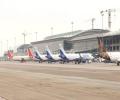
According to Hyderabad Airport GMR, British Airways flight 277 and Kuwait Airways flight 373 received the bomb threat. The BA 277 flight travelling from Heathrow to Hyderabad landed safely at 5:25 AM. Following the landing, standard safety protocols were initiated.

The harsh truth is that the US is no longer a reliable partner, cautions Ramesh Menon.

As Qatari negotiators travel to Iran in an effort to ease tensions and create conditions for the resumption of US-Iran talks following the recent military escalation between them, US President Donald Trump on Friday said that Washington has agreed to continue talks with the Islamic Republic following Tehran's request but reiterated that the US still considers the ceasefire between the two sides to be "over".
