
Chinese President Xi Jinping called for global collaboration in artificial intelligence development, emphasising a "symphony of global collaboration" over a "solo performance" by any single nation. Speaking at the World Artificial Intelligence Conference in Shanghai, Xi highlighted the need for ethical AI governance, shared prosperity, and addressing challenges like the widening digital divide. He also announced China's commitment to support developing countries with 5,000 AI research projects and training programmes. The event also saw 29 countries sign an agreement to establish the World Artificial Intelligence Cooperation Organisation (WAICO) in Shanghai.

Chinese President Xi Jinping has called for global collaboration in Artificial Intelligence development, stating it should be a "symphony" rather than a "solo performance." His remarks came at the World Artificial Intelligence Conference (WAIC) in Shanghai, where 29 countries also signed an agreement to establish the World Artificial Intelligence Cooperation Organisation (WAICO), an independent intergovernmental body headquartered in Shanghai. China also pledged 5,000 AI research projects and training for developing nations.

Chinese President Xi Jinping has arrived in Pyongyang for his first official visit in seven years, meeting with North Korean leader Kim Jong-un to reaffirm their long-standing friendship and pledge further development of bilateral relations amidst Pyongyang's deepening military ties with Moscow and China's assertions against Japan's 'new militarism'.

China on Tuesday listed out the four-point proposal given by President Xi Jinping for lasting peace in the Middle East.

Chinese President Xi Jinping warned US President Donald Trump that mishandling the Taiwan issue could trigger conflicts between the two countries during wide-ranging talks on trade, Iran, and energy security.

US President Donald Trump is set to visit China for talks with President Xi Jinping on trade, global issues, and the Gulf war. The visit aims to address trade frictions and other key issues, with high expectations for progress.

Chinese President Xi Jinping has called for the Strait of Hormuz to remain open for normal passage of ships, describing it as an 'international waterway' amid rising tensions between the US and Iran.

External Affairs Minister S Jaishankar met his Chinese counterpart Wang Yi in Manila, reiterating that peace and tranquillity in border areas are prerequisites for normal India-China relations. He stressed the importance of mutual respect, interest, and sensitivity, while also raising concerns about market access, trade imbalance, and supply chain uncertainties.

For India, the guiding principle should remain clear: Engage Bangladesh as a sovereign nation and society rather than through the prism of any individual leader or political party, suggests Manoj Mohanka.
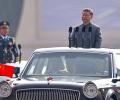
'For the first time in a hundred years, the army has been taken out of the political equation. And for the first time ever, there is only one man who calls the shots. Not even Mao had this kind of power.'

Poland's Secretary of State, Wladyslaw T Bartoszewski, has credited Prime Minister Narendra Modi with preventing Russian President Vladimir Putin from using tactical nuclear weapons in Ukraine in late 2022, highlighting Modi's significant influence on the Russian leader.

Former US President Donald Trump lauded Prime Minister Narendra Modi as a 'great leader' and 'tough guy' who has been in power for over 12 years, placing him alongside China's President Xi Jinping as leaders he admires for their power and ability to execute.

National Security Adviser Ajit Doval held "constructive" talks with Chinese Foreign Minister Wang Yi in New Delhi, focusing on the normalisation of bilateral ties. The discussions reviewed recent developments and progress towards rebuilding trust after the eastern Ladakh border standoff. Both sides have implemented measures, including disengagement pacts and high-level meetings, to improve relations.

Russian President Vladimir Putin will attend the BRICS summit in New Delhi on September 12-13, according to a presidential aide.

A Chinese official stated that India and China should view each other as cooperative partners and opportunities for development, not rivals or threats. This statement came in response to Russian President Vladimir Putin's comments on the independent and strong ties Russia maintains with both nations, emphasising non-interference in India-China relations.

Beijing clearly intends to extend the China-Myanmar Economic Corridor to Bangladesh as part of its larger Maritime Belt and Road Initiative to boost its Indian Ocean presence.

Russian President Vladimir Putin and Chinese President Xi Jinping have reaffirmed their commitment to dismantling global hegemonism and building a 'multipolar world' during high-level talks in Beijing.

Dhaka and Beijing on Thursday agreed to strengthen cooperation on the management of the Teesta and other rivers and signed 13 agreements to bolster bilateral ties following talks between Bangladeshi Prime Minister Tarique Rahman and Chinese Premier Li Qiang.

Glimpses from Donald Trump and Xi Jinping's ceremonial Beijing engagement capture diplomacy, symbolism and statecraft at historic Chinese landmarks.

US President Donald Trump concluded his Beijing summit with Chinese President Xi Jinping, describing it as 'incredible' and highlighting 'fantastic trade deals' and a 'very strong' relationship between the two leaders.

Chinese President Xi Jinping warned that the Taiwan issue could lead to clashes and even conflicts between China and the United States if not handled properly. He emphasised the importance of safeguarding peace and stability across the Taiwan Strait for stable relations.
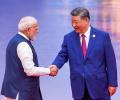
India's dual pursuit of a robust strategic partnership with Washington and a pragmatic, tension-management policy with Beijing represents the essence of modern multi-alignment. By embracing economic pragmatism, learning to compartmentalize political differences, and engaging in continuous dialogue, India can secure its borders, grow its economy, and contribute to a stable, multipolar Asian century, points out Ambassador Rajasekhar.

Donald Trump agreed with Xi Jinping's assessment of the US as a 'declining nation,' but attributed the decline to the policies of the Biden administration.

Russian President Vladimir Putin stated that Moscow would not interfere in the "delicate" bilateral relations between India and China, expressing confidence in their ability to resolve border disputes amicably. He also discussed Russia's independent partnerships with both nations, touched upon India-Pakistan ties, and highlighted ongoing and proposed defence cooperation with India, including the BrahMos missile and a potential Su-57 fighter jet project.

For the foreseeable future, the most likely outcome remains continuation of the status quo. Taiwan will remain self-governing without formally declaring independence, while China continues to apply sustained pressure short of war, predict Krishnan Srinivasan and Manoj Mohanka.

United States and China have agreed that "Iran can't have nuclear weapons," and that the Strait of Hormuz must be opened, according to US President Donald Trump.

The Beijing summit may have reduced immediate diplomatic uncertainty, but it did not resolve the deeper structural contest between the United States and China. That contest appears likely to define the coming decade, notes Varun Arya.

US President Donald Trump and Chinese President Xi Jinping began a crucial two-day summit in Beijing on Thursday, with both leaders signalling a desire to stabilise relations between the world's two biggest economies despite deep disagreements on trade, Taiwan, technology and security issues.
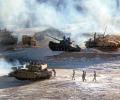
While tensions have eased at several friction points and mechanisms for managing the boundary have been reactivated, underlying differences persist. Disputes over naming practices in Arunachal Pradesh, continued infrastructure development on both sides, and unresolved questions regarding patrolling rights indicate that the structural gap remains, notes Dr Kumar.

Following his visit to China, US President Donald Trump has suggested a potential shift in Washington's approach to Taiwan, expressing reluctance to engage in military conflict over Taiwan's independence and cautioning against unilateral moves.

Donald Trump asked countries involved in the peace talks with Iran to sign on to the Abraham Accords, which deal with establishing diplomatic, economic and security ties between Israel and Arab nations.
Two former Chinese defence ministers, Wei Fenghe and Li Shangfu, were sentenced to death with a two-year reprieve over graft charges, official media reported.

US President Donald Trump and Chinese President Xi Jinping met in Beijing to discuss a range of issues, including trade frictions and the war in Iran.

Donald Trump says several issues were settled during the final day of talks with Xi Jinping covering trade, tariffs, and diplomacy.

Russian President Vladimir Putin is set to visit China for talks with Chinese leader Xi Jinping, shortly after US President Donald Trump's visit to Beijing. The visit underscores the close strategic ties between China and Russia amid global tensions.
The US-China rapprochement, however tenuous, is not without implications for India. Both China and Pakistan have become closer to the US, notes Ambassador T P Sreenivasan.

India would confront a more entrenched China, a less dependable United States, and a regional order increasingly shaped by great-power bargaining over which it exercises limited influence, notes Amberish K Diwanji.

An explainer on the 'Thucydides Trap' and its relevance to current tensions between the United States and China, as discussed by President Xi Jinping.

US President Donald Trump met with Chinese President Xi Jinping in Beijing to discuss trade, technology, Taiwan, and the Iran war. Xi Jinping said that 2026 will be a 'historic, landmark year' for China-US relations.

The joint statement was issued during Pakistan Prime Minister Shehbaz Sharif's recent visit to China.
