
Security forces have intensified search operations and strengthened the cordon in Jammu and Kashmir's Rajouri district to track down suspected terrorists believed to be hiding in the area.
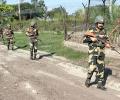
Border Security Force troops in Akhnoor, Jammu and Kashmir, have intensified their patrolling along the Chenab river, a crucial stretch of the India-Pakistan border in the Jammu sector.

The first direct Vande Bharat Express service between Jammu and Srinagar has commenced commercial operations, significantly reducing travel time between the two cities and enhancing rail connectivity in the region.

According to intelligence reports, the terrorists entered the Akhnoor region through the Battal area, and a wireless set seized from them confirmed their association with the JeM.

Glimpses of Indian Army personnel celebrating Diwali along the Line of Control in the Akhnoor sector, on the outskirts of Jammu.

A gun battle erupted between terrorists and security forces in the Kishtwar district of Jammu and Kashmir. The operation is ongoing, with reports of minor injuries to a security personnel. This is the latest in a series of encounters in the region as security forces hunt for terrorists.

Sunlit beaches, playful hammocks, and lavender grace -- Akhnoor Kaur turns every look into a statement, every vibe into magic.

The Indian Army responded in a measured and effective manner to the provocation.
This came after Pakistan initiated "unprovoked" firing on BSF posts in Jammu sector from 9 pm on Friday.

Flood crisis intensifies as rescue operations expand across Akhnoor, Jammu, Telangana and Himachal Pradesh.

The Indian Army demonstrates how it thwarted Pakistan's aerial attacks in the Akhnoor sector in Jammu.

Over 5,000 people have been evacuated from flooded areas in the Jammu region following heavy rains and flash floods. Rescue and relief operations are underway to restore essential services and provide assistance to those affected.
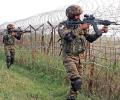
This marked the sixth consecutive night of ceasefire violations by Pakistan along the LoC, amidst heightened tensions between New Delhi and Islamabad following a recent terror attack in Pahalgam on April 22.

The firing exchanges are taking places in five districts out of seven border districts of Jammu and Kashmir. So far, there has been no firing reports along International Border in Samba and Kathua districts.

The Supreme Court has questioned the 'arbitrariness' in the consideration of 'criteria appointment' for Short Service Commission (SSC) women Army officers seeking permanent commission, compared to their male counterparts. The court is hearing a plea from women officers challenging the denial of permanent commission.

Following the Pahalgam terror attack, the Indian Army launched Operation Sindoor, targeting Pakistani terror infrastructure and posts in the Poonch sector of Jammu and Kashmir. Over 600 artillery shells were fired in three days, decimating 20 Pakistani posts used for infiltrating terrorists into India. The precision strikes crippled enemy logistics, material, and morale, prompting retaliatory attacks by Pakistan on civilian areas. Despite the retaliation, Indian Army officers described the operation as a success, highlighting the high morale of the troops and the effective coordination between artillery and air defense units. The article details the intensity of the artillery shelling and the impact on both sides, highlighting the strategic significance of the Poonch sector and the ongoing tension between India and Pakistan.

India and Pakistan agreed on May 10 for a cessation of firing and military activity as a result of 'direct contact' between the director generals of military operations (DGMOs) of both nations, which was 'initiated by the Pakistani side', the Centre informed Parliament on Friday.
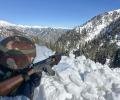
The exchange of fire occurred even though the directors general of military operations of India and Pakistan spoke over the hotline on Tuesday amid rising tensions between the two countries over the Pahalgam terror attack on April 22.

For the ninth consecutive night, Indian and Pakistani troops engaged in small arms fire along the Line of Control (LoC) in Jammu and Kashmir, continuing a pattern of heightened border tensions. The skirmishes, initiated by Pakistani troops in violation of the ceasefire agreement, have led to a tense situation along the LoC and International Border (IB). The incidents come in the wake of the April 22 terror attack in Pahalgam, which claimed the lives of 26 people, mostly tourists. Civilians residing near the border have begun preparing their bunkers, anticipating potential escalation. Despite a recent hotline conversation between the Directors General of Military Operations (DGMOs) of India and Pakistan, where India cautioned Pakistan, the ceasefire violations persist.
Pakistan troops have violated the ceasefire agreement for the 11th consecutive night, firing on Indian posts along the Line of Control (LoC) in Jammu and Kashmir. The firing began in Kupwara and Baramulla districts and spread to other sectors, including Poonch, Rajouri, Mendhar, Naushera, Sunderbani, and Akhnoor. The Indian Army responded promptly and proportionately. The ceasefire violation comes despite a recent phone call between the Directors General of Military Operations (DGMOs) of India and Pakistan on April 29. This marks the latest escalation of tensions between the two countries, following a terror attack in Pahalgam in April.

Giving details of how she silenced three hostile posts resorting to unprovoked firing on her position during Operation Sindoor, she said, "I had three posts falling in my area. I pinned down the people at all three hostile locations. We hit them with every weapon we had. They were forced to flee their posts."
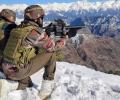
Pakistan's troops have engaged in unprovoked firing along the Line of Control (LoC) and International Border (IB) in five districts of Jammu and Kashmir, prompting retaliation from the Indian Army. This marks the eighth consecutive night of such incidents, following heightened tensions stemming from a recent terror attack in Pahalgam. Civilians residing along the LoC and IB are preparing their bunkers in anticipation of potential escalation.

'Due to orographic rainfall, localised areas are experiencing intense downpours.' 'In a very heavy downpour, the burst of water has to find its way and therefore whatever comes in its path gets washed away.'

The Indian Army effectively responded to firing by Pakistan military at some places along the Line of Control (LoC) in Jammu and Kashmir on Thursday night, military sources said. There were no reports of any casualties. The firing by Pakistan Army comes amid increasing tensions between the two sides over the Pahalgam terror attack that killed 26 civilians.
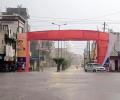
Heavy rainfall across North India leads to fatalities, structural damage, travel disruptions, and school closures. Eastern states brace for more rain.
Pakistani troops continued unprovoked small arms firing in different sectors along the Line of Control (LoC) in Jammu and Kashmir for the 10th consecutive night, prompting effective retaliation by the Indian army. The ceasefire violations, which started after the April 22 terror attack in Pahalgam, were reported from eight places across five districts in the Union Territory during the intervening night of Saturday and Sunday. Indian Army responded promptly and proportionately to the unprovoked firing, a defence spokesperson said.

After record rains wreaked havoc in Jammu and Kashmir over the past two days, the death toll in related incidents rose to 41, most of them victims of the landslide on a Vaishno Devi pilgrimage route, while there was some let-up in the showers on Wednesday, allowing relief efforts to pick up pace.

Two Indian Army personnel, including a captain, were killed and another was injured when suspected terrorists set off an improvised explosive device (IED) near the Line of Control (LoC) in the Akhnoor sector of Jammu on Tuesday. This was the third incident of cross-border action by terrorists in the Jammu region in four days, highlighting the ongoing security challenges in the area. The blast occurred while the troops were on patrolling duty near a forward post, underscoring the risks faced by security personnel in the region. Following the incident, the Army launched search operations in the area and expressed condolences for the loss of its personnel.
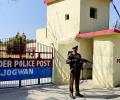
The armies of India and Pakistan on Thursday held a brigade commander-level flag meeting along the Line of Control (LoC) in Jammu and Kashmir's Poonch district to discuss issues related to border management.

The Border Security Force (BSF) remains on high alert along the International Border (IB) and has not let its guard down, BSF Inspector General, Jammu Frontier, Shashank Anand said on Tuesday. Operation Sindoor, aimed at preventing infiltration attempts, continues as Pakistan cannot be trusted, he added. Anand highlighted the BSF's robust response after the April 22 Pahalgam terror attack, including destroying multiple terror launch pads and thwarting infiltration attempts.

Defence Minister Rajnath Singh praised Jammu and Kashmir Chief Minister Omar Abdullah for his efforts to reduce the distance between the hearts of people in Jammu and Kashmir and Delhi. Singh asserted that the BJP government treats Delhi and Kashmir equally, emphasizing a commitment to bridge the gap between the regions. He criticized Pakistan occupied Kashmir (PoK) Prime Minister Chaudhry Anwarul Haq for his remarks against India and reiterated the importance of PoK as an integral part of Jammu and Kashmir.

Naik Mukesh Singh Manhas, a 29-year-old soldier from Jammu and Kashmir's Samba, was killed in an IED blast carried out by terrorists near the Line of Control (LoC) in Jammu's Akhnoor sector. Manhas, who was supposed to get married in April, had returned to his Army unit on January 28 after his engagement and giving final touches to his new house. He was killed along with Captain Karamjit Singh Bakshi from Jharkhand's Ranchi. Manhas's family and friends mourned his death, remembering him as an enthusiastic cricketer and a kind-hearted individual.

The Indus Waters Treaty, brokered by the World Bank, has governed the use of the Indus River and its tributaries between India and Pakistan since 1960.

Escalating its tensions with India, Pakistan on Thursday targeted Jammu with loitering munitions and the Indian air defence guns are firing back. A complete blackout has been enforced in Jammu city.

On Tuesday, October 29, morning, the security forces gunned down two more terrorists holed up in the forest near a village in Akhnoor, taking the number of terrorists killed in the 27-hour gunfight near the Line of Control to three.
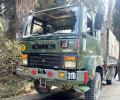
The troops returned fire and reinforcements were rushed to neutralise the terrorists, the officials said, adding that a search operation is underway in the area.

The anti-terror operation was part of Indian security forces' counter-offensive Operation Asan, launched after terrorists attacked an Army convoy in the Battal area on October 28.

The high point of the 19 Shastri months was the 22-day war that he fought against great odds and won in principle, even if military historians often call it a stalemate. Pakistan saw a great opportunity to conquer Kashmir and lost. It was the last time they had the relative strength militarily and diplomatically to take Kashmir. Shastri's resolve buried that dream forever, points out Shekhar Gupta.

The Pakistan Army continued shelling along the Line of Control (LoC) in four sectors of Jammu and Kashmir, prompting a befitting response by the Indian Army, officials said on Thursday. The intensity of cross-border firing was less than Wednesday, when Pakistan Army carried out one of the most intense artillery and mortar shelling in years targeting the forward villages in J-K following missile strikes by India as part of 'Operation Sindoor'.

India has to fill in all the critical gaps in missiles, ammunition, sensors and stockpile in the fastest possible manner, focusing on the critical instruments that worked this time, asserts Shekhar Gupta.
