
The Cockroach Janta Party (CJP) chief spokesperson Saurav Das has termed Education Minister Dharmendra Pradhan's resignation 'non-negotiable' amidst ongoing protests over the NEET-UG paper leak, while Union Health Minister JP Nadda has called for an in-depth discussion on the issue in Parliament.

US Vice President J D Vance confirmed that peace talks with Iran are underway in Switzerland, with negotiators Steve Witkoff and Jared Kushner already present. Vance plans to join soon, expressing confidence in the US's strong negotiating position despite a delay caused by recent Israel-Lebanon firing.

Donald Trump claims a peace deal with Iran is 'largely negotiated' after calls with Israel and other allies, but Iran rejects Trump's claim on Strait of Hormuz.

Indian stock markets are set to be influenced by developments in US-Iran negotiations, crude oil prices, and foreign investor activity in the upcoming holiday-shortened week, according to market analysts.

Iranian President Masoud Pezeshkian stated that Iran is considering various paths to address regional tensions, including negotiations conducted with dignity and authority, while emphasising that military gains should be reinforced through diplomacy.

The Brazilian Football Confederation (CBF) is in advanced negotiations to bring its national football team to Kolkata, India, for a friendly match in early October, marking a significant event for the region's large Brazilian fan base.

Congress leader Rahul Gandhi has voiced strong support for protesting students, asserting that their demand for the removal of Education Minister Dharmendra Pradhan is non-negotiable. He contrasted the students as India's future with Prime Minister Narendra Modi as the past, encouraging the students to continue their agitation at Jantar Mantar.

Educator-activist Sonam Wangchuk has ended his 26-day hunger strike, stating he received assurances from the government and MPs regarding examination reforms, compensation for NEET-UG paper leak victims, and protection for peaceful protesters.

A new assessment by the Institute for the Study of War (ISW) reveals that a power struggle within Iran's leadership, with hardliners gaining influence, could significantly impact future negotiations with the United States.

Amidst escalating protests over the NEET paper leak, the Cockroach Janta Party (CJP) has declared Education Minister Dharmendra Pradhan's resignation 'non-negotiable' and is also demanding 1 crore compensation for families affected by suicides linked to the exam cancellation.

Iranian Foreign Minister Abbas Araghchi has revealed the intense psychological pressure faced by Tehran's diplomatic delegation during peace negotiations with the United States, recalling a direct exchange with US President Donald Trump's Middle East envoy, Steve Witkoff, where he questioned the envoy about the constant military threats.

Cockroach Janta Party (CJP) representatives Abhijeet Dipke and Saurav Das have accused Bharatiya Janata Party (BJP) workers of disrupting ongoing student protests, pelting stones, and attempting to defame protesters. They also reiterated the 'non-negotiable' demand for Education Minister Dharmendra Pradhan's resignation amidst the NEET-UG paper leak controversy, while Union Health Minister JP Nadda urged against politicising the issue.

An Indian-origin diamond businessman, Dhiru Ramani, abducted in Mali in April, has been freed after his family reportedly paid a 4 million euro ransom. Ramani, originally from Gujarat, remains in Mali for questioning by local authorities.

The Indian government has significantly altered its approach to the Cockroach Janata Party (CJP)-led agitation over the NEET paper leak, moving from dismissal to calibrated political engagement, including promises of fast-track courts, a new anti-paper leak law, and negotiations with key protest leaders.

As Qatari negotiators travel to Iran in an effort to ease tensions and create conditions for the resumption of US-Iran talks following the recent military escalation between them, US President Donald Trump on Friday said that Washington has agreed to continue talks with the Islamic Republic following Tehran's request but reiterated that the US still considers the ceasefire between the two sides to be "over".

Iranian Parliament Speaker Mohammad Bagher Ghalibaf stressed on Friday (local time) that Tehran remains prepared for "full-scale defence" should the US betray the Memorandum of Understanding signed by the two countries last month.

Sonam Wangchuk has strongly denied allegations of a 'deal' with the Centre, clarifying that he concluded his 26-day hunger strike only after receiving a crucial written assurance.

Despite disagreements over nuclear ambitions, recent US-Iran peace talks led by Vice President JD Vance have fostered crucial goodwill and a deeper understanding between the two nations, potentially paving the way for future negotiations.

Representative of Iran's Supreme Leader in India, Abdul Majid Hakeem Ilahi, expressed doubts about the United States' intentions regarding negotiations, citing conflicting actions and a desire to force Iran into accepting US demands.

Avoid builders with very large commitments.

India anticipates a reduction in the United States' proposed tariffs on Indian goods under the Section 301 investigation, following New Delhi's recent notification to restrict the import of products made with forced labour.

Pakistan capital Islamabad is emerging as the leading venue for the next round of technical negotiations between the US and Iran, a media report said Sunday.

Bira 91 founder Ankur Jain and his family have stepped down from the board and executive positions of B9 Beverages, the parent company, after reaching a settlement with the craft beer maker's lenders and investors.

Union Education Minister Dharmendra Pradhan has resigned from his post amidst widespread nationwide protests concerning the NEET-UG 2026 paper leak controversy, citing the larger interest of students and the need to prevent exploitation by anti-national forces. The government is also preparing to introduce a stringent anti-paper leak law.

US President Donald Trump has reportedly urged Israeli Prime Minister Benjamin Netanyahu to withdraw Israeli military units from southern Syria and Lebanon, warning that Israel's continued presence could escalate regional tensions.

The statement comes even as Tehran links the issue to ongoing efforts to bring a complete end to hostilities in West Asia involving the United States and Israel.

Indian benchmark indices, Sensex and Nifty, saw a significant rebound in early trade, driven by a decline in crude oil prices. This drop followed US President Donald Trump's announcement of progress in negotiations with Iran towards an agreement to end the war, leading to a temporary pause in 'Project Freedom' to escort ships through the Strait of Hormuz. Track Nifty 50 and BSE Sensex performance and key global triggers.

Germany's Football Association (DFB) has held initial, constructive discussions with Juergen Klopp in New York regarding him taking over as the national team head coach. Both parties are confident of reaching a deal, pending agreement with Klopp's current employer, Red Bull. Klopp is the DFB's preferred choice to succeed Julian Nagelsmann after Germany's disappointing World Cup exit.

Ahead of the expiry on Tuesday of the two-week ceasefire declared by US President Donald Trump in the conflict with Iran, US media outlets reported on Sunday that negotiators Steve Witkoff, special envoy for peace missions and Jared Kushner will head to Islamabad for talks with Iran.

Iran on Tuesday said that the Islamic Republic has "no plans" to hold any meetings with the United States in the coming days at any level, even as diplomatic engagements continue separately in Doha on the related implementation of the 14-point memorandum of understanding (MoU) aimed at ending the hostilities in West Asia.
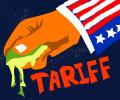
A bipartisan group of US senators has introduced a comprehensive bill imposing extensive sanctions on Russia, with India identified as one of five countries that could incur tariffs for its continued purchase of Russian oil.

Indian benchmark indices, Sensex and Nifty, experienced a decline in early trade due to uncertainty surrounding the upcoming US-Iran negotiations in Doha. Foreign fund outflows and a dip in major IT stocks further contributed to the market's cautious sentiment, despite mixed performance in global markets.

Pakistan's Prime Minister Shehbaz Sharif has welcomed the ceasefire between the US and Iran and invited delegations from both countries to Islamabad for peace negotiations.

Iranian military spokesperson said that stability in the region would be ensured only by the strength of Iran's armed forces and warned that energy and oil markets would not return to previous levels unless this reality was acknowledged.

Iranian news agencies have denied reports of Iranian officials travelling to Pakistan for negotiations with the United States, even as Pakistan prepares for potential talks and faces criticism from Israel.

Kushagra Ojha scored an unbeaten century, guiding India U-19 to a strong position of 253 for three against Sri Lanka on the opening day of the second Youth Test. After a shaky start where India lost two early wickets for no runs, Ojha, along with Yashbardhan Chauhan (78) and Manal Chauhan (55*), built crucial partnerships to stabilise the innings.

Hours after US President Donald Trump on Wednesday said that the ceasefire deal with Iran was "over", the US President indicated that Washington could launch another round of strikes against the Islamic Republic, following strikes on Tuesday, saying it had already hit Tehran "very hard" and warning of further attacks.

US President Donald Trump has claimed that Iran has accepted "just about everything" the United States has demanded in ongoing indirect nuclear negotiations, particularly regarding denuclearisation. He also asserted that American forces repeatedly carried out military strikes that crippled Tehran's military infrastructure, including radar installations, and escorted commercial oil tankers through the Strait of Hormuz. Trump dismissed reports of Iran's strength, stating its military and economy were severely weakened.

India has lodged a 'strong protest' with Iran over recent strikes on commercial vessels in the Strait of Hormuz, which resulted in the death of one Indian sailor and injuries to several others, calling for an immediate cessation of hostilities and a return to diplomatic engagement.

Iran's Islamic Revolutionary Guard Corps (IRGC) on Saturday (local time) announced the closure of the Strait of Hormuz "until further notice," stating that the strategic waterway would remain shut until the United States ends its "interference" in the West Asia region, Press TV reported.
