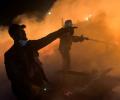
Israel's Defence Minister, Israel Katz, has affirmed that Gaza's annexation was part of a military strategy and troops will remain in the security zones created in Lebanon and Syria indefinitely, Al Jazeera reported.

President Trump has been briefed on potential military actions against Iran, including strikes on infrastructure and control of the Strait of Hormuz, even as negotiations continue. He maintains economic pressure is the primary strategy, while legal questions arise over war powers.

The plan includes three such formations: A China-focused Northern Theatre Command, a Pakistan-focused Western Theatre Command, and a Maritime Theatre Command.

China has confirmed providing on-site technical support to Pakistan during last year's conflict with India, according to official media reports.

Srivastava warned that continued bombing of Iran by the US and Israel could severely undermine any prospects of reopening critical maritime routes through negotiation with Tehran.

Both sides have now revealed a preference for escalation over strategic defeat, and each new provocation narrows the space for the next pause. The Touska seizure, Iran's refusal to negotiate under blockade, Israel's strikes on Iranian oil infrastructure -- all of these add up to an increasingly untenable situation. This makes the wild card -- Trump and his motormouth -- more consequential than ever, notes Prem Panicker in his must read blog on the Iran War.

Iran has issued a defiant response to United States President Donald Trump's claims regarding the conclusion of hostilities, asserting that it alone will 'determine' the end of military actions against American and Israel targets.

History is rarely decided by who has the biggest weapons, but by who has the better process. The same rule applies to investing, says Ramalingam Kalirajan.
On the first anniversary of Operation Sindoor, the Indian military issued a stern warning to Pakistan, stating that no terror sanctuary across the border is safe and that India will continue to dismantle terrorist infrastructure.

A Pakistan minister refuted social media reports about the conclusion of the operation against Afghan Taliban, stating that the operation is continuing with full intensity.
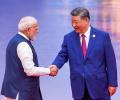
For India, China's Indian Ocean power projection, maritime domain awareness, dual-use ports, underwater surveillance, antisubmarinewarfare, naval exercises with Pakistan, pose considerable pressure, depleted India's strategic depth and marginalises Indian role, points out Srikanth Kondapalli.

Iran has submitted a fresh proposal to regional intermediaries offering to cease its military operations in the Strait of Hormuz, contingent upon a complete cessation of hostilities and the removal of the US blockade on Iranian maritime hubs.

'Strikes into the Gulf countries are proof that the security guarantees offered by the US are ineffective and that the Gulf countries cannot rely on American security assurances for their safety.'

'The entire US ecosystem built over decades at the bases in the Gulf region, especially the UAE, costing trillions of dollars have been decimated, dealing a mortal blow to the US Central Command's war capability,' points out Ambassador M K Bhadrakumar.

The United States Central Command confirmed that the USS Rafael Peralta intercepted an Iranian-flagged ship, enforcing a maritime blockade against Iran. The US military is prepared to resume major combat operations if ordered by the President.

Beijing has been wary of Sanae Takaichi's efforts to boost Japan's military profile since taking office six months ago, points out Dr Rajaram Panda.
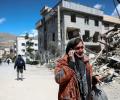
Fleur Hassan-Nahoum, special envoy, foreign ministry of Israel, has asserted that the situation has effectively been a "multi-front regional conflict" since its inception, while claiming significant military and strategic gains against adversarial forces.

Donald Trump has issued a stern warning to Iran, stating that the US will take a tougher stance if a diplomatic resolution regarding its nuclear programme is not reached soon.

Israel's Defence Minister Israel Katz has stated that Israel is prepared to escalate military action against Iran, pending approval from the United States. This comes as US President Donald Trump says he would not use nuclear weapons in any conflict with Iran, while also claiming the US has 'total control' over the Strait of Hormuz.

US President Donald Trump stated he would not set a deadline for ending the conflict with Iran, claiming Iran's military capabilities have been severely weakened. He also said he would not use nuclear weapons and maintained the US has complete control over blockade measures against Iran.

'Iran cannot trust the USA because it considers the USA to be Israel-controlled. And no, the IRGC is not going to accept anything else but major US concessions.'

'In a volatile global market, India is pursuing a low-risk, low-return policy, akin to a SIP -- slow, steady investment.' 'Pakistan is following a high-risk, high-return policy.'

Iran has lodged a formal complaint with the United Nations, accusing the US of engaging in 'piracy' following the seizure of Iranian vessels. The complaint was detailed in a letter sent by Iran's UN envoy to the UN Secretary-General and the Security Council.

Trump emphasised that diplomatic discussions remain ongoing. At the same time, he issued a stark warning, saying that failure to reach an agreement could trigger military action.

According to Iranian state media, Islamic Republic of Iran Broadcasting (IRIB), the threat was articulated by Ebrahim Zolfaghari, spokesperson for Iran's Khatam al-Anbiya Central Headquarters.

As Iran heads into crucial peace talks with the United States of America, here are the six men who decide the Islamic Republic's course.
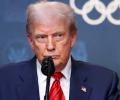
Each time a deadline almost runs out, President Trump hands out a new one.

This sharp Iranian response came after a series of uncompromising remarks from the US president.

The US Navy seized an Iranian-flagged cargo ship in the Gulf of Oman, escalating tensions as ceasefire talks face uncertainty. The incident raises concerns about the fragile ceasefire and the ongoing blockade of the Strait of Hormuz.

An Army brigadier and his son were allegedly assaulted in Delhi after the officer objected to public drinking. Police have registered an FIR and are investigating the incident.
While Trump has been examining the possibility of stationing ground forces in the Middle East, CBS News reported that he has yet to define the exact conditions under which he would approve their use.

'As result, Netanyahu 'convinced' Trump to go to war with the help of overoptimistic Israeli intelligence assessments, essentially explaining to him that they only need to bomb Iran for 3-4 days, and the regime would then collapse.' 'Rather unsurprisingly, Netanyahu is ever since blaming his own intel service for the entire operation failing.'

AI reduces the time taken to find a target and launch a strike. This has led to a major increase in the pace of the conflict, with one report mentioning nearly 900 strikes launched on Iranian targets in the first 12 hours of an operation.

The World Bank has affirmed India's strong position to withstand the current global energy shock, citing high foreign exchange reserves, fiscal space, and low inflation as key buffers supporting continued growth despite international headwinds.

The incident came shortly after a spokesperson from Iran's military warned that Tehran could target ports and docks in the United Arab Emirates following recent United States strikes on Kharg Island, a key hub for Iran's oil exports.
Although extensive air attacks have been carried out to destroy most of Iran's defence capabilities, the latter's resilience and sustenance during the war clearly indicate that the US landing force would encounter severe resistance in the operation, explains Commodore Venugopal Vengalil (retd).

A new analysis by the Institute for the Study of War has warned that Iran could escalate its attacks on Israel by launching large missile salvos aimed at maximising psychological pressure on civilians.

Karex, the Malaysian company that makes roughly one in five of the world's condoms -- about five billion a year, supplying Durex and Trojan among others -- announced this week that it is raising prices by up to 30 percent. The reason is the Strait of Hormuz.

It may now be time to question the price India is paying for Israel's disregard of the serious undermining of India's energy security, asserts former foreign secretary Shyam Saran.

Far from it; the country's resistance to the US, its nuclear ambitions, and its pursuit of influence and proxies across the Middle East are driven by a constant search for independence and security. Thus, Iran will never capitulate. Trump will learn this home truth ultimately, and it is going to be a humbling personal experience that may even destroy his presidency, predicts Ambassador M K Bhadrakumar.
 © 2026 Rediff.com - Advertise with us - Disclaimer - Privacy Policy - Sitemap - Feedback - About us - Terms of use - Grievances