
Pakistan has welcomed an Indian delegation's visit to Islamabad for a Shanghai Cooperation Organisation (SCO) meeting, marking the first such visit after a significant gap. The visit is seen as a positive step towards regional peace and cooperation, with Pakistan also commenting on other international and domestic issues.

Prime Minister Narendra Modi is embarking on a two-nation tour to Uzbekistan and the Kyrgyz Republic, where he will attend the SCO Summit. He aims to advance India's vision for the region, focusing on security, connectivity, and opportunity, and to strengthen strategic partnerships in Central Asia, fostering a region free from terrorism.

India has highlighted 13 key outcomes from the recent Shanghai Cooperation Organisation (SCO) summit, focusing on enhanced cooperation in security, counter-terrorism, and addressing transnational threats. These outcomes include the establishment of a Universal Centre for Countering Challenges and Threats to Security, a strong stance against state-sponsored terrorism, and agreements on narcotics control, climate change, and artificial intelligence, reinforcing India's engagement in the Eurasian region.

Prime Minister Narendra Modi, addressing the SCO summit in Bishkek, called for a united front against terrorism and its financing, rejecting double standards. He emphasised resolving conflicts through dialogue and diplomacy, not battlefields. Modi also highlighted that connectivity projects must respect national sovereignty and territorial integrity, a veiled reference to China's Belt and Road Initiative. India's vision for SCO rests on security, connectivity, and opportunity.

Given the current friction in ties, such a visit looks unlikely at this juncture.

Russian Foreign Minister Sergey Lavrov has publicly supported India's bid for a permanent seat on the United Nations Security Council. He stated that any reform of the UNSC should not grant additional seats to Western countries like Germany and Japan, citing their "militarism and revanchism." Instead, Russia advocates for increased representation from Asia, Africa, and Latin America, specifically backing India and Brazil, while also emphasizing the need to address African interests.

Prime Minister Narendra Modi met Iranian President Masoud Pezeshkian at the SCO summit, advocating for dialogue and diplomacy to resolve the West Asia conflict and expressing India's desire to expand and diversify trade with Iran. Pezeshkian, in turn, urged India to leverage its contacts to promote peace.

Wushu player Divyanshi Choudhary has alleged physical and mental harassment by the national federation after being dropped from the Asian Games squad on medical grounds. Choudhary claims she was replaced despite doctor's clearance, while the Wushu Association of India maintains she had an ACL tear. The athlete, who defeated her replacement in trials, expressed distress and even threatened self-harm in a video.

Wushu player Divyanshi Choudhary, dropped from the Asian Games squad due to an alleged ACL tear, has accused the national federation of physical and mental harassment, claiming she was cleared by doctors to compete and was replaced unfairly.

Wushu player Divyanshi Choudhary, dropped from the Asian Games squad due to an alleged ACL tear, has accused the national federation of physical and mental harassment, claiming she was medically cleared to compete. The Wushu Association of India maintains she was replaced due to a high-grade ACL tear confirmed by MRI, while Divyanshi alleges foul play to favour another athlete.

External Affairs Minister S Jaishankar, addressing the UN General Assembly, condemned the targeting of commercial shipping and seafarers in the Gulf, calling it "simply unacceptable." He also voiced deep concern over the "weaponisation of everything," which he stated has severe consequences for Global South nations, impacting peace, progress, and development globally. India urged restraint, de-escalation, and protection of civilians, while also highlighting the 4F crisis (food, fuel, fertiliser, finance) faced by developing countries.

Former CDS Anil Chauhan stated that China poses a long-term and comprehensive challenge to India, with the boundary issue remaining unresolved due to differing perceptions of the Line of Actual Control. However, he emphasised that India's ties with Beijing cannot be solely defined by border disputes, advocating for engagement through platforms like SCO and BRICS. He also highlighted the broader global geopolitical flux and instability in India's neighbourhood as significant security concerns, stressing the need for self-reliance.

Prime Minister Narendra Modi urged Russian President Vladimir Putin to move from 'endless war to the end of war' in Ukraine, emphasising that a peaceful resolution is humanity's shared priority.

Prime Minister Narendra Modi, in bilateral talks with Chinese President Xi Jinping, emphasized that both nations must show sensitivity to each other's core issues and be guided by mutual respect, sensitivity, and interest. Modi highlighted the critical importance of peace and tranquillity along the Line of Actual Control for the development of India-China relations, while also addressing concerns regarding Taiwan and Tibet.

US Secretary of State Marco Rubio stated he does not believe India and Iran are pursuing a trade deal, despite a recent meeting between their leaders. He acknowledged that many countries engage with the Iranian regime but reiterated President Trump's warning against helping Iran evade sanctions, threatening penalties for nations that do so.
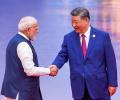
Ahead of Xi Jinping's visit, National Security Advisor Ajit Doval and Chinese Foreign Minister Wang Yi held extensive talks in Beijing on August 25 on the boundary issue and reached an eight-point consensus.

Russian President Vladimir Putin has arrived in India for a three-day visit to attend the BRICS summit and hold bilateral talks with Prime Minister Narendra Modi, focusing on expanding trade, investment, and energy cooperation amidst global geopolitical challenges.

Chinese President Xi Jinping's first visit to India in seven years for the BRICS Summit and bilateral talks with Prime Minister Narendra Modi is set to address crucial aspects of India-China relations, including trade, investment, and persistent border tensions.

Xi brought in asymmetrical power play by stating that India should have 'strategic cognition' and 'strategic judgement made on the basis of the stage of development the two countries are at'. This is a very nuanced way of asserting China's coercive diplomatic posture and reflects Beijing's penchant to unleash border instability at will, restrict rare earth metal exports, exert pressure on India at global and regional orders, asserts China expert Srikanth Kondapalli.

Chinese Foreign Minister Wang Yi stated that President Xi Jinping and Prime Minister Narendra Modi reached a crucial consensus during the BRICS summit, agreeing that China and India should be partners, not rivals. The leaders pledged to maintain peace and tranquility in border areas, deepen cooperation, and support each other in multilateral forums, aiming to strengthen the Global South and promote a multipolar world order.

Prime Minister Narendra Modi and Russian President Vladimir Putin held extensive discussions to strengthen bilateral trade, defence, and energy cooperation, while also addressing the ongoing Ukraine conflict and exploring avenues for peace and resolution, with Modi reiterating India's call for dialogue and diplomacy.

Prime Minister Narendra Modi conveyed to Chinese President Xi Jinping that peace and tranquillity along the frontier remains an "essential" basis for the development of India-China relations, even as the two leaders welcomed "steady progress" in bilateral ties during their talks on the sidelines of the BRICS summit.

During the 18th BRICS Summit in New Delhi, Chinese President Xi Jinping and Prime Minister Narendra Modi held a bilateral meeting, outlining a four-point approach for the steady and long-term development of China-India relations. The leaders stressed strategic understanding, win-win cooperation, mutual respect, and inclusive multilateral engagement, reaffirming their commitment to resolving the boundary question and addressing economic concerns. They also discussed global challenges and strengthening people-to-people ties.

Ahead of President Vladimir Putin's visit to India for the BRICS summit, Russia has expressed support for New Delhi's peace initiatives to resolve the Ukraine conflict. Discussions between Putin and PM Modi will cover defence, energy, technology, and the repatriation of Indian nationals from the Russian military, alongside addressing trade and investment ties.
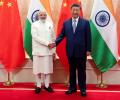
India has asserted that the state of its border with China directly impacts the broader bilateral relationship, emphasising the critical importance of maintaining peace and tranquillity along the Line of Actual Control (LAC). The Ministry of External Affairs also firmly rejected China's claims over Arunachal Pradesh, reiterating its status as an integral part of India. This stance was reiterated during a recent Working Mechanism for Consultation and Coordination meeting, where both sides agreed to continue using diplomatic and military channels to resolve outstanding issues.

India and China are in what experts call 'a cooperation-versus-competition situation'.

A question has been raised whether the Mecca Pact will have a negative impact on our doctrine that the Operation Sindoor has only been suspended and that it would be resumed if Pakistan engages in terrorism in the future. But the Mecca Pact only speaks of aggression, not defence against terrorism, points out Ambassador T P Sreenivasan.

Russia on Monday assured India of uninterrupted supply of energy and fertilisers amid disruption caused by the West Asia crisis, as External Affairs Minister S Jaishankar met President Vladimir Putin in Moscow and held talks with his key interlocutors.
India and China held diplomatic talks to review the situation along the Line of Actual Control (LAC), discussing boundary delimitation, border management, and trans-border cooperation. Both nations stressed the importance of maintaining peace and tranquillity for bilateral relations and agreed to continue using existing channels to resolve outstanding issues.

India on Tuesday conveyed to China the importance of maintaining peace and tranquility along the Line of Actual Control (LAC) for overall bilateral ties as national security advisor Ajit Doval held talks with Chinese Foreign Minister Wang Yi focusing on delimitation of the frontier and sustaining work on trans-boundary cooperation.

External Affairs Minister S Jaishankar met his Chinese counterpart Wang Yi in Manila, reiterating that peace and tranquillity in border areas are prerequisites for normal India-China relations. He stressed the importance of mutual respect, interest, and sensitivity, while also raising concerns about market access, trade imbalance, and supply chain uncertainties.
Indian squash players Ananya Narayanan, Pooja Arthi Raghu, and Anika Dubey secured victories in the women's first round of the HCL Squash PSA Challenger Tour in Chennai. The tournament also saw international players from Sri Lanka, Egypt, Spain, Malaysia, Kuwait, and Scotland competing in both men's and women's categories.

Indian top seed Anahat Singh and three male players, Aryaveer Dewan, Yusha Nafees, and Gurveer Singh, have advanced in their respective categories at the World Squash Junior Individual Championships in Ontario, Canada, showcasing a strong start for the Indian contingent.
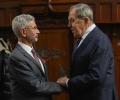
India's External Affairs Minister S Jaishankar addressed the Shanghai Cooperation Organisation (SCO) Council of Heads of Government meeting, advocating for a 'zero tolerance' approach to terrorism and emphasizing the need for the SCO to adapt to the changing global landscape.

National Security Adviser Ajit Doval held "constructive" talks with Chinese Foreign Minister Wang Yi in New Delhi, focusing on the normalisation of bilateral ties. The discussions reviewed recent developments and progress towards rebuilding trust after the eastern Ladakh border standoff. Both sides have implemented measures, including disengagement pacts and high-level meetings, to improve relations.

Defence Minister Rajnath Singh met his Chinese counterpart Admiral Dong Jun in Bishkek to discuss maintaining peace and tranquility along the Line of Actual Control (LAC) and broader regional security concerns.
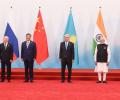
The Shanghai Cooperation Organisation (SCO) strongly condemned the Pahalgam terror attack and concurred with India's position that 'double standards' in the fight against terrorism are unacceptable.

China on Friday said the Shanghai Cooperation Organisation (SCO) summit to be held in Tianjin later this month will be the largest in the bloc's history, with 20 world leaders, including Prime Minister Narendra Modi, attending it.

India is navigating a complex diplomatic landscape, attempting to balance its 'forever honeymoon' with the Israel-UAE-Bahrain axis against its historical ties with Iran, as evidenced by recent high-level visits and evolving geopolitical realignments in the Middle East, observes Ambassador M K Bhadrakumar.

Describing the visit as "productive" in a post on X, the PM said he emphasised India's position on key global issues during his engagements.
