
The clock on the ceasefire is running out. But everyone's already whispering about round two, possibly as soon as this weekend.

A United States missile strike has reportedly hit an educational facility in Khomeyn in central Iran, according to a report by Al Jazeera citing Iran's Mehr news agency. The site was identified as the Dr Hafez Khomeyni School.

Falling debris from an intercepted Iranian drone caused a 'limited fire' at Saudi Aramco's Ras Tanura refining facility in Saudi Arabia, Saudi Defence Ministry spokesperson Turki Al-Maliki said, according to Al Arabiya.

Pakistan's Prime Minister Shehbaz Sharif has offered to host talks between the US and Iran to help resolve the ongoing conflict in the Middle East, following reports of Pakistan's involvement in backchannel diplomacy.

The United States has ordered the withdrawal of non-emergency staff from its consulates in Karachi and Lahore, Pakistan, citing security concerns amid regional tensions and protests.

Eid al-Fitr was celebrated across India with prayers for peace and brotherhood, alongside protests condemning US-Israel actions in West Asia.

Both sides have now revealed a preference for escalation over strategic defeat, and each new provocation narrows the space for the next pause. The Touska seizure, Iran's refusal to negotiate under blockade, Israel's strikes on Iranian oil infrastructure -- all of these add up to an increasingly untenable situation. This makes the wild card -- Trump and his motormouth -- more consequential than ever, notes Prem Panicker in his must read blog on the Iran War.

The ministry of interior of Bahrain on Sunday claimed that Iran attacked civilian targets in a water desalination plant after a drone attack.

The US President clarified that these negotiations do not involve the new Supreme Leader, Mojtaba Khamenei.

Prime Minister Narendra Modi spoke with Iranian President Masoud Pezeshkian to discuss the escalating tensions in West Asia, emphasising the safety of Indian nationals and the need for regional stability through dialogue and diplomacy.
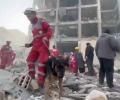
Despite the escalation in US military action, the War Secretary noted that Iran's missile response has declined in the last 24 hours.

Prime Minister Narendra Modi spoke with leaders from Oman, Kuwait, and Qatar, expressing concern over attacks in West Asia and discussing the safety of the Indian community.

'The entire US ecosystem built over decades at the bases in the Gulf region, especially the UAE, costing trillions of dollars have been decimated, dealing a mortal blow to the US Central Command's war capability,' points out Ambassador M K Bhadrakumar.

Trump claims the United States is performing exceptionally well in its ongoing conflict with Iran, citing weakened Iranian military capabilities and a strong US position.

Brent crude prices surged sharply on Monday, rising by more than 25 per cent to $116.5 per barrel, amid the ongoing conflict in West Asia, which has made crude prices bullish.

Amid escalating tensions in West Asia, the Indian government has established a control room to provide crucial support and assistance to the nearly one crore Indian citizens residing in the region.

AICC President Mallikarjun Kharge criticised Prime Minister Narendra Modi's relationship with US President Donald Trump, alleging that Modi is acting as Trump's 'slave' and jeopardising India's interests on trade, oil and foreign policy.

Trump may strike. He may announce productive talks and extend again. He may do both at the same time. Iran will not open the Strait on someone else's terms, so no matter what happens, that problem will remain unsolved. And the IRGC will still be collecting its $2 million toll from every ship bold enough to ask permission to pass.

The Ministry of External Affairs informed a parliamentary committee that nearly 1,000 Indians remain in Iran amidst the West Asia conflict, and 23,000 students in the Gulf region missed CBSE exams due to the turmoil.

Pakistan's Prime Minister Shehbaz Sharif has offered to mediate between the US and Iran to de-escalate the ongoing conflict in West Asia, following a joint US-Israel attack on Iran. Sharif has been in contact with Saudi Arabia, the UAE, and other nations to promote dialogue and diplomacy.

Iran launched retaliatory military strikes targeting Israel and American military bases across the region, including in Qatar, the United Arab Emirates, Kuwait, Bahrain and Jordan.

'The next two to three weeks will not be decided in Washington.' 'They will be decided in Tehran, in whatever calculation Iran makes about the costs of continued resistance against the costs of appearing to have yielded.'

Prime Minister Narendra Modi spoke with the King of Bahrain and the Crown Prince of Saudi Arabia, condemning recent attacks on both countries and emphasising the importance of regional peace and stability.

Australian police helped two more members of the Iranian women's football delegation slip their minders to claim asylum, but one has changed her mind and decided to go back to Iran.

Fathali further stated that Tehran has instructed its embassy in India to facilitate the Indian government, ensuring smooth operations amid the ongoing regional conflict.

"The US President's statements are within the framework of efforts to reduce energy prices and gain time to implement his military plans," the ministry stated.
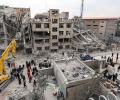
The call came before Iran's new supreme leader Mojtaba Khamenei vowed vengeance and urged citizens to continue their fight against the attacks by US and Israel.

The US Embassy acknowledged the attack in a post on X, urging Americans to avoid the facility 'until further notice' and announcing that all appointments had been cancelled.

A French soldier was killed while several others were injured in an attack in the Erbil region of Iraq, French President Emmanuel Macron confirmed. Macron, in a post on X, confirmed that Chief Warrant Officer Arnaud Frion of the 7th Battalion of Chasseurs Alpins lost his life in the attack.

India has advised its citizens residing in Iran to leave the country due to the evolving security situation, including protests and fears of potential US military action.

Russia has shared intelligence with Iran that could help Tehran target American warships, aircraft and other military assets in the region, according to United States intelligence assessments cited by media reports, marking the first indication of Moscow's possible involvement in the ongoing conflict. Officials familiar with US intelligence findings said a significant portion of the shared information reportedly includes imagery from Russia's network of surveillance satellites.

Iran has rejected United States allegations that it is preparing attacks on American facilities, alleging that Washington, DC is attempting to escalate tensions in West Asia, Iranian state broadcaster Press TV reported.

'To suddenly give the impression of taking a position that is hostile to Iran, or, at least, not friendly to Iran, is not a good thing.'

Foreign investors pulled out Rs 21,000 crore (around $2.3 billion) from Indian equities over the last four trading sessions amid deteriorating global risk sentiment triggered by the West Asia crisis.

He added that opposition parties were assured that their concerns regarding the impact of the West Asia situation on India and the safety of Indian citizens were addressed in detail.
Iranian President Masoud Pezeshkian maintained a stance of defensive necessity, noting that Tehran is "forced to retaliate to attacks" but clarified that this does not imply a dispute with neighbouring countries

The USS Abraham Lincoln has been operating in the Arabian Sea since the end of January.

Iran has blamed the US for disruptions in oil and gas shipping through the Strait of Hormuz, citing 'destabilising actions' as the cause amid the ongoing West Asia conflict and rising energy prices.

Shiromani Akali Dal president Sukhbir Singh Badal and Punjab Vidhan Sabha Speaker Kultar Singh Sandhwan have appealed to Prime Minister Narendra Modi to take urgent steps for the evacuation of Indian citizens stuck in countries affected by the recent joint Israel-US attack on Iran.

Peaceful demonstrations were held in several Shia-dominated areas of Kashmir in support of Iran, following congregational prayers on Friday. Protesters voiced their support for Iran and condemned the US and Israel.
