
A senior Geological Survey of India official warns that the Himalayas are vulnerable to cascading disasters, where one high-altitude event can trigger a chain of destructive events downstream, as evidenced by Nepal's recent floods. He stresses the need for integrated monitoring using satellite data and ground investigations to identify high-risk areas and improve preparedness in the Indian Himalayas.


Nirmal Purja, the Nepali-British climber famous for scaling all 14 of the world's 8,000-metre peaks in record time, has been confirmed dead after an avalanche on Broad Peak, located in Pakistan-occupied Kashmir's Gilgit-Baltistan.

Veteran Congress leader Karan Singh has called for the establishment of a Himalayan authority involving all Himalayan nations, including India, Pakistan, and Nepal, to protect the fragile mountain range from destruction. He also criticised the four-laning of highways in Uttarakhand's Char Dham region, deeming it "reprehensible" due to its environmental impact. His appeal comes as Nepal grapples with devastating flash floods, highlighting the region's vulnerability.

A scientist from the Wadia Institute of Himalayan Geology highlights how climate change, including glacial retreat, shifting precipitation patterns, and rising nighttime temperatures, is exacerbating the risk of flash floods and landslides in the Himalayas, as seen in recent disasters in Nepal and Uttarakhand.

'There needs to be a monitoring of glaciers in high altitude areas and one needs to check regularly how geological changes are taking place.' 'We can mitigate that by regular monitoring but unfortunately, hardly any monitoring is happening.' 'And without monitoring those higher altitudes of Himalayas, people are suffering.'

The devastating floods in Nepal have brought back memories of two major disasters in Uttarakhand in recent years, the Rishiganga tragedy of February 2021 and the Dharali disaster of August 2025, which caused extensive loss of life and property and left thousands struggling to rebuild their lives.
'The valley is around 16 km from the Nepal border, and it took just 8-10 minutes for the ice and rocks to reach the Nepal border. You can imagine how fast it must have travelled!'

'The trigger for the flood was definitely natural, but the damage that it caused was human-made.'
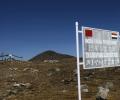
Two women from Arunachal Pradesh, January Tali and Hachu Lombo, have successfully scaled the 7,077-metre high Mt Kun in Ladakh, a challenging peak in the Zanskar range. Their achievement has been lauded by the Arunachal Pradesh Governor and is expected to inspire youth in the state.

'It appears to be a combination: A glacier breaking away, and a dam-like formation downstream reaching capacity and releasing water suddenly.'

Nepal has launched a diplomatic initiative to secure climate-related compensation from major greenhouse gas emitters, asserting that post-disaster assistance for recent deadly flash floods should be viewed as a moral and legal liability, not charity. Foreign Minister Shisir Khanal highlighted Nepal's disproportionate suffering from global warming despite negligible emissions, citing rapid glacier melt and extreme mountain disasters. The country has formally approached the Loss and Damage Fund board for urgent financial aid following a catastrophic flash flood in the Bhotekoshi river basin.

The death toll from the devastating flash floods in Nepal has climbed to 1,355, according to the latest figures released by Nepal's National Disaster Risk Reduction and Management Authority.

'This is no longer a single-hazard problem; it is a cascading, multi-hazard problem. A landslide never occurs in isolation. This entire chain is the cascading effect of what looks, at first, like a single disaster.'

Experts from the International Centre for Integrated Mountain Development (ICIMOD) suggest that an ice-rock avalanche originating in a high-altitude area likely triggered the devastating flash floods that swept across central Nepal districts, killing at least 95 people and leaving nearly 500 missing.

Soaring above the mighty Chenab River, this record-breaking railway bridge is a sight to behold.

Zesty, spicy, tasty recipe to try this monsoon.

Anxiety grips Mumbai families as a 61-member Kailash Mansarovar pilgrimage group, including prominent doctor-mountaineer Milind Chitley, remains untraceable following devastating flash floods along the Nepal-Tibet border.

'When a glacier collapse or a major flood event does occur, the water will simply reclaim its original path, and anything built in that path will be swept away.'

Nepal's devastating flash floods have claimed 1,127 lives, with thousands still missing a week after the disaster. Rescuers are intensifying efforts to find survivors and recover bodies across affected regions, while police work to identify victims and relocate families from high-risk areas.

Scientists are examining how a possible glacial collapse and ice-rock avalanche may have triggered the devastating flash floods along Nepal's Bhote Koshi River, with preliminary assessments indicating that debris may have temporarily blocked the Lhende River and created a landslide dam that subsequently gave way.

Following devastating flash floods in Nepal, experts are calling for systematic scientific assessments of glaciers to understand and mitigate hazards, alongside the development of a robust land use policy for the Himalayan region. The floods, which killed over 460 people and left thousands missing, are believed to be linked to climate change impacts on glaciers and permafrost.
I learn that success isn't measured in metres gained but in how we handle the moment when plans dissolve. The mountain doesn't grade on completion -- only on presence and effort, discovers Manoj Mohanka.

'All this diversity that our country provides brings in a lot of learnings.' 'That is what I really end up sharing with the whole community.' 'But it all comes through making my shoes dirty.'

''With Aamir, I have maintained a friendship, and I'm so grateful for that. He's been so kind and generous throughout these years, whether it's in Los Angeles, London or here.'

The 13.153-km Zojila Tunnel, the world's longest single-tube bi-directional road tunnel at the highest altitude, and its final breakthrough will be a historic milestone in India's infrastructure history.

Gwadar is viewed as a critical pearl in China's maritime strategy as it would give a permanent logistical footprint near an important choke point - the Strait of Hormuz and the oil rich Persian Gulf, explains Commodore Venugopal Menon (retd).
Discover the only way to travel, where fun meets fitness!

Sacred spots and soaring peaks: Bucket-listing across the heartland. Roopa Unnikrishnan and her father journey through the heart of India.

The first thing you notice about Bhutan is not the mountains, but the silence.

The amazing story of how a little known cheese from Ladakh stunned the world!

Kangana Ranaut opens a cafe in Mandi, her Lok Sabha constituency.

Chinese geologists say the range might even start becoming shorter.

'It's a lifetime opportunity to cook for the most high-profile table of India. It's a matter of honour for me.'

'You don't know what you are going to encounter every 10-20 metres.' 'These mountains are unpredictable.'

President Droupadi Murmu will fly in the indigenously developed Light Combat Helicopter (LCH) 'Prachand' at the Jaisalmer Air Force Station. She will also attend the IAF's mega firepower demonstration 'Vayu Shakti' at the Pokhran Field Firing Range.
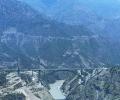
Prime Minister Narendra Modi on Friday flagged off two specially designed Vande Bharat trains between Katra town and Srinagar city, reducing travel time between the two places by two to three hours and ensuring all-weather surface connectivity with the Kashmir valley.
An Indian mountaineer and a CIA expert have come out with an authoritative account of how nuclear devices were planted atop high Himalayan peaks to monitor Chinese nuclear tests in the 1960s.

Activists from Himalayan states condemn the arrest of Sonam Wangchuk, demanding his release and supporting the call for statehood and inclusion in the Sixth Schedule of the Constitution. They also warn of a larger crisis unfolding across the Himalayan region due to climate change and poor governance.
'What we are witnessing is not a freak incidence or a freak occurrence, but a new climate reality where warming oceans, monsoon variability and local geography are combining to produce extreme events.'
