

The first thing you notice about Bhutan is not the mountains, but the silence.

As it was rightly said: 'Nature has music for those who listen'.
Bhutan is a country where you feel like you are surrounded by melodies. We found endless peace in the Land of Thunder Dragons.
From the lush greenery to the panoramic views of the glacial peaks, this country won the hearts of us city dwellers.
The first thing you notice about Bhutan is not the mountains, but the silence.
Key Points
- Bhutan offers a unique transition from chaotic Indian border towns to serene, orderly landscapes marked by silence and natural beauty.
- Key attractions: Thimphu, Buddha Dordenma, Dochula Pass, and Punakha Dzong, each offering cultural and scenic significance.
- Adventure experiences -- river rafting in Mo Chhu and trekking in Phobjikha Valley -- are a chance to engage with Bhutan's natural environment.
- Paro highlights: Vibrant Tshechu festival, Rinpung Dzong architecture and local markets showcasing Bhutanese traditions and craftsmanship.
- The Tiger's Nest monastery hike stands out as the most challenging yet rewarding experience, combining spirituality, endurance and breathtaking Himalayan views.
Venturing Into Bhutan...

The road going to Bhutan starts off quietly, as if it is a secret. The drive from Bagdogra to Siliguri slowly changes from busy streets to quieter outskirts as the landscape opens up.
The city of Siliguri slowly lets go of its hold on us as we drive out. The busy streets give way to quieter suburbs and the pace of life begins to change without us noticing almost.

But the real change happens in Jaigaon.
There is noise, colour and a kind of familiar chaos on one side of the border.
But everything is completely different just across the arched gate.
The streets are quieter, the air feels different, and things seem be in order almost right away.
Immigration procedures are more than just crossing a border; they felt like we are entering a whole new world.

The first stop is Gedu Stupa, standing quietly against a backdrop of rolling hills. It is a moment of peace before the long drive ahead.
The Kharbandi Gompa, not far from there, looks out over the plains below. It is a chance to stop and take in the vastness of the landscape, like nature is unfolding in layers.

The Wankha Waterfall seems to come out of nowhere along the side of the road. The rushing water through the rocks gives the otherwise still mountains a sense of movement.
The Chuzom Confluence is a striking place where two rivers met. Each river has its own hue. As they merge, each keeps is its own colour for a short distance.
This is one of those rare sights that makes you stop, even if you're on a long trip.
Thimphu Mesmerises

During the journey we halt at one of the local eateries.
We eat Ema Datshi, a cheese chilly stew. And Paneer Datshi which is a paneer version.
Famished, this wholesome meal fills our stomachs.

Among the dense forests lies this modern yet down-to-earth city, Thimphu, the capital of Bhutan. It is home to Bhutan's royal family who reside in Lingkana Palace.
The Buddha Dordenma is a colossal 54-metre-high, gilded bronze Buddha statue seated atop a hill in Kuenselphodrang valley overlooking Thimphu, offering wonderful vistas of the entire city.
The base of the statue is a three-storey temple with a meditation hall of intricate paintings which tell stories of the life of Buddha.
It is said that the statue was built based on prophecies stating that a giant Buddha statue would be built to bestow blessings, peace, and prosperity upon the entire world.


The Motithang Takin Reserve is a high-altitude forest ecosystem dominated by tall pines and rhododendron shrubs.

As we ascend into the mountains we come across a cosy cafe where we share a comforting latte along with a surreal view.
The Motithang Takin Reserve is very unique and beautifully designed. The enclosures were connected by wooden paths, even bridges, across minor streams instead of concrete footpaths.
There are huge enclosures for the Bhutan national animal -- the takin or drong gimtse, a kind of muskox.

Adjacent is a deer enclosure.
The preserve thrives without any intervention by humans.
They are not caged -- it is a huge open space with only a few precautionary boundaries at the sides.
Dochula Pass Scenic Views

Dochu La is a mountain pass in the snow-covered Himalayas on the road from Thimphu to Punakha.
Memorial chortens or stupas, 108 of them together, known as the Druk Wangyal Chortens, were built at the pass by Queen Mother Ashi Dorji Wangmo Wangchuk, in memory of the Bhutanese soldiers who died in a 2003 battle with Assamese insurgents.
The stupas are built in neat, circular rows, the white structures with their red bands and golden spires creating a striking contrast against the deep green hills and cloudy sky.
They stand amidst the fog that shrouds the hills. It feels like the sky has fallen to the ground. Or a cotton blanket is hugging the meadows.
The cool and damp air penetrates through our thick puffer jackets.
The number 108 is considered auspicious in Buddhism and holds significance, representing the total number of earthly desires, passions or delusions (kleshas) a human must overcome to achieve enlightenment.
From the bottom of the hill there is a viewpoint to look out at the Himalayan ranges. But the fog had veiled the hills, making it impossible to see the mighty Himalayas.
Punakha River Rafting

After descending the hills, we drive along a road winding alongside the 'female' river, known as Mo Chhu and the 'male' river, Pho Chhu.
These rivers converge at Punakha Dzong, the administrative centre of Bhutan's Punakha district and the second-oldest as well as second-largest dzong (fortress-type building) of Bhutan.
The river rafting on the Pho Chhu river is considered swifter because of comparatively many more and frequent rapids. On the other hand on the Mo Chhu, which has less rapids, rafting is calmer.
We experience voyaging on the female river, ie, Mo Chhu. The rafting is less adventurous but more scenic, with picturesque Punakha Dzong and the Khamsum Yulley Namgyal Chorten alongside. The gentle breeze brushes against our skin. The cold river water splashes us as we move through the rapids which we encounter every few minutes.
On our way we even see a herd of meek sheep, which belong to the royal family of Bhutan, wandering on a hill alongside the river. We stop our rafts at certain points where we are allowed to swim in the icy river, its water feels like silk on our skin.
Our feet gently touch the rocks on the river bed.
Our 45-minute rafting experience concludes at the shallow end of the river.

Punakha Suspension Bridge, Bhutan's longest suspension bridge, spans a mountain river. Measuring 180 m, it is a long metal bridge, over a mountain river, decorated with colourful Buddhist prayer flags.
We walk across -- a spectacular view of Pho Chhu awaits. The river has steep, rocky banks and many riverine islands. Its clear water glides over rocks, while the distant mountains stand quietly in the background.
The bridge sways with the rhythm of the wind and our footsteps. At the other end is a local art shop selling hand-woven scarfs made out of yak wool, with motifs.

Gangtey monastery of the Nyingmapa school of Tibetan Buddhism is the main seat of the Pema Lingpa tradition, located in the Wangdue Phodrang District.
It had whitewashed walls and dark wooden roofs.

The monastery, like a guardian of the hill it is located on, peacefully overlooks the open expanse of the Phobjikha Valley. Inside the monastery, colourful prayer flags flutter and monks walk around in their traditional robes.
The low hum of the prayers in this spiritual atmosphere shall linger in our hearts and minds.

We commence our nature trail walk from near the monastery in the Phobjikha valley by making our way down the slope on a ribbon-like path. The earth beneath our feet is soft and the breeze swirling around unburdens us of our stress. The trail is uneven with small stones and sometimes even wooden walkways. Its rustic charm enchants us.
The valley is largely dominated by pines and rhododendrons, while narrow streams flowed lazily across the vast land. There was no one to be seen in miles. The landscape felt like a scene straight out of Taylor Swift's Folklore album cover. Timeless. Nature was the only music by nature. We were alone with our introspective thoughts.
Yaks graze. The valley is cradled by the tranquil mountains.
The hike is neither challenging nor tiring; instead deeply immersive.

The Phobjikha valley is also home to the black-necked crane, a vulnerable endangered species -- a bird with remarkable contrasting plumage, a pale gray body and black head, neck, tail, legs, with a red crown above a white cheek patch.
Tiger's Nest Hike Experience
After we depart from Punakha, we begin our journey towards Paro, retracing our path along the winding mountain roads. The drive presents us with a final glimpse of the valleys and rivers that had accompanied us throughout the trip as we gradually move towards the more expansive views of Paro Valley.
The change in surroundings is subtle yet noticeable as the terrain opens up. The air carries a slightly different stillness.

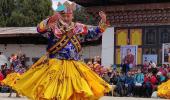
En route, we witness the vibrant Paro Tshechu, one of the most significant cultural festivals in Bhutan. The festival is celebrated annually and is known for its elaborate masked dances, known as cham dances, which are performed by monks and trained dancers and artists.

Each dance holds a symbolic meaning, often representing the triumph of good over evil or narrating stories from the Bhutanese Buddhist traditions.

The performers wear specially-designed costumes and colourful masks -- a spectacle that is both visually striking and spiritually significant.
The beat of traditional drums and the echoing sounds of the long horns fill the air, adding an immersive aspect to the celebrations.
As we reach Paro, we visit the iconic Rinpung Dzong, a fine example of Bhutanese architecture. The fortress stands majestically, perched above the valley with massive whitewashed walls and carved wooden windows. It serves both as a monastic body and an administrative centre, reflecting the harmonious blend of religion and governance in Bhutanese culture.
Walking through its courtyards, one can sense its importance.

Later, we spend time exploring the streets of Paro, which provide a peek into the everyday life of the locals.
The streets are lined with small shops displaying traditional handicrafts, textiles, and souvenirs.
The atmosphere is calm and unhurried, allowing us to wander at ease and take in the surroundings.

The hike to the Tiger's Nest monastery, also known as the Paro Taktsang, is challenging. But unforgettable.
We start from a gentle slope all energetic and robust with wooden hiking sticks in our hands. From the bottom we are able to see a tiny and mainly white cubicle-like structure of the monastery against the rigid cliffside of the upper Paro valley.
The trail begins gradually. It is a dusty path going steadily uphill, surrounded by trees through which sunlight filters through.
Slowly the terrain shifts, becoming rugged as if made to test our stamina. Some rocks are high. And some are there to simply make us trip and fall.
There are many benches along the way and big rocks for us to sit on. We also see people effortlessly going up on horses part of the way.

About halfway up, a viewpoint reveals the monastery itself, perching impossibly on a sheer cliff face.
The cafe located here felt like a reward. We sit staring at the stunning nest waiting to be conquered.
We continue, gathering all our might and stamina, soldiering on with the thought "Why in the world are we even climbing?" without knowing what the view from above will behold. On the way up there are frequent mini stupas and small stones stacked. We even come across prayer wheels in some sections of the trail.
The air becomes thinner and cooler. The sun is overhead and we feel completely drained. As we come near we reach a viewpoint giving us a flabbergasting look of the majestic monastery. The walls are whitewashed and the sloping traditional roofs brown and golden with colourful prayer flags.
The final stretch is the most intense.
Descending a little before we climb steep stone steps again, with a waterfall cascading nearby. The sound of rushing water echoes through the mountains as we make our way across a narrow bridge and up, finally, towards the monastery.

As we near the entrance of the monastery, we believe the climbing part is over, until we see more stairs inside!
Inside are four main temples. Dedicated to Guru Rinpoche, inside are gilded gates, statues and murals of the Lotus Guru in his various manifestations. There are spaces for the god of wealth and the god of long life.
The stone floors are cold under our feet.
The golden light flickered from the oil lamps and the soft chants and prayers echoed.
The Temple of Self-Speaking Buddha is the major shrine featuring a 12-foot statue of Guru Rinpoche, alongside paintings of his eight manifestations and 25 chief disciples.
The temple was like a symbol of serendipity. The soothing wind and the breathtaking view from the balconies of the temples from various chambers are enchanting. There is also a narrow cave on the temple's premises, where it said Guru Rinpoche used to meditate.
The air felt sacred as we moved along within its walls, each chamber telling a story.
After completing the hike there is a sense of achievement and pride in us. It is an awe-inspiring experience at 10,240 feet up!

Back in Paro a traditional Bhutanese hot stone bath or menchu is waiting.
River rocks heated until red-hot are dropped into a wooden tub of water with local medicinal herbs. It is enough to relax our body after the long and draining hike that we will never forget.
Prisha and Mysha have just passed their 10th grade from Mumbai.
Photographs curated by Manisha Kotian/ Rediff
Feature Presentation: Ashish Narsale/ Rediff







 © 2026