
Built as an expendable, short-duration turbojet engine for single-mission applications, it can power tactical cruise missiles, anti-ship missiles, and long-range loitering munitions.

The Defence Research and Development Organisation (DRDO) and the Indian Air Force (IAF) have successfully conducted flight tests of the RudraM-II air-to-surface missile, marking a significant milestone in indigenous defence technology.

India has successfully conducted the maiden salvo launch of the indigenously developed Naval Anti-Ship Missile-Short Range.

India successfully test-fired two Pralay missiles in quick succession off the coast of Odisha, paving the way for its induction into the military. The missile is indigenously developed and features a state-of-the-art navigation system.
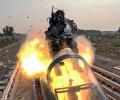
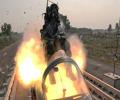
On Tuesday, December 2, 2025, the Defence Research and Development Organisation successfully conducted a high-speed rocket-sled test of a fighter aircraft escape system at the Rail Track Rocket Sled facility at the Terminal Ballistics Research Laboratory in Chandigarh.

India has successfully conducted the first flight trial of its indigenously developed Tactical Advanced Range Augmentation (TARA) glide weapon system off the coast of Odisha, marking a significant step in enhancing its defence capabilities.

Hyderabad-based Nexon Geochem has partnered with Russia's Giredmet to establish integrated rare-earth processing and downstream facilities in India. This collaboration aims to bridge critical gaps in India's rare earth value chain, focusing on producing NdFeB permanent magnets essential for electric vehicles, wind turbines, and defence systems, reducing reliance on imports.

Three milestones in three days signal India's growing mastery in next-generation strategic technologies spanning nuclear deterrence, hypersonic propulsion and precision stand-off strike capability.

We must seize the opportunity provided by the COVID-19 crisis to kick-start indigenous research efforts, recommends Colonel Anil A Athale (retd).

India has successfully conducted a flight test of an advanced Agni missile featuring Multiple Independently Targetable Re-entry Vehicle (MIRV) technology off the coast of Odisha.

As remarkable as DRDO's contribution in containing and treating COVID-19 has been, its success over the last 15 months has been in its primary role of developing conventional defence equipment and technologies.

The Indian government has defended its E20 ethanol blending programme, stating that extensive testing and field experience show no evidence of abnormal engine wear, corrosion, or reduced vehicle life, despite a potential 2-6% reduction in fuel economy.
TARA is India's first indigenous modular glide weapon, capable of transforming conventional unguided warheads into long-range precision-guided weapons.

The Anti-Terrorism Squad (ATS) of Maharashtra Police has filed a charge sheet against DRDO scientist Pradeep Kurulkar, who is accused of providing confidential information to a Pakistani intelligence operative.

Through his commitment to democratic norms, debate, dissent and constitutionalism, Jawaharlal Nehru helped ensure that parliamentary democracy took deep root in independent India. Utkarsh Mishra evaluates Nehru's 17 years as India's first prime minister, examining his role in nation-building, democratic institution-building, economic planning, scientific advancement and foreign policy.

Restoring weighted tax deductions and adopting a petty patents regime can foster firm-level innovative activity critical for competitiveness, points out Nagesh Kumar.

India successfully test-fired the newly-developed tactical missile Pralay, capable of carrying conventional warheads, from APJ Abdul Kalam island off the coast of Odisha. The missile, developed by DRDO, has a range of 150 to 500 km and a payload capacity of 500-1,000 kg.
The DRDO conducted the test in collaboration with the Aeronautical Development Agency and Hindustan Aeronautics Limited.

'The heat shield technology for re-entry vehicles was first mastered in DRDO for the Agni missile.' 'This is why the Americans were so opposed to Agni in the 1980s, unlike other missiles -- it was a re-entry vehicle.'

IIT Kanpur has announced a breakthrough in stealth technology, which would make tanks and fighter aircraft invisible, or near-invisible to enemy radar.

It said the tests were carried out against high-speed unmanned aerial targets under different interception scenarios.

'Our problem is not a budget deficit but a trust deficit. We need to trust our institutions and industries to innovate and lead. That is the way forward for India.'

The Defence Research and Development Organisation has developed a lightweight bullet-proof jacket that weighs nine kilogram and meets the qualitative requirements of the Indian Army, the defence ministry said on Thursday.

The tests were conducted by the Indian Air Force, which will be the first service to induct the Akash missiles in its inventory.
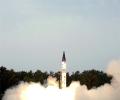
India on Friday successfully test-fired its indigenously developed nuclear-capable Agni-I ballistic missile with a strike range of 700 km from a test range off Odisha coast as part of a user trial by the army.

The Defence Research and Development Organisation on Friday successfully flight-tested a propulsion system that enables a missile to intercept aerial threats at very long range at supersonic speeds.

The missile positioned at launch pad-3 of the ITR swung in to action after getting signal from the radars to intercept a moving aerial target supported by an unmanned air vehicle (UAV) 'Banshee' over the Bay of Bengal, officials said.

India successfully test-fired its indigenously built nuclear capable Agni-I missile, which has a strike range of 700 kilometre on Thursday, from a test range off Odisha coast as part of a user trial by the army.

The drone christened 'Bharat' has been developed by DRDO's Terminal Ballistics Research Laboratory (TBRL), Chandigarh. It has been made to operate in high-altitude areas and can also adapt to extreme climates. It is also known to be agile.
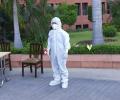
While it was not directly suggested that the COVID-19 pandemic was related to biological warfare, it is significant that the government is exhorting military laboratories to work concertedly on biological defence.

India on Friday night successfully conducted maiden night test of its indigenously developed nuclear-capable Agni-I ballistic missile with strike range of 700 km from a test range off Odisha coast as part of a user trial by the Army.

Describing the trial a "complete success", sources said that all the mission objectives were met during the test.
India and the United States have signed an agreement for cooperation in the development of Air-Launched Unmanned Aerial Vehicle (ALUAV), in yet another step to further expand bilateral defence and military cooperation.
'If you take any ministry of defence project, Nibe is up there, getting orders.'
The $1.2 billion in-space manufacturing market is expected to grow and be worth more than $20 billion by 2033.

A critical drug developed on a DRDO technology for radiological and nuclear emergencies has received approval from the Drugs Controller General of India (DCGI), the defence ministry said on Tuesday.

The Enhanced Pinaka has demonstrated a range of 75 km and an ability to strike within 10 metres of where it is aimed. This allows a Pinaka battery to destroy a terrorist camp, or an enemy post, logistics dump or headquarters, without sending soldiers across the border.

India has successfully test-fired a long range hypersonic missile from the APJ Abdul Kalam Island off the coast of Odisha, Defence Minister Rajnath Singh said on Sunday.

India on Monday successfully test-fired its indigenously built nuclear-capable intermediate range Agni-I ballistic missile, capable of hitting a target 700 km away, from a test range off Odisha coast as part of a user trial by the Army.
Agni-I missile is equipped with sophisticated navigation system which ensures it reaches the target with a high degree of accuracy and precision.
