

'Our problem is not a budget deficit but a trust deficit. We need to trust our institutions and industries to innovate and lead. That is the way forward for India.'

India's patent landscape has come a long way -- from a time when intellectual property was barely understood to an era where filings are rising across laboratories, universities, and industry.
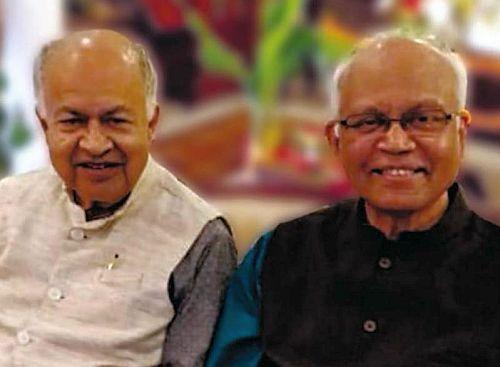
Few have shaped this transformation as decisively as Dr Raghunath Anant (Ramesh) Mashelkar, who served as director general of the Council of Scientific and Industrial Research (CSIR) and one of the country's foremost champions of intellectual property-led innovation.
"Patents aren't just pieces of paper; they must lead to commercialisation and wealth creation," Dr Mashelkar tells Shivanand Kanavi.
Thank you for your time, Dr Mashelkar. You became widely known not just for your work in polymer engineering or leading CSIR, but for championing intellectual property rights (IPR) in India. I recall people from Pune once naming you 'Patent-kar'.
Recent WIPO data shows a rapid rise in patents filed from India -- around 80,000 in 2023, with high growth rates, though the numbers are still modest compared to South Korea or China.
Of course, we lack granular data on how many are filed by GCCs (Global Capability Centers -- R&D hubs of MNC's located in India) which now number around 1,600 and are very active in R&D; and how many by Indian labs.
So, it's unclear how many patents come from Indian institutes, universities, IISERs, India Inc as against companies like IBM or Microsoft.
Nevertheless, the culture of patenting you advocated for has clearly taken root.
I just saw a LinkedIn post where a doctoral advisor was proudly stating his student had a PhD, and 13 research publications and six patents!
What are your thoughts on the journey so far and what needs to be done to make this deeper and more meaningful?
I remember my early days as the director, National Chemical Laboratory in 1989.
On my very first day, addressing the entire staff, I outlined my challenge: Whenever we did something ahead of the world, Indian companies would ask, "But has DuPont done it? How can we1 do it?"
I declared my intention to transform NCL from a national to an international chemical laboratory. I said we should be able to license our patents even to a giant like GE.
A fellow scientist pointed out that GE's R&D budget was two-and-a-half times India's entire R&D budget. I replied, "It's not the power of the budget, but the power of ideas that matters." We did it.
By 1992, we had licensed three US patents to GE on polycarbonates, where they held a 40% global market share. That success story made others take notice. Companies like DuPont asked, "If they are so good, why aren't we in India ?"
That's how India started becoming a global R&D hub, with nearly 2,000 R&D centres today.

Awareness was very poor back then. I remember Dr A P J Abdul Kalam asking me to speak to 55 DRDO directors in 1994. He asked what I would talk about. I said, "Fighting in the marketplace." He was puzzled.
I explained that while DRDO worked in the protected area of defence, after the 1991 economic reforms, CSIR had to compete with multinationals as tariff barriers vanished.
During my talk, I introduced the concept of 'patent literacy' -- the ability to read patents, to bypass them and write patents so others cannot bypass you. I gave examples from our licensing success.
Dr Kalam later asked me, "What can I patent?" I explained that the systems and sensors he developed could. He immediately called his people over to listen. This same awakening happened in industry.
I recall traveling with Jamshed Irani of Tata Steel. He asked if patents were important for the steel industry. I explained how they were, and we sent our IP head, to speak to their senior leadership.
I still have a letter from Dr J J Irani written many years ago, showing an exponential rise in their patenting,
The point is, leaders like those at Tata and Dr Kalam created awareness.
We have moved a lot, but have we moved enough? The answer is no.
Today, the University of California is number one globally. China is now a major player.
CII (Confederation of Indian Industry) must be applauded for creating national IP awards, covering patents, trademarks, and copyrights.
I've chaired these awards for nine years and have seen progress, but it's not enough.
Companies like TCS dominate in patenting, but I don't see other players coming in a big way.
Patents aren't just pieces of paper; they must lead to commercialisation and wealth creation. That is still not where it should be.
To illustrate how awareness has spread, I was once invited to address 1,500 inmates at Yerwada jail, who were to be released in 6 to 12 months.
After my talk, they showed me the kitchen where they make 10,000 rotis a day using a twin-screw extruder.
Some engineer inmates had modified it for better laminar shear mixing, improving dough quality and speed.
They asked the supervisor, "There's some Mashelkar who talks about patents. Can we patent this?" Imagine -- inmates at Yerwada jail were thinking about patents! They did eventually get a patent. I consider that a significant achievement.
What about higher education institutions? Central universities, state universities, IITs, IISERs, AIIMS? From an IPR angle, what do you see?
The curve is definitely upward. IP is getting counted in performance evaluation.
I've been chairman of IISER Mohali, Kolkata, and Pune, and I've seen this shift. They are beginning to realise that knowledge can create wealth -- that there needn't be a disconnect between Saraswati (knowledge) and Lakshmi (wealth).
I always give the example of Professor George M Whitesides of Harvard, one of the world's most highly cited scientists (H-index ~200), who has 134 patents and whose companies have a market cap of over $20 billion.
He exemplifies deep science coupled with a strong patent portfolio and commercialisation.
The Anjani Mashelkar Foundation awards recognise this balance -- high science (papers in Nature, PNAS) alongside strong patent portfolios. This culture is definitely spreading.
Are patent cells now established in many institutions?
Yes. CSIR was a pioneer. We set up our Intellectual Property Management policy in 1996, the first in the country.
We then helped ICAR, ICMR, and even the Indian Institute of Science create their policies. These policies now exist practically everywhere.
The current government also deserves credit for fostering a startup culture.
What about strategic sectors like space, nuclear, and defence (DAE, ISRO, DRDO), where the import option is limited? Did your conversation with Dr Kalam about patenting smaller, commercially viable components have an impact?
Yes, absolutely. For example, the Explosives Research & Development Laboratory (ERDL) in Pune invited me for their 50th anniversary celebrations.
They recalled my conversation with Dr Kalam and mentioned they had now crossed the 100-patent mark. This movement is everywhere.
When Mr Sharad Pawar was chairman of ICAR, he asked me to chair a committee on reforms. We brought in a patenting culture, and it has grown substantially.
I see it now at the Tata Memorial Centre, where I'm on the board; they are talking about creating incubators and a startup culture.
The awareness is undeniable. The intensity and realising the full potential is what we must focus on.
Another neglected area is agriculture. We did a lot of research, but when Monsanto's Bt cotton came, there were patent infringement issues. How important is IP awareness in ICAR and agricultural universities?
Absolutely crucial. Scientists are often completely unaware that 80% of new knowledge exists in patents, not just journals. They rarely refer to them.
The awareness has been late in coming. But better late than never.
The turmeric patent case became a landmark. Could you recount that story?
I read a small item in The Times of India by N Suresh stating that the wound-healing properties of turmeric had been patented in the US.
I thought, "My mother used this! Where is the novelty factor necessary for patenting in this ?"
That evening, I was giving the Homi Bhabha Memorial Lecture, chaired by Dr P N Haksar. I declared from the podium that I would fight this patent.
As director general of CSIR, I had freedom, but as Secretary, I needed permission.
All hell broke loose the next day, but the country trusted me. We fought and revoked the patent in 14 months.
It was easy and cost only Rs 5 lakhs, contrary to the belief that it would cost crores. Its implications were huge.
I was lucky to become chairman of the standing committee on information technology at WIPO.
In a speech to 176 member nations, I argued that knowledge generated in the 'laboratories of life' by my ancient predecessors was just as valid as knowledge from Stanford or Cambridge.
They didn't consider traditional knowledge as 'prior art', because it wasn't in their International Patent Classification system.
We, along with China, Brazil, and others, introduced new sub-codes for traditional knowledge.
I visited the US patent office and showed them ten wrong patents, providing 'prior art' from our ancient texts for each claim.
They were cooperative and showed me their search process.
When they typed 'turmeric','powder', 'wound healing', nothing came up because this knowledge was either in people's heads or ancient books.
This led to the creation of the Traditional Knowledge Digital Library under Dr V K Gupta.
It's now a 30 million page repository translated into the international patent classification language.
This had three effects: It eliminated wrong patents, deterred MNCs from filing them as they would be caught, and gave India a voice at the high table in WIPO.
This benefited not just India but all developing nations with rich traditional knowledge, like China and African countries.
In the last 20 years, there's been a significant expansion of higher education: New IITs, IISERs, AIIMS, IIITs. However, it takes decades to build a culture of research and excellence.
What is your view on this expansion? Also, many universities declined after being transferred to state governments in the 1970s. What are your thoughts on strengthening higher education?
I totally agree. We had a pyramid: IITs at the top, ITIs at the bottom, and government colleges and regional engineering colleges (RECs) in between.
Raising the standards of each is crucial. IITs must be research institutions, not just teaching colleges.
My very first committee was to review the RECs. I found that while IITs selected one out of a hundred applicants, the next three or four were often just as good. On another day, the selection could have been different.
More importantly, who served India? It was the REC graduates. Many top IIT graduates went abroad. The REC graduates served in Indian companies, space, defence, and atomic energy.
My committee recommended converting RECs to National Institutes of Technology (NITs/em>) with central funding and autonomy. Credit goes to Dr Murli Manohar Joshi, the education minister in Atal Bihari Vajpayee's government, for implementing this.
I had written that with freedom and autonomy, some NITs would surpass some older IITs.
I'm proud to see that happening with NITs like Warangal, Suratkal, and Trichy.
The lesson is: Empower current institutions with more funding, autonomy, and flexibility.
You don't always need to create new ones. While good private institutions have emerged, their exorbitant fees (e.g., Rs 12 lakhs/year) put them out of reach for the middle class.
Access to education is a fundamental right. My municipal school education was free, and the Tata scholarship of Rs 60/month (equivalent to Rs 25,000 today) supported my household. Without that, I wouldn't be here.
Education, research, and innovation must go together. Education disseminates known knowledge, research creates new knowledge, and innovation converts it into economic and social good.
The idea of IISERs is a great move. I was part of the science advisory committee to the PM.
In 2006, I made a presentation to Dr Manmohan Singh, showing how China was retaining talent by creating world-class institutions like Tsinghua.
I pointed out that the Indian Institute of Science, Bengaluru was turning 100, but was created by the Tatas, not the government.
This discussion led to the decision to create IISERs, combining high quality science education and research.
I spontaneously offered 100 acres of NCL land in Pune for the first IISER.
Today, in one square kilometre in Pune, we generate a thousand PhDs. This clustering has a great impact.
A good trend is the return of Indian students who went abroad for PhDs and post-docs.
When you create centres of excellence, brain drain turns into brain gain and then brain circulation. For example, the GE R&D centre came to Bengaluru because Indian scientists voted for it.
The scientists who joined GE didn't all stay; they moved to other Indian institutions, startups, or companies like Reliance. This circulation of knowledge and talent is vital.
My dream in 1995, was for India to become a global R&D platform. People thought I was crazy, but the strategy was based on competing with skill, not just products. This knowledge diffusion is happening.
You mentioned the prime minister's science advisory council. Why does a PM need such a council? What was its contribution from your long tenure (from Rajiv Gandhi's time in the 1980s till 2014)?
It acts as a scientific think-tank, assisting the PM in strategising. For instance:
- The idea of a National Science Foundation-like body was born there.
- The Technology Development Board (TDB), which provided seed money for pioneers like Varaprasad Reddy (Shantha Biotech, Hepatitis B vaccine) and Krishna Ella (Bharat Biotech, Covaxin), came from SAC.
- The Technology Information, Forecasting and Assessment Council (TIFAC) was created.
- The Centre for Development of Advanced Computing (C-DAC) was initiated.
- I recall Professor Roddam Narasimha advising Rajiv Gandhi to compete in areas like parallel processing supercomputing where everyone was at the same starting line. Rs 10 million was instantly approved, and Vijay Bhatkar delivered PARAM 8000 in 3 years, making India ahead of China at that time.
- The National Knowledge Commission and the Prime Minister's National Innovation Council, during Dr Manmohan Singh's time led to State Innovation Councils and the concept of Tinkering Labs. Atal Tinkering Labs, originated from these discussions.
SAC brought together independent thinkers with great vision. There was an intimate relationship with the prime minister, who gave time for these discussions.
Both PMs I worked with; Rajiv Gandhi and Dr Manmohan Singh, were receptive.
The contributions were huge in shaping India's science and technology policy, creating new institutions, and driving reforms.
Finally, your views on manufacturing. We need smart manufacturing and mass employment for our youth. What should our strategy be, especially with initiatives like PLI (Production-Linked Incentive)? How do we avoid the pitfalls of old-style import substitution?
I believe re-skilling and up-skilling are paramount. The nature of work remains, but the skills change.
For example, translation is now done by AI, but humans refine it. The new skill is crafting the right prompts for generative AI.
For manufacturing to be competitive, we must look holistically at land, labour, and input costs (power, water).
Clustering, like MIDCs in Maharashtra or the chemical cluster in Gujarat, is the best strategy, not creating isolated islands. Special Economic Zones (SEZs) like China's are needed.
I am fully for Atmanirbhar Bharat (Self-Reliant India), but with Atma Vishwas (self-confidence). We need aggressive policies.
Let me give an example: The New Millennium Indian Technology Leadership Initiative (NMITLI) I launched in 2000.
It was about leadership -- doing what nobody had done. It was a risky public-private partnership where industry got loans at 3% interest when the market rate was 19%. This de-risked innovation for industry.
Take fuel cells. Nobody was talking about them in 2002-2004. NMITLI funded a consortium of NCL, CSIR's Central Electrochemical Research Institute, and KPIT Technologies.
Years later, the prime minister launched India's first indigenous hydrogen fuel cell-based ferry in Kochi, developed by Cochin Shipyard.
It's ahead of the world in performance and lowest in cost. This is true Atmanirbharta -- creating new, globally competitive technology for greening our waterways, not just import substitution behind tariff walls.
The key is talent, technology, and trust. Our problem is not a budget deficit but a trust deficit. We need to trust our institutions and industries to innovate and lead. That is the way forward for India.
Thank you. This has been a fantastic conversation covering immense ground from your firsthand experiences.
Shivanand Kanavi, a frequent contributor to Rediff, is a theoretical physicist, business journalist and former VP at TCS.
He is the author of the award winning book Sand to Silicon: The Amazing Story Of Digital Technology and edited Research by Design: Innovation and TCS.
He can be reached at skanavi@gmail.com
Feature Presentation: Ashish Narsale/Rediff







 © 2026