
The Maharashtra Vidhan Bhavan in Mumbai was evacuated following a bomb threat received via email during the budget session, prompting security checks and a search operation.

The Gujarat assembly complex received a bomb threat via email, leading to the evacuation of staff and MLAs and a search operation by local police.

Both Houses of Parliament were adjourned sine die, concluding a Budget session marked by the passage of key legislations and the defeat of a Constitution amendment bill on women's reservation. The session saw frequent opposition protests and discussions on various issues, including the West Asia conflict.

The first leg of the Budget session concluded with debates over the India-US trade deal and a former army chief's memoir, and will reassemble on March 9.
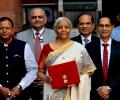
The Budget session of Parliament will be held from January 28 to April 2, featuring the President's address, the Economic Survey, and the presentation of the general Budget.

The Maharashtra Vidhan Bhavan in Mumbai received a bomb threat via email during the budget session, leading to a security search and evacuation. Authorities deemed the threat a hoax after finding nothing suspicious.

The absence of NCP-SP leaders from a key Maha Vikas Aghadi meeting in Maharashtra has ignited concerns about opposition unity ahead of the crucial budget session and upcoming Rajya Sabha elections.
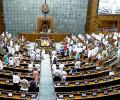
India's Monsoon session of Parliament remains formally unprorogued 40 days after adjournment, setting a new record. This unusual delay fuels speculation that the government intends to introduce a key legislation, possibly an amendment to the women's reservation law, without convening a new session. The proposed amendment aims for a 50 per cent seat expansion to address concerns over delimitation.

The Indian Parliament is expected to extend its budget session to introduce a bill increasing Lok Sabha seats to 816, reserving 273 for women, and amending the women's reservation law.

More than half of the bills introduced in the 18th Lok Sabha have been passed by both Houses in the same session, a significant acceleration compared to previous terms, raising concerns about the time available for legislative scrutiny and stakeholder consultations.

Telangana Chief Minister A Revanth Reddy will virtually deliver the keynote address at the Harvard Kennedy School's AI symposium, focusing on the global AI landscape.
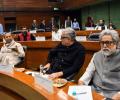
India's Parliament is set to begin its Budget session on Friday, with opposition parties poised to demand a discussion on the alleged mismanagement of the Maha Kumbh festival in Prayagraj, where 30 pilgrims died in a stampede. The opposition also accused the government of politicising parliamentary committees and pushing its agenda through its majority. The session will start with President Droupadi Murmu addressing both houses of Parliament. Finance Minister Nirmala Sitharaman will present the Union Budget on Saturday for the eighth consecutive time.

The President will address both the Houses of Parliament assembled together in the Lok Sabha chamber on Friday and Finance Minister Nirmala Sitharaman will present the General Budget on Saturday.

A brief Budget session of Parliament, the last of the 17th Lok Sabha, will be held between January 31 and February 9, Parliamentary Affairs Minister Pralhad Joshi said on Friday.

The Lok Sabha's monsoon session concluded on Thursday, marked by relentless opposition protests over critical issues like the NEET paper leak and police action on students, yet saw the passage of several key bills without extensive debate. Home Minister Amit Shah expressed readiness to debate the student protest issue, urging the speaker to allocate time.

Ten days after both Houses of Parliament were adjourned sine die, the Monsoon session is yet to end formally, giving rise to speculation that the government wants to pass a key legislation without convening a new session.

Lok Sabha takes up FCRA Amendment Bill amid opposition protests.
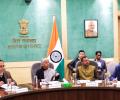
Parliament's Budget Session will be held from January 31 to April 4, with Finance Minister Nirmala Sitharaman set to table her eighth straight budget on February 1. The session will begin with President Droupadi Murmu's address to a joint sitting of the Lok Sabha and Rajya Sabha on January 31, followed by the tabling of the economic survey. The first part of the Budget Session will have nine sittings from January 31 to February 13, after which Parliament will break for recess to examine the budget proposals. The session will reconvene on March 10 to discuss the demands for grants of various ministries and complete the budgetary process, concluding on April 4.

Pakistan has increased its defence budget by 17.6 per cent to PKRs 3,000 billion for the upcoming fiscal year, as announced by Finance Minister Muhammad Aurangzeb. The federal budget, estimated at PKRs 18,771 billion, targets 4 per cent GDP growth, with significant allocations for debt service and pensions. Prime Minister Shehbaz Sharif highlighted economic stability and ongoing discussions with the IMF, while the opposition protested Imran Khan's incarceration during the budget session.

A couple, identified as the parents of a custodial death victim, was detained by police in Chennai after attempting to breach Tamil Nadu Chief Minister C Joseph Vijay's convoy. They sought to petition the Chief Minister for justice regarding their son's death in police custody in March. The incident caused a brief slowdown of the CM's vehicle.
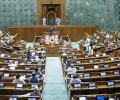
The deportation of Indians from the United States, deaths in the Maha Kumbh stampede and the joint Parliamentary committee report on the Waqf bill were among the issues that led to heated exchanges and some disruptions in an otherwise smooth first part of the Budget session that ended on Thursday.
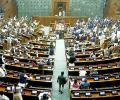
The government has also listed three new bills for the session -- 'The Protection of Interests in Aircraft Objects Bill, 'Tribhuvan Sahkari University Bill', and the 'Immigration and Foreigners Bill'.

Police have registered cases against senior DMK leaders A Raja, P K Sekar Babu, and Vasantham Karthikeyan for allegedly making defamatory remarks against Tamil Nadu Chief Minister C Joseph Vijay and Energy Resources and Law Minister R Nirmal Kumar during recent party protests. The controversy stems from CM Vijay's comments questioning DMK chief M K Stalin's MISA detention during the Emergency, which the DMK claims is a long-standing narrative.
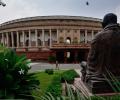
Parliament will reconvene on March 12 for the second part of the Budget Session.
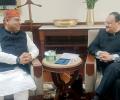
The budget session of the Delhi Assembly concluded with over 15 hours of legislative business. Speaker Vijender Gupta voiced concerns over the opposition's conduct during the session.

'It is not about a place with fewer incidents of violence but a city where women have real agency in planning their daily lives.'

The Tamil Nadu assembly descended into chaos, leading to the eviction of DMK MLAs, as they vehemently protested Chief Minister C Joseph Vijay's statements.

The Tamil Nadu Assembly has unanimously adopted a resolution, moved by Chief Minister C Joseph Vijay, urging the Centre to recognise Tamil as the principal language of the Madras High Court. The resolution highlights Tamil's classical status and the need for judgments to be available in the local language, while also addressing historical demands and constitutional provisions.

Glimpses of lady MPs as the nation's lady finance minister presents the Budget for the next financial year on Wednesday, February 1, 2023.

Both Lok Sabha and Rajya Sabha committees had recommended that their suspension be withdrawn after they expressed regret for their conduct during the Winter session when their relentless protests prompted the Chairs to take action.

Tamil Nadu Chief Minister C Joseph Vijay issued a stern warning against personal attacks, double-meaning insults, and derogatory language targeting women, particularly in political discourse. Speaking in the Assembly, he recalled past humiliations faced by late CM J Jayalalithaa and condemned recent incidents involving women personalities, stressing that such behaviour would face immediate legal consequences. He also outlined his administration's vision for public security and zero-tolerance against crime.

The parliamentary committee scrutinizing the Waqf (Amendment) Bill has been granted an extension until the last day of the next Budget Session. This decision follows a heated meeting marked by a walkout from opposition members who expressed concerns about the committee's draft report. The committee will visit several states to meet stakeholders and finalize its report.
The session started on January 29 and was originally slated to end on April 8 but several members had urged Speaker Om Birla to end the session earlier as they focus on electioneering for the five assemblies.

"The ray of hope being seen by the world will glow brighter -- for this, I firmly believe the finance minister will make all efforts to meet these aspirations," Modi said.

In 100 days in office, Chief Minister V D Satheesan has ordered five SITs. This would appear to be some kind of a record, points out Aditi Phadnis.

Weak verbs and poor language can make even impressive achievements seem ordinary, points out Nayagam PP, a career coach and founder of EduJob360.

Former Tamil Nadu Deputy Chief Minister Udhayanidhi Stalin was arrested for an alleged 'double-meaning' remark alluding to actor Trisha, leading to widespread protests by DMK cadres and condemnation from various political leaders.

The Parliament resumes on Monday after a break. WATCH THE LIVE DEBATES HERE.

Finance Minister Nirmala Sitharaman will present the general budget in Parliament on February 1. The Budget session of Parliament begins on January 28 with President Droupadi Murmu addressing both houses.

The West Bengal government plans to introduce two new bills in the Assembly to address public disorder, vandalism, and attacks on police and public servants. One bill will amend the existing Public Order Act, 1972, while the other, titled the Public Safety Control and Anti-Social Activity Bill, will comprehensively strengthen public safety measures. These legislative changes aim to curb incidents of violence and allow for compensation recovery from offenders.
