
Shrishti Arora secured a bronze medal for India in the women's 10m air pistol SH1 event at the Asian Para Games in Nagoya. This marks India's fourth shooting medal at the Games, following earlier successes by Manish Narwal, Mona Agarwal, and Avani Lekhara.

Malicious cyber activity has disrupted technology at water and wastewater facilities in at least seven US states, forcing utilities to revert to manual operations, with authorities actively probing whether Iranian-linked hackers are responsible.

Indian women's kabaddi captain Pushpa Rana led her team to a record-extending fourth Asian Games gold medal, defeating a strong Iranian side 37-34. Rana highlighted the team's reliance on their raiders and the pressure of maintaining India's dominance in the sport.

An Indian national was killed and two others were injured in an attack on King Fahd International Airport in Dammam, Saudi Arabia. This incident follows another attack on the Shaybah oilfield where an Indian was also injured, amidst escalating strikes by Yemen's Houthi rebels on Saudi infrastructure.

The Indian men's blind football team began its Asian Para Games campaign with a 0-2 loss against South Korea in Nagoya. South Korea's Jang Yeongjun scored both goals. India is set to play hosts Japan next on Saturday.

Israel has implemented new aviation security directives, barring pilots and cabin crew from countries without diplomatic ties, including Pakistan, from entering its airspace. This follows a hijacking attempt last month on a flight to Israel, where Indian Captain Smit Machchhar was injured while thwarting the plot. The restrictions affect over two dozen nationalities and have prompted airlines like Air France and United Airlines to adjust crew assignments.


The American military's air-defence missile inventories, including Patriot and THAAD interceptors, are significantly depleted due to the ongoing five-month confrontation with Iran. A CSIS assessment reveals a steep drop in reserve stocks, raising concerns about the US's capacity to maintain Middle East operations and address other global security challenges. This depletion could force the US and its allies to take higher operational risks.

A bipartisan group of US Senators has agreed to fast-track a bill allowing the President to impose sanctions on major purchasers of oil from Russia and Iran. This legislation, known as the Lindsey O. Graham Sanctioning Russia and Iran Act of 2026, aims to restrict funding for Russia's war efforts and Iran's energy and weapons sectors, potentially impacting countries like China and India through tariffs and other restrictions.

India's men's and women's Kabaddi teams successfully defended their gold medals at the Asian Games, both defeating Iran in their respective finals. The men's team secured their ninth gold with a 40-34 victory, while the women's team clinched their fourth gold with a 37-34 win, showcasing strategic play and composure under pressure.

The US military has lost at least 45 MQ-9 Reaper drones during the conflict with Iran, representing a quarter of its fleet and a significant financial blow. These losses, some due to communication failures, raise questions as India recently signed an agreement to procure 31 of these drones.

Indian para-athlete Suvarna Raj won the gold medal in the women's F54 discus throw at the Asian Para Games in Nagoya, achieving a best effort of 15.66m.

Sports Minister Mansukh Mandaviya will inaugurate the BRICS Traditional and Indigenous Demonstration Games 2026 in Ahmedabad on Monday. Organised by the Ministry of Youth Affairs and Sports in collaboration with the Gujarat government, the event on 12 October 2026, under India's BRICS Chairmanship, will feature traditional sports like Mallakhamb, Yogasana, and Kalaripayattu from India. The non-competitive Games aim to foster cultural exchange and knowledge-sharing among BRICS and partner countries including Belarus, Bolivia, Brazil, China, Ethiopia, Iran, Kazakhstan, Russia, South Africa, and the UAE.

Pakistan has welcomed an Indian delegation's visit to Islamabad for a Shanghai Cooperation Organisation (SCO) meeting, marking the first such visit after a significant gap. The visit is seen as a positive step towards regional peace and cooperation, with Pakistan also commenting on other international and domestic issues.

US Secretary of State Marco Rubio's visit to India this week underscores the complex dynamics of global energy policy, as Washington re-evaluates sanctions on Russian oil buyers amidst India's continued reliance on Russian crude.

The article presents the medal tally after Day 14 of the Asian Games, showing China's significant lead, followed by Japan and South Korea. India is positioned fourth with a total of 85 medals.

Pakistan Prime Minister Shehbaz Sharif clarified that the recent Memorandum of Understanding (MoU) signed between the US and Iran does not include provisions regarding Tehran's ballistic missile programme. This statement followed talks with Iranian President Masoud Pezeshkian, with Sharif emphasising Iran's right to its defence capabilities and Pakistan's role as a mediator in the US-Iran peace process.

India has advised its nationals to postpone travel to Iran and urged those already there to consider leaving due to increasing instability and conflict in the region. The advisory from the Indian Embassy in Tehran highlights heightened caution and the need to monitor the security situation.

United States Treasury Secretary Scott Bessent has warned that Iranian airlines could be effectively shut out of international travel from Wednesday, September 23, as Washington threatens secondary sanctions against foreign companies that continue providing services to Iran's carriers.

Indian swimmer Kapil Kumar clinched a silver medal in the men's 400m freestyle S10 event at the Asian Para Games in Nagoya.

India has issued an advisory for its nationals in Saudi Arabia, urging them to stay indoors during aerial attacks and follow local instructions, amidst ongoing tensions and drone/missile attacks by Houthi rebels. The advisory follows an attack on Riyadh airport that killed one Indian national and injured several others, leading to flight suspensions by Indian carriers.

The first-ever BRICS Traditional and Indigenous Demonstration Games concluded in Ahmedabad, featuring nearly 160 participants from 10 member nations. India prominently showcased yogasana and mallakhamb, alongside other traditional sports like kalaripayattu. The event also saw demonstrations of wushu from China, togyzkumalak from Kazakhstan, and Jiu-Jitsu from Brazil. Participants from South Africa, China, and Russia praised India's hospitality and the cultural exchange.

Foreign Portfolio Investors (FPIs) have withdrawn Rs 48,056 crore from Indian equities in October, driven by elevated crude oil prices, Middle East tensions, inflation concerns, and weak corporate earnings, though selling pressure moderated towards the end of the month.

Cristiano Ronaldo scored Al-Nassr's second goal in their 3-1 victory over Uzbekistan's Neftchi in the AFC Champions League Elite, a match that was delayed by an hour due to a security warning in Riyadh.

Reports from the New York Post, citing Mohsen Heydari, reveal that Mojtaba Khamenei was "pulled from the rubble" of a Tehran hospital after alleged US and Israeli strikes. This occurred before his secret selection as Iran's new Supreme Leader by the Assembly of Experts, which was also reportedly targeted. Conflicting accounts from Donald Trump and Iranian President Masoud Pezeshkian have further shrouded Khamenei's health in mystery, with some suggesting severe injuries while others claim he is "completely" healthy.
Sikkim has hosted the inaugural leg of the 2026 Zabarvan Extreme Legends Series, an international downhill mountain biking competition. The event, featuring riders from eight countries, aims to bolster the state's adventure tourism profile. Chief Minister Prem Singh Tamang flagged off the competition and highlighted plans for infrastructure development to support tourism in the region.

India is navigating a complex diplomatic landscape, attempting to balance its 'forever honeymoon' with the Israel-UAE-Bahrain axis against its historical ties with Iran, as evidenced by recent high-level visits and evolving geopolitical realignments in the Middle East, observes Ambassador M K Bhadrakumar.
India's Sandeep won a gold medal in the men's 400m T64 final at the Asian Para Games, setting a new world record. Compatriot Ajay Kumar secured a bronze in the same event. Additionally, Nimisha Chakkungalparambil and Parmod Bijarnia each claimed silver medals in women's long jump T47 and men's 1500m T46, respectively, contributing to India's strong performance.

India's men's and women's kabaddi teams have secured their spots in the Asian Games finals, maintaining their unbeaten run. Both teams will face Iran in their respective gold medal matches, aiming to defend their titles.

Navigating this geopolitical minefield requires a cold-blooded blend of immediate tactical pleading, structural domestic diversification, and aggressive collective resistance, suggests Ambassador Rajasekhar.
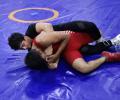
Indian wrestlers Jaskaran Singh and Chandermohan have advanced to the bronze medal bouts in their respective weight categories at the U23 World Wrestling Championships in Las Vegas. Rohit and Shivan also remain in contention for medals through the repechage rounds, while Sumit Bharaskar's campaign concluded.

Defence Minister Rajnath Singh on Tuesday called for dialogue and diplomacy to resolve global conflicts, stating, "war can never be the answer to war," while addressing the Shanghai Cooperation Organisation (SCO) Council of Heads of Government meeting in Dushanbe, Tajikistan.

US President Donald Trump has expressed interest to his advisers in setting up a meeting with Iranian officials present in New York for the UN General Assembly's 81st session, "if the conditions are right."

Indian sprinter Simran secured a gold medal and set a new Games record in the women's 200m T12 event at the Asian Para Games on Tuesday. Her compatriot Tejalben Damor also won a bronze in the same competition. Simran, a Paris Paralympics bronze medallist, overcame dietary challenges to achieve her win, while debutant Tejalben expressed determination for her upcoming 400m race.

Iran's Islamic Revolutionary Guard Corps (IRGC) asserted full control over the Strait of Hormuz, claiming two oil tankers turned back after a fire, and warned countries supporting the US against interference in the strategic waterway.

MI5 Director General Ken McCallum has issued a stark warning about artificial intelligence "supercharging" cybersecurity challenges and national security risks. He revealed that terrorists are already exploiting AI for attack capabilities and announced the launch of the AI Threat Assessment Centre (AITAC). McCallum also highlighted a fourfold increase in threats from hostile states like Russia, Iran, and China, urging public resilience.

Five British nationals arrested on suspicion of terror charges related to an explosives threat near RAF Fairford have been released on police bail. The Counter Terrorism Policing (CTP) investigation is ongoing, with stringent conditions placed on the suspects. Iran has denied any involvement, while former US President Donald Trump claimed US intelligence assisted in the arrests.
India's men's and women's kabaddi teams continued their winning streak at the Asian Games, securing comprehensive victories against Bangladesh and Iran respectively. The women's team defeated 2018 gold medallist Iran 37-23, while the men's team beat Bangladesh 48-25, showcasing their strong performance and aiming for gold.

The main culprit behind this cost escalation are rising prices of sugar and milk that go into making the sweets.

Iran's Supreme Leader Mojtaba Khamenei will not attend his father, former Supreme Leader Ali Khamenei's, funeral due to security concerns stemming from Israeli threats. This decision follows a sharp warning from Iran's Foreign Minister to the United States, urging it to control Israel after its Defence Minister reportedly marked Khamenei for death. The incident highlights escalating tensions and ongoing diplomatic efforts to de-escalate hostilities in West Asia.
