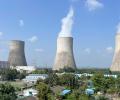
The Bill is likely to pave the way for amending two existing legislations -- the Atomic Energy Act 1962, and the Civil Liability for Nuclear Damage Act 2010.

India's nuclear energy share in total installed capacity remains limited, fluctuating between 1.9 per cent and 2.9 per cent from FY10 to FY24.

President Vladimir Putin announced that Russia has successfully tested the Poseidon, a nuclear-powered submersible drone with unlimited range, along with updates on the Sarmat missile and Burevestnik cruise missile.

A fire erupted in Russia's Kursk Nuclear Power Plant on Sunday after Ukraine launched a drone attack at one of Russia's biggest nuclear power plants, damaging a transformer and causing a fall in the output of one of its reactors by 50 per cent, Anadolu Agency reported, citing the plant's press service.
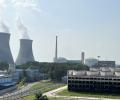
Russia has offered India cooperation in localising large and small nuclear power plants as part of a civil nuclear energy collaboration between the two countries. The offer was made during a meeting at the IAEA General Conference in Vienna.

Adani Group Chairman Gautam Adani announced a capital expenditure programme of over 2 trillion for Adani Power, aiming for 45 gigawatts (Gw) capacity in five years, including a significant entry into nuclear power with a target of 10 Gw by 2035 through Adani Atomic Energy.
The Supreme Court is reviewing a plea challenging the 2025 SHANTI Act, which caps liability at Rs 3,000 crore for nuclear plant incidents, raising concerns about victim compensation and operator accountability.

'The Atomic Energy Commission has approved the FDI policy and it is going in for ministerial consultations.'

India is increasingly focusing on long-range weapons capable of reaching targets across China.

A projectile struck near Iran's Bushehr Nuclear Power Plant, resulting in one security personnel casualty and damage to an auxiliary building. The incident has raised concerns about nuclear safety and potential regional consequences, drawing criticism from Iranian officials and prompting calls for restraint from the IAEA.
Ushering in reforms, Union Finance Minister Nirmala Sitharaman on Saturday proposed to open up the nuclear power sector for private players and announced a Rs 20,000 crore Nuclear Energy Mission for research in the field, with an aim to set up five small and modular reactors by 2033.

India has voiced deep concern over a drone attack targeting the Barakah nuclear facility in the United Arab Emirates (UAE), calling it a dangerous escalation in the West Asia conflict.

A senior Pakistani defence official, Lt Gen (retd) Mazhar Jamil, claimed that India's long-range missile development indicates ambitions to become a global nuclear power capable of threatening Western capitals, urging international attention to India's military modernisation. He also reiterated Pakistan's commitment to deterrence stability in South Asia.

India has commissioned its new indigenously-built nuclear-powered ballistic missile submarine INS Aridaman into service, further strengthening the naval component of its nuclear triad. Defence Minister Rajnath Singh also highlighted the Indian Navy's role in securing maritime trade routes.

A powerful 7.5 magnitude earthquake struck northeastern and northern Japan, prompting a tsunami warning for the Pacific coasts of Hokkaido, Aomori, and Iwate prefectures. Tsunami waves of up to 3 meters were forecast, and residents were urged to evacuate to higher ground. No abnormalities were reported at nuclear plants.

China is significantly expanding its nuclear power sector, aiming to become a global leader by 2030. The country has the capacity to construct up to 50 nuclear reactors simultaneously, reducing reliance on fossil fuels.

In many ways, this is only the beginning -- of a new chapter in India's nuclear story, and of a future where its vast thorium reserves could finally power its ambitions.

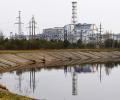
Forty years ago a reactor at the Chernobyl Nuclear Power Plant in Ukraine tore itself apart during a failed test, triggering the worst violent release of radioactive debris into the atmosphere.

Facing escalating threats from the US, Iran is mobilizing its citizens to form 'human chains' around power plants as a defensive measure against potential airstrikes, raising concerns about international law and civilian safety.

Former CIA Analyst, Larry Johnson, said on Friday that US President Donald Trump asked US chairman of the joint chiefs of staff, Dan Caine, if they could use the nuclear weapons, but the latter denied.

Experts' worries intensified after Pakistan commissioned its first Chinese-built Hangor-class submarine, PNS Hangor, last month.

India on Tuesday said cooperation in peaceful uses of nuclear technology is an important pillar of the multifaceted cooperation with Russia, which offered help in building small tropical nuclear power stations.
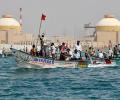
Though it still has only a single-digit share in total electricity production, India has been looking to tap nuclear power faster.

'We were in a heavily nuclearised environment. China had tested for Pakistan in the 1980s and helped their missile programme stay just one step behind us.'

'We were not protesting for a wage hike or provident fund. We were protesting for the safety of the larger population. There is no personal gain.'

Chinese President Xi Jinping has arrived in Pyongyang for his first official visit in seven years, meeting with North Korean leader Kim Jong-un to reaffirm their long-standing friendship and pledge further development of bilateral relations amidst Pyongyang's deepening military ties with Moscow and China's assertions against Japan's 'new militarism'.

Former US President Donald Trump claimed that Iran has agreed to return its "nuclear dust" to the United States as part of broader assurances not to pursue nuclear weapons. He expressed optimism about ongoing negotiations and a potential deal.

India's 500 MWe Prototype Fast Breeder Reactor (PFBR) at Kalpakkam in Chennai has achieved first criticality, marking a significant advancement in the country's nuclear energy capabilities and long-term energy security.

Earlier, Israeli Prime Minister Benjamin Netanyahu also declared that Iran would never be allowed to acquire nuclear weapons, regardless of any agreement.
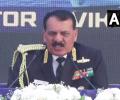
India is strengthening the naval component of its nuclear triad with Navy Chief Admiral Dinesh K Tripathi on Tuesday saying that the third indigenous nuclear-powered submarine 'Aridaman' will be commissioned soon and that his force is focusing on boosting its overall combat prowess.

Successful interceptor, anti-ship, MIRV and hypersonic technology tests have strengthened India's position among a select group of advanced missile powers.

A new report from the Stockholm International Peace Research Institute (SIPRI) indicates that India has expanded its nuclear arsenal and is developing long-range weapons capable of reaching targets across China, while also maintaining focus on its rivalry with Pakistan.

If Iran and Oman choose to charge a fee for rendering services to vessels using their territorial waters, so be it. The US is indulging in an irrationally self-destructive act, notes Ambassador M K Bhadrakumar.

The RusBeam 2800 is now India's largest electron-beam wire deposition 3D printer operating under vacuum. The machine was custom-built for India and is operated with software developed by Rosatom.

Construction major L&T is gearing up to expand its footprint in the global nuclear supply chain, a senior company official has said, while calling for amendments to key legislations on the domestic front to pave the way for the entry of private players and foreign capital necessary for capacity enhancement.

Three milestones in three days signal India's growing mastery in next-generation strategic technologies spanning nuclear deterrence, hypersonic propulsion and precision stand-off strike capability.

A lesson for India is to clearly define objectives beforehand, so that the adversary or other parties do not attempt to mitigate them midway.

Top leaders from the US, Iran, and Pakistan, along with other nations, have gathered in Switzerland for high-level talks aimed at restoring peace in West Asia. These negotiations follow a recently signed Memorandum of Understanding between the US and Iran, initiating a 60-day window for a deal. Discussions focus on Iran's nuclear programme and the fragile interim peace deal, amidst renewed tensions and the fluctuating status of the Strait of Hormuz.

US President Donald Trump stated that Iran is eager to make a deal and predicted a sharp decline in oil prices due to abundant supply, amidst a Senate resolution to limit his war powers in Iran.

Iranian Foreign Minister Seyed Abbas Araghchi announced the official end of the war and warned that any Israeli attack on Lebanon would violate an agreement between Iran and the United States. He also stated that negotiations on nuclear issues and sanctions lifting would begin on Saturday, led by Iran's Parliamentary Speaker M B Ghalibaf and US Vice President J D Vance.
