
18 Indian-flagged vessels with 485 Indian seafarers still remain in the western Persian Gulf region

The United States and Iran, with regional mediators, are reportedly discussing a potential 45-day ceasefire to prevent further escalation of conflict, including strikes on Iranian infrastructure and retaliation against Gulf states' facilities.

'The US landed in this war without planning. The US felt that if they kill Ayatollah Khamenei the people of Iran will come out on the roads and do a regime change.' 'On the contrary, the US bombings on Iran has united the entire nation.'

The Indian government has refuted claims of an impending Rs 25-28 per litre hike in petrol and diesel prices post-assembly elections, stating no such proposal is under consideration by the Ministry of Petroleum and Natural Gas.
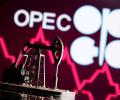
The United Arab Emirates has announced its decision to withdraw from OPEC and the wider OPEC+ alliance, effective May 1, 2026, signalling a significant policy-driven evolution in its long-term energy strategy aimed at aligning with domestic economic goals and increased production investment.

In a sharp escalation of regional tensions, US President Donald Trump issued a fresh warning to Tehran on Monday, asserting that the American military is prepared to sink any Iranian vessels that approach the newly established naval blockade in the Strait of Hormuz.

The ministry of external affairs on Monday said that a joint statement could not be issued following the BRICS deputy foreign ministers and special envoys on the Middle East and North Africa (MENA) meeting, which took place on April 24 in the national capital, as member countries were unable to reach a general consensus concerning the conflict in West Asia.

A senior Russian official has stated that Russia is prepared to supply fertilisers and other agricultural products to countries in the Global South and East, following concerns about the closure of the Strait of Hormuz impacting global fertiliser exports and food security.

External Affairs Minister S Jaishankar spoke with his Portuguese counterpart Paulo Rangel to discuss the West Asia conflict and explore ways to enhance bilateral cooperation.
The United Arab Emirates has announced its decision to withdraw from OPEC and the wider OPEC+ alliance, effective May 1, 2026, signalling a significant policy-driven evolution in its long-term energy strategy aimed at aligning with domestic economic goals and increased production investment.

The government has dismissed speculation of an imminent increase in petrol and diesel prices, assuring citizens that there are no plans for a hike despite rising crude oil costs.

Tensions between Washington, DC and Tehran have reached a boiling point, as a heavy barrage of aerial strikes was reported across multiple locations in Iran on Tuesday.

The US Central Command (CENTCOM) announced the start of operations to clear mines in the Strait of Hormuz, a claim swiftly denied by Iran, leading to increased tensions in the region amidst stalled negotiations between the two countries.

The container ship SELEN, en route to Karachi, was denied passage by the Islamic Revolutionary Guard Corps (IRGC) Navy due to lack of permission and failure to coordinate with Iranian maritime authorities.

A Pakistani court has remanded a man to judicial custody after he allegedly threatened to bomb the US Consulate General in Karachi. The accused, Sharjeel Akbar, was arrested following a complaint lodged by the Foreign Security Cell after the consulate received a threatening phone call.
An Indian national sustained injuries from shrapnel after a drone was intercepted by the UAE's air defence system. This incident follows similar events involving injuries and fatalities to Indian nationals in the region due to intercepted missiles and drones.

Two more Indian-flagged LPG tankers have safely navigated the Strait of Hormuz, ensuring continued cooking gas supply to India amidst regional conflict. These tankers are expected to reach Indian shores soon, following the successful transit of previous vessels.

Understand your travel insurance policy before travelling abroad this summer. This article outlines what travel insurance covers, including trip cancellations, missed connections, and medical emergencies, and what it excludes, such as war-related disruptions and pre-existing conditions.

The threat has raised concerns about possible asymmetric attacks outside the region. Iran has also stepped up attacks on energy infrastructure in Gulf countries.
US President Donald Trump on Sunday announced that the American Navy will henceforth block all maritime traffic entering the Strait of Hormuz.

External Affairs Minister S Jaishankar addresses the Indian Ocean Conference, expressing deep concern over the West Asia conflict and its economic repercussions on energy, trade, and food security. India calls for a swift return to peace and opposes targeting civilians and infrastructure.
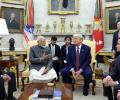
Prime Minister Narendra Modi and US President Donald Trump discussed the Middle East crisis, with a focus on the Strait of Hormuz.

An Indian worker was killed in an attack on a power and water desalination plant in Kuwait, according to Kuwait's Ministry of Electricity, Water and Renewable Energy.

Uncertainty surrounds the US-Iran talks as a two-week ceasefire approaches its end. Pakistan is attempting to mediate, but tensions remain high after a recent naval incident.

Economist Jeffrey Sachs saw Gulf nations' decision to partner with the US through the Abraham Accords as an "invitation for disaster" as it made them more dependent on American protection.

There are enough people at the top decision-making level in Tehran who are still willing to negotiate, provided Trump can create the right setting for the negotiation to acquire a dynamic of its own, points out Ambassador M K Bhadrakumar.

US President Donald Trump has announced plans to clear the Strait of Hormuz to secure the vital oil corridor, citing risks to global energy supplies and criticising other nations' inaction.

The Ministry of External Affairs (MEA) has stated that Prime Minister Narendra Modi and External Affairs Minister S Jaishankar are actively engaged with world leaders to promote dialogue and diplomacy for peace in West Asia, while also ensuring the safety and well-being of the Indian community in the region.

An Indian national sustained a minor injury in Abu Dhabi after debris from an intercepted ballistic missile fell in a residential area. Emergency teams responded to the incident, and authorities urged the public to rely on official sources for information.

On Saturday, it was reported that a drone strike had targeted the Fujairah Port in the UAE, triggering a fire.

For weeks, the war skirted the edge of catastrophe without tipping over. Missiles flew, there was much destruction, commanders were assassinated, cities across the Gulf and even in Israel struggled to absorb the shock. But one line held: Energy infrastructure, the arteries of the global economy, remained largely untouched. That is no longer true. Prem Panicker continues his must read daily blog on the Gulf War.

'In such a scenario, Iran could proclaim itself victor, rebuild, re-enforce its diminished regional proxies to further destabilise neighbouring nations and take control of the Persian Gulf and Strait of Hormuz.'

The Americans can occupy Bab el Mandeb, claim to have 'solved' the Strait of Hormuz crisis, declare victory that President Trump so desperately needs, points out Colonel Anil A Athale, former head of the history division, ministry of defence.

The escalating conflict in West Asia has resulted in 19 ships carrying essential energy resources for India being stranded in the Strait of Hormuz, raising concerns about potential disruptions to the country's energy supply.

External Affairs Minister S Jaishankar discussed the West Asia conflict's impact on the global economy, particularly energy security, with US Secretary of State Marco Rubio. He also engaged with GCC ambassadors and his Sri Lankan and German counterparts on the same issue.

China and Pakistan have jointly proposed a five-point peace plan to address the ongoing conflict in West Asia, focusing on de-escalation and safe passage through the Strait of Hormuz.

US President Donald Trump has shared an article suggesting that the option of enforcing a naval blockade was available in the context of Iran, as peace talks ended in a stalemate in Islamabad after differences of opinion arose between the two parties on the Strait of Hormuz and Iran's nuclear capacities.

Trump has made it clear: the US will not lift its blockade of Iranian ports until a deal is signed.

A projectile struck near Iran's Bushehr Nuclear Power Plant, resulting in one security personnel casualty and damage to an auxiliary building. The incident has raised concerns about nuclear safety and potential regional consequences, drawing criticism from Iranian officials and prompting calls for restraint from the IAEA.

The question is whether the clocks allow enough time for two deeply mistrustful sides to get there, and whether the surface calm holds long enough for the paddling to produce something before the ceasefire ends on April 22, notes Prem Panicker in his must read blog on the Iran War.
 © 2026 Rediff.com - Advertise with us - Disclaimer - Privacy Policy - Sitemap - Feedback - About us - Terms of use - Grievances