

For weeks, the war skirted the edge of catastrophe without tipping over.
Missiles flew, there was much destruction, commanders were assassinated, cities across the Gulf and even in Israel struggled to absorb the shock.
But one line held: Energy infrastructure, the arteries of the global economy, remained largely untouched.
That is no longer true.
Prem Panicker continues his must read daily blog on the Gulf War.

Croesus, king of Lydia, wanted to go to war with the Persians. He consulted the Oracle of Delphi. The oracle prophesied that if he launched a war, he would destroy a mighty empire. Croesus was overjoyed. He sent gifts to the Delphic priests, mustered his forces, and marched.
He destroyed a mighty empire. His own. [Read]
The oracle did not lie. It simply told Croesus what he needed to hear, and he walked into the trap.
Those who cluster around authoritarians, hoping that some of the perks of power will rub off on them, do this all the time: They shield the leader from bad news, and they tell him only what he wants to hear.
Shakespeare understood how this works. The witches told Macbeth that no man born of woman could harm him. What Macbeth heard was that he would be invincible. The prophecy was true, but not in the way Macbeth thought, and it destroyed him.
Patrick Wintour's reconstruction in The Guardian of how the Iran war began is this story retold for our times.
Key Points
- In a single day: Energy infrastructure is now fair game; the conflict has spread across sovereign borders in the Gulf; and economic warfare has moved to the centre of strategy.
- Donald Trump has never been accused of knowing history and learning lessons from it. But even he appears to have realised that Israel's latest attacks have crossed the thin red line.
- If the Gulf remains difficult and the Red Sea stays dangerous, India may have to rethink its entire connectivity strategy, potentially pivoting back east toward the Pacific.
On February 26, two days before the US and Israel launched their attack, Iran's negotiating team in Geneva showed Donald Trump's envoy Steve Witkoff a seven-page written offer for a nuclear deal.
British officials present, including Jonathan Powell, the UK's national security adviser, thought the offer was worth pursuing. Jared Kushner, Donald Trump's son-in-law, admitted that the deal, as presented, was better than Barack Obama's 2015 accord. Oman's foreign minister, who had been mediating, believed three more months would have clinched it.
Over a lunchtime break, Witkoff called Trump. He came back insisting on a ten-year enrichment moratorium. Iran had offered three to five. Oman's foreign minister dashed to Washington to explain how close the two sides were. The conversation, reportedly, turned to shoes.
Two days later, the war started.
Witkoff, who referred to the Strait of Hormuz as the 'Gulf of Hormuz' in a recent interview, and admitted his knowledge of Iran's nuclear programme was 'sketchy', rarely took notes across five rounds of talks. In February, he arrived at negotiations in Muscat with the US military commander in full naval uniform; the Omani foreign minister politely asked the admiral to leave.
One Gulf diplomat with direct knowledge of the talks described Witkoff and Kushner as 'Israeli assets that had conspired to force the US president into entering a war from which he is now desperate to get himself out.'
The oracle did not lie. It told Trump what he needed to hear: That Iran would fold quickly, that this would be a clean and quick win, that he would destroy a mighty empire. Eighteen days in, with the Strait of Hormuz partially closed, oil at $90 a barrel, Ali Larijani dead and with him any hope of a quick mediated settlement, with the Pentagon now asking for an additional $200 billion to prosecute the war (only three countries spend more than that on defence in a year) and with no discernible endgame in sight, we are learning in real time which empire is in the crosshairs, and it isn't Iran.
This is the fog of war that I have been banging on about ever since I started this blog: Not the fog of battle, but the manufactured fog of those who needed a war and made sure the president heard only what would give him one.
DIMLY, THROUGH THE FOG
For weeks, the war skirted the edge of catastrophe without tipping over. Missiles flew, there was much destruction, commanders were assassinated, cities across the Gulf and even in Israel struggled to absorb the shock. But one line held: Energy infrastructure, the arteries of the global economy, remained largely untouched.
That is no longer true.

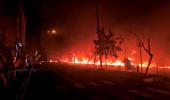
In the past 24 hours, Israel struck Iran's South Pars gas field, the largest natural gas reserve in the world and the backbone of Iran's domestic energy system. Fires were reported near Asaluyeh, and parts of production were knocked offline.
The strike represents a doctrinal shift from degrading military capability to constricting economic lifelines. [Associated Press; The Guardian]
Iran's response came quickly. Missiles and drones targeted energy infrastructure across the Gulf, in Qatar, the UAE, Saudi Arabia and elsewhere. Tehran warned that refineries and gas installations across the region were now legitimate targets, and issued evacuation advisories for key energy sites.
The war is no longer contained within two adversaries. It has expanded into a regional contest where third-country infrastructure is both target and leverage. [Reuters]
The most consequential single strike may have been on Ras Laffan, Qatar's liquefied natural gas hub. Missile strikes caused fires and extensive damage. A second wave followed, and Doha responded by expelling Iranian military officials and condemning the attack in unusually sharp terms. [Reuters] [Wall Street Journal, paywalled]
Qatar accounts for roughly a fifth of global LNG supply; even partial disruption reverberates immediately across Asia and Europe. Production has already been curtailed, with fears the outage could extend for weeks.
Oil has surged toward $110 a barrel. Gas prices in Europe have jumped. Financial markets are showing signs of strain. [The Guardian]
In sum, three lines have been crossed, three boundaries have collapsed, in a single day: Energy infrastructure is now fair game; the conflict has spread across sovereign borders in the Gulf; and economic warfare has moved to the centre of strategy.
The phrase circulating in policy circles is 'systemic risk'. This is no longer a war you can geographically contain or analytically silo. It runs through pipelines, shipping lanes, and price charts.
The war has crossed the energy Rubicon. And as history teaches us, once crossed, there is no going back.
Donald Trump has never been accused of knowing history and learning lessons from it. But even he appears to have realised that Israel's latest attacks have crossed the thin red line.
In a post on Truth Social, he says, 'The United States knew nothing about this particular attack, and the country of Qatar was in no way, shape, or form, involved with it, nor did it have any idea that it was going to happen.'
He also says, in typical all-caps style, that no more attacks will be made by Israel on South Pars, caveating this by adding that if Iran attacks Qatar, the US will blow up the entire South Pars Field. Make of that what you will.
And in passing, if Israel is still hoping to prompt Iranian citizens to revolt against the regime, the assassination of Ali Larijani appears to have had the opposite effect: via Reuters, ANI has a video of Larijani's funeral that is worth watching for the mood on the ground.
THE RIPPLE
The Ras Laffan strike is not a distant Gulf story for India. Qatar is India's single largest supplier of LNG. The fires at Ras Laffan directly impact Indian power generation, industrial supply chains, and the already-stressed domestic gas market where, as we reported yesterday, commercial LPG cylinders are trading at three times their normal price on the black market.

India's broader position grows more uncomfortable by the day. Nicolas Blarel, associate professor at Leiden University and author of the authoritative study of India's Israel policy, told Rohan Venkat in an interview that the Modi government is caught between its instinct for strategic balance and a series of decisions including the Tel Aviv visit two days before the war and the muted response to the torpedoing of the IRIS Dena, that have made that balance harder to maintain.
The Dena episode is particularly pointed: A US submarine torpedoed an Iranian naval vessel participating in India's own MILAN exercise, in waters India considers its strategic neighbourhood, with no prior coordination or warning to New Delhi. S Jaishankar, one of India's most articulate foreign policy communicators, had 'almost seemed to lack words' at the Raisina Dialogue, Blarel noted.
India's larger strategic architecture is also taking damage. IMEC -- the India-Middle East-Europe Corridor that was supposed to be the spine of India's westward connectivity -- has both its anchor points, Emirati ports and Haifa, under active threat.
The Chabahar route through Iran has moved further out of reach. If the Gulf remains difficult and the Red Sea stays dangerous, India may have to rethink its entire connectivity strategy, potentially pivoting back east toward the Pacific. [Rohan Venkat, Substack]

READING LIST
The most consequential article I've read so far this week, possibly even of the war so far, is Patrick Wintour's essay in The Guardian. A detailed reconstruction of how nuclear talks that were genuinely close to a deal collapsed through ignorance, impatience, and what one Gulf diplomat calls deliberate sabotage.
The detail about Witkoff calling the Strait of Hormuz the 'Gulf of Hormuz' would be funny if the consequences weren't catastrophic. [The Guardian]

Alongside the Wintour piece, also read this from Amwaj Media: The anatomy of the breakdown in Iran-US diplomacy. This deeply reported account reconstructs the final, fragile weeks of Iran-US diplomacy, and how it unraveled at the brink of a deal.
Drawing on regional political and security sources, it traces backchannel mediation through Oman and Qatar, surprising areas of convergence in Muscat and Geneva, and the mounting distrust driven by shifting US demands, thin technical preparation, and hardening red lines on enrichment.
With negotiators edging toward a framework that included verification, limited enrichment, and economic cooperation, the collapse, followed within days by assassinations and full-scale war, raises a stark question: Was this a failed negotiation, or a negotiation overtaken by a decision already made? [Amwaj Media]
In The Atlantic, Anne Applebaum is scathing on why allied leaders have stopped trying to find the hidden logic in Trump's actions. The key insight: They are not refusing to help out of cowardice -- they've simply concluded that any contribution they make will count for nothing.
A few days later, Trump won't even remember it happened. [The Atlantic]
Amr Hamzawy in Foreign Affairs makes the structural argument about what this war has done to the Gulf region. A decade of cautious Iran-Gulf rapprochement that included reopened embassies, restored communication channels, and the Saudi-Iran Yemen de-escalation, has collapsed in three weeks.
Hamzawy's counterintuitive point: Iran's strategy of hitting Gulf infrastructure may be deepening Gulf reliance on Washington rather than fracturing the anti-Iran coalition. [Foreign Affairs]
A February 2025 George Packer piece in The Atlantic is worth re-surfacing, as it provides essential backstory. Packer writes of the dismantling of American soft power and what replaces it: Raw coercion, a McKinley-era 'might makes right' mindset. Read alongside Wintour, it explains how you get from there to here. [The Atlantic]
Two book reviews in the Financial Times by Linda Colley -- one from July 2023, the other from earlier this week on Rana Dasgupta's After Nations -- on empire and its discontents reads differently now. In the 2023 piece, she summarises the argument John Rapley and Peter Heather make in their book Why Empires Fall: Empires erode their own authority through the very transformations they unleash. In the Dasgupta review, there is a line by Antonio Gramsci, which seems singularly apt today: 'The old is dying and the new cannot be born.'




 © 2026