
In West Bengal's political circles, it was widely believed that after Mamata Banerjee, Suvendu Adhikhari was perhaps the only leader with a truly significant mass base of his own.

The Trinamool Congress government's massive defeat in West Bengal shows "deep anti-incumbency and unpopularity" as out of 35 ministers who contested the assembly elections, 22 have been defeated, including Chief Minister Mamata Banerjee in her constituency.

The diplomatic intervention follows various media reports which attributed comments to Iranian lawmaker Alaeddin Boroujerdi, suggesting that merchant vessels were being charged USD 2 million for safe passage through the "conflict-hit Hormuz."
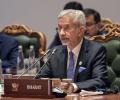
India has expressed serious concerns about the West Asia crisis and its potential impact on energy supplies and maritime stability, urging BRICS nations to find practical solutions to geopolitical challenges and unilateral sanctions.

Chinese President Xi Jinping warned US President Donald Trump that mishandling the Taiwan issue could trigger conflicts between the two countries during wide-ranging talks on trade, Iran, and energy security.
China has called on Iran to reopen the Strait of Hormuz and expressed appreciation for Tehran's commitment not to develop nuclear weapons, a key demand of the US to end the conflict.

Iran has submitted a fresh proposal to regional intermediaries offering to cease its military operations in the Strait of Hormuz, contingent upon a complete cessation of hostilities and the removal of the US blockade on Iranian maritime hubs.

US President Donald Trump has announced plans to clear the Strait of Hormuz to secure the vital oil corridor, citing risks to global energy supplies and criticising other nations' inaction.

The container ship SELEN, en route to Karachi, was denied passage by the Islamic Revolutionary Guard Corps (IRGC) Navy due to lack of permission and failure to coordinate with Iranian maritime authorities.

Iran has lodged a formal complaint with the United Nations, accusing the US of engaging in 'piracy' following the seizure of Iranian vessels. The complaint was detailed in a letter sent by Iran's UN envoy to the UN Secretary-General and the Security Council.

Islamabad's attempt to position itself as a mediator in the West Asia conflict has come to naught with the Iranian side refusing to meet any US-led delegation in Pakistan, reports the Wall Street Journal.

Iran has presented a multi-layered proposal to the US in an attempt to break the deadlock in peace talks, focusing on de-escalation and nuclear programme discussions.

Former US President Donald Trump has criticised Iran's stance on the Strait of Hormuz, calling it a form of 'extortion' amid ongoing negotiations for a peace deal. The remarks come as Iran considers imposing transit fees on vessels crossing the strategic waterway.

President Trump asserts the US military has decimated Iran's forces and no longer requires assistance from NATO allies to secure the Strait of Hormuz, despite earlier requests for support.
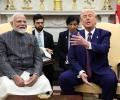
Prime Minister Narendra Modi and US President Donald Trump discussed the West Asia crisis and the importance of keeping the Strait of Hormuz open and secure. They also reviewed progress in bilateral ties and anticipated upcoming deals in the energy sector.

US President Donald Trump is inclined to reject Iran's latest diplomatic proposal, which suggests restoring maritime traffic through the Strait of Hormuz while deferring nuclear programme concerns, according to CNN. Concerns remain over Iran's nuclear enrichment and internal government fractures.

Iran has reimposed restrictions on the Strait of Hormuz, with its forces opening fire on a passing tanker and forcing at least two Indian vessels to reverse course, escalating tensions in the region and raising concerns over energy supplies.

Ali Mousavi stated that such cooperation is essential for maintaining stability in the strategic waterway.

US President Donald Trump said on Wednesday that Washington is considering a "joint venture" with Iran to secure the Strait of Hormuz, following his announcement of a two-week ceasefire.

Despite a ceasefire agreement between Iran and the United States, the Strait of Hormuz remains blocked due to Iran's inability to locate and remove all the mines it laid during the conflict, hindering global oil and gas supplies.

Iran has reportedly allowed select "friendly nations" including India and Pakistan limited access to the Strait of Hormuz amid ongoing conflict, easing some energy supply concerns. Here's what the move means for global trade and oil routes.

Amid ongoing tensions with the US, Iran's IRGC Navy has issued new directives restricting maritime movement through the Strait of Hormuz, allowing only civilian vessels on Iranian-designated routes and barring all military ships.

Global energy markets saw a significant correction as oil prices nosedived following Iran's announcement that the Strait of Hormuz has been fully reopened, dismantling the 'war-risk' premium that had gripped the market.

According to the report, the Pentagon is deploying the USS Tripoli ARG, along with the 31st Marine Expeditionary Unit (MEU), part of its own strike group.

The fragile ceasefire in West Asia between the US and Iran to halt the hostilities in the region for two weeks faces renewed uncertainty as Tehran reportedly moved to block the strategic Strait of Hormuz once again due to Israel's intensified offensive against Hezbollah in Lebanon, according to Iranian state media Islamic Republic News Agency (IRNA), which US President Trump says was "not included" as part of the ceasefire deal.
Chinese Foreign Minister Wang Yi has urged Iran to guarantee freedom and safe passage through the Strait of Hormuz, a critical waterway for global oil trade, amid ongoing tensions with the US.

Delhi should keep all its options open in what is essentially a transitional period in the geopolitics of energy rather than remain a gatekeeper serving Trump's 'America First', suggests Ambasssador M K Bhadrakumar.

A convoy of India-bound ships carrying crude oil and gas was stopped by the Iranian Revolutionary Guard Corps (IRGC) in the Strait of Hormuz, leading to several vessels returning to the Persian Gulf.

India is in communication with Iranian officials to ensure the safety and secure passage of its ships through the Strait of Hormuz, following recent firing incidents involving Indian vessels.

Far from it; the country's resistance to the US, its nuclear ambitions, and its pursuit of influence and proxies across the Middle East are driven by a constant search for independence and security. Thus, Iran will never capitulate. Trump will learn this home truth ultimately, and it is going to be a humbling personal experience that may even destroy his presidency, predicts Ambassador M K Bhadrakumar.
The UK Maritime Trade Operations issued a warning noting that the incident took place approximately 15 nautical miles north of Sharjah.

Conflicting reports emerge regarding the effectiveness of the US blockade on Iranian ports, with Iran claiming successful transit of vessels and the US asserting complete maritime dominance.

Former Central Command chief David H Petraeus suggests the US and Iran are likely to extend their ceasefire beyond the initial two-week period, citing willingness from both sides to continue negotiations.

The big question is whether Trump is any longer in command of the situation. For all practical purposes, the war seems set to cascade as the US is preparing for a potential ground operation in Iran and threatens to destroy 'bridges next, then electric power plants', points out Ambassador M K Bhadrakumar.
There are roughly 2,000 ships stranded in the Persian Gulf, carrying more than 20,000 seafarers, according to the International Maritime Organisation, as quoted by The Wall Street Journal.
A spokesperson for the Central Khatam al-Anbiya Headquarters said that Iran's armed forces are prepared to intensify their response if aggression continues.

In a sharp escalation of regional tensions, US President Donald Trump issued a fresh warning to Tehran on Monday, asserting that the American military is prepared to sink any Iranian vessels that approach the newly established naval blockade in the Strait of Hormuz.

The United States Central Command (CENTCOM) has confirmed the implementation of a naval blockade on Iranian ports, enforcing strict measures on vessels entering or departing, significantly escalating tensions between the two nations.

Donald Trump has extended the deadline for Iran to reopen the Strait of Hormuz, amid escalating tensions between the two countries. Trump issued a harsh warning to Tehran, threatening to target Iran's energy and civil infrastructure if the Strait is not opened.

An oil tanker carrying Saudi crude safely reached Mumbai after crossing the war-hit Strait of Hormuz with its tracking system briefly switched off.
