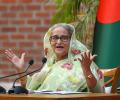
Former Bangladesh Prime Minister Sheikh Hasina has declared her intention to return to Bangladesh in December, despite facing a death sentence and the risk of arrest. Speaking from India, she stated her goal is to restore democracy and justice, criticising the current state of affairs in Bangladesh and alleging that her government's collapse was due to organised violence. Her son also claimed Bangladesh is a "failed state" and a concern for India.
India has distanced itself from former Bangladesh prime minister Sheikh Hasina's recent media interaction in New Delhi, stating it played no role in the event nor endorsed her comments regarding the Bangladesh government. This comes after Bangladesh expressed outrage over the permitted interaction, which saw Hasina announce her determination to return to Bangladesh to restore democracy.

Shouting slogans against President Pervez Musharraf, dozens of volunteers of the Pakistan Muslim League in the US has asked the UN to pressurise the "military dictator" to step aside and restore democracy in the country.
Brussels-based International Crisis Group cited the rigged local election and said there was little faith that Musharraf will restore democracy and that failure to do so will only provide political space to jihadi outfits.
"After one year of unsuccessful authoritarian rule, this is the best way to address the Maoist insurgency and to build a brighter future of Nepal's people," the statement said.

The Indian government has summoned Meta's global head of public policy after Prime Minister Narendra Modi's Facebook post, addressing youth and promising action against paper leaks, was temporarily removed. Meta attributed the removal to a 'glitch' in its automated content filters, an explanation the government deems insufficient, demanding further discussions.

A parliamentary standing committee on Information Technology has demanded a personal apology from Meta CEO Mark Zuckerberg for the temporary removal of Prime Minister Narendra Modi's video from Facebook. The committee also discussed potential legal action and the withdrawal of safe harbour protection, while questioning Meta officials on algorithmic bias and accountability.

Municipal workers have repainted the graffiti-covered walls around Jantar Mantar, erasing the visual remnants of a student-led protest that led to the resignation of Union Education Minister Dharmendra Pradhan. The protest saw walls adorned with slogans, sketches, and messages reflecting youth anger, which have now been removed by the New Delhi Municipal Council.

Dharmendra Pradhan's resignation is significant because it punctures, however slightly, the perception that the Modi government never retreats under pressure. Every long-serving government eventually reaches a point where every institutional failure is identified with the leader himself. Removing the minister may have prevented that political burden from falling directly on Modi. Whether it also resolves the underlying crisis is another matter, notes Ramesh Menon.

Former BJP leader K Annamalai has criticised the Centre for its handling of the NEET issue, alleging a lack of accountability despite three question paper leaks and questioning the delay in engaging with student protesters.

For India, the guiding principle should remain clear: Engage Bangladesh as a sovereign nation and society rather than through the prism of any individual leader or political party, suggests Manoj Mohanka.

The government on Tuesday summoned a top Meta executive after Prime Minister Narendra Modi's recent post addressing India's youth and promising stringent measures against paper leaks was briefly restricted by Facebook, and although the US-headquartered social media giant blamed it on a technical glitch and apologised, the IT Ministry found the explanation "inadequate".

The BJP's West Bengal unit chief, Samik Bhattacharya, has criticised the Trinamool Congress (TMC) government, accusing it of crushing democracy and creating a lawless environment in the state. He highlighted political violence, rising debt, and a lack of investor confidence as key issues under the TMC's rule.
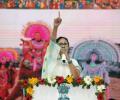
The BJP's West Bengal unit chief, Samik Bhattacharya, criticised the Trinamool Congress (TMC) government, accusing it of crushing democracy and fostering lawlessness in the state. He highlighted alleged political violence, economic decline, and disrespect for constitutional posts under the TMC's rule.

West Bengal Chief Minister Mamata Banerjee has accused the BJP of disrupting a TMC protest march concerning the Baruipur rape and murder case, alleging that the police acted as an 'arm' of the saffron party by failing to enforce a Calcutta High Court order permitting the rally.

A caste recalibration is simmering just below the surface in UP.

Tamil Nadu Governor RV Arlekar announced that the TVK regime, led by Chief Minister C Joseph Vijay, will take steps to ensure fair financial devolution from the Centre, including pursuing the matter in the Supreme Court. The government also plans to conduct a 'Social Justice Survey' and address the state's severe financial deterioration.

By asking Vijay to produce letters of majority support before inviting him to form the government, the governor risks overstepping established Constitutional principles, notes Harishchandra.
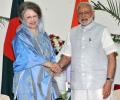
Prime Minister Narendra Modi expressed sadness over the death of former Bangladesh PM Khaleda Zia, acknowledging her contributions to Bangladesh's development and India-Bangladesh relations.

If one has to compare the tenures of the two prime ministers one must credit Nehru with laying the foundations on which Modi is building a grand edifice, asserts Colonel Anil A Athale (retd).

Expressing concern over recent course of events in Egypt that saw ouster of Mohammed Morsi, the United States has asked the country's military to hand over powers to a democratically elected government as soon as possible.

'This daylight robbery of elections is happening in the commercial capital of India, Mumbai city, so you can imagine what they will do to win elections in the interiors of India.'
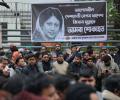
Former Indian envoys reflect on the life and legacy of Bangladesh's former Prime Minister Khaleda Zia, highlighting her role in restoring democracy and the complex relationship between India and Bangladesh during her tenures.

In a state known for high political literacy and ideological mobilisation, the Congress' inability to quickly settle on a leader after securing a massive mandate has fed a narrative that the party remains excessively dependent on Delhi, deeply faction-ridden and vulnerable to internal sabotage
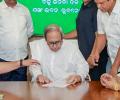
BJD chief Naveen Patnaik has called for Odisha Chief Minister Mohan Charan Majhi's intervention to restore law and order after an attack on the residence of senior BJD leader Pratap Jena. The incident has sparked a political row, with allegations of internal conflict within the BJD.

Sensitive issues remain. Water sharing of the Ganga and Teesta rivers. Treatment of minorities, particularly Hindus. Border management. Trade imbalances. Connectivity projects.What happens next will shape not just bilateral ties, but the balance of South Asia itself, points out Ramesh Menon.

After being wrongly deported and labelled as Bangladeshis, migrant workers in West Bengal's Murshidabad are heading to the polls to reclaim their Indian identity and fight for their right to belong.

Khaleda Zia, the former Prime Minister of Bangladesh and a dominant figure in the country's politics, has died at the age of 80 after a prolonged illness. Her career spanned decades and included periods of both power and controversy.

'Never before has the Congress been part of a rainbow coalition, and the response from the people has been overwhelming.' 'Assam's diversity cannot be represented by a single voice -- it requires a collective effort, and that is what we are building.'
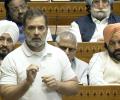
The suspension of eight opposition MPs from the Lok Sabha is likely to be revoked, following a decision made at a meeting convened by Speaker Om Birla. The MPs were suspended in February for unruly behaviour during the Budget session.

'Our government is committed to addressing it firmly while protecting the rights of genuine citizens.'

Prime Minister Narendra Modi has accused the TMC government in West Bengal of 'maha jungleraj' following an incident in Malda where judicial officers were allegedly held hostage. He framed the upcoming elections as a battle between the TMC's 'fear' and the BJP's 'trust', promising accountability for alleged atrocities and a focus on development.
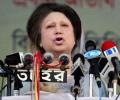
Khaleda Zia, Bangladesh's former first female prime minister and chairperson of the Bangladesh Nationalist Party, has died at the age of 80 after a prolonged illness.

Opposition MPs, led by Congress MP Mohammad Jawed, have written to Home Minister Amit Shah expressing concerns over alleged threats to Muslims in Uttam Nagar, urging him to direct the Delhi Police to take decisive action against those spreading hate and creating an atmosphere of fear.

Tarique Rahman is Bangladesh's first male prime minister in more than three decades, ending an era of female leadership that began in 1991.

Trinamool Congress leader Abhishek Banerjee has warned of a significant increase in cooking gas and fuel prices by the BJP-led central government following the West Bengal assembly elections. He accused the BJP of neglecting the fuel crisis and challenged them to pledge no price hikes for the next five years.
Trinamool Congress leader Abhishek Banerjee alleges the BJP-led government may increase fuel prices after the West Bengal assembly elections, accusing them of neglecting the common man and withholding funds from the state.

Activist Sonam Wangchuk, recently released from detention, calls for constructive dialogue between the government and the people of Ladakh, viewing his release as a positive step towards building trust.
