
Prime Minister Narendra Modi and US President Donald Trump held a telephone conversation to review progress in bilateral ties, covering trade, defence, and energy, against the backdrop of heightened trade friction due to the 'Lindsey O. Graham Sanctioning Russia and Iran Act of 2026'.

Prime Minister Narendra Modi and US President Donald Trump exchanged pleasantries and held a brief conversation at the G7 summit, their first in-person encounter in 16 months, setting the stage for high-stakes bilateral talks amidst continuing strain in India-US relations.

Indian government sources revealed that a 'cautious approach' was adopted during Prime Minister Narendra Modi's June talks with then-US President Donald Trump due to concerns over Trump's 'unpredictable behaviour' with foreign leaders, leading to a preference against a joint media interaction.

Prime Minister Narendra Modi and US President Donald Trump are set to hold comprehensive talks focusing on a bilateral trade deal, defence cooperation, and energy and critical minerals sectors during the G7 summit in Evian-les-Bains, France.

'The flip side of this is that he won't hesitate to call out India if he thinks its policies are hurting US economic interests or border US foreign policy goals.'

The US President had hosted Modi for an official working visit in Washington, DC, on February 13 last year.

The finance minister said that consolidation of state-owned banks could proceed at any time without waiting for the recommendations of the proposed high-level committee on banking.

Prime Minister Narendra Modi urged US President Donald Trump to prioritise the safety of Indian seafarers in the Strait of Hormuz during the implementation of Washington's proposed Iran peace deal, as both leaders focused on repairing strained bilateral relations at the G7 summit.

White House Press Secretary Karoline Leavitt said that Trump feels "very positive and strongly" about the future of India-US relationship.

Elon Musk reportedly participated in a phone call between US President Donald Trump and Indian Prime Minister Narendra Modi to discuss the Iran crisis, raising questions about his involvement in diplomatic discussions.
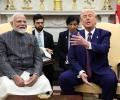
Prime Minister Narendra Modi and US President Donald Trump discussed the West Asia crisis and the importance of keeping the Strait of Hormuz open and secure. They also reviewed progress in bilateral ties and anticipated upcoming deals in the energy sector.
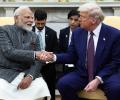
No one should make China an issue in their bilateral relations and their cooperation should not harm the interests of another country, the Chinese Foreign Ministry said on Friday reacting to queries on the meeting between Prime Minister Narendra Modi and United States President Trump.
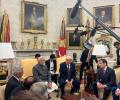
'Trump is not shy when he is frustrated with countries'
Prime Minister Narendra Modi on Saturday 'deeply' appreciated United States President Donald Trump's 'positive assessment' of the India-US partnership after the American leader hailed the 'special' relationship between the two nations -- remarks seen as an attempt to check the downturn in the ties.
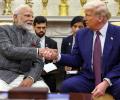
Amid trade tensions between Delhi and Washington, the NYT article gives an account of how relations between Trump and Modi "unraveled" after Trump's repeated claims of solving the four-day conflict in May between India and Pakistan, an assertion denied by India.

The turning point came with the appointment of Sergio Gor as the US ambassador to India.

Modi also said that President Trump's leadership is vital for global peace, stability, and prosperity.
Ties between India and Bangladesh came under severe strain after deposed prime minister Sheikh Hasina was forced to leave the country in the face of a massive anti-government protest in August 2024.

India and the US have agreed to a trade deal that will see Washington reduce reciprocal tariffs on Indian goods from 25% to 18%, according to US President Donald Trump. The deal also includes commitments from India to reduce tariffs and non-tariff barriers against the US and to increase purchases of American products.

United States Senator Lindsey Graham on Sunday claimed that Indian Ambassador to the US Vinay Mohan Kwatra spoke to him last month about India buying less Russian oil and asked him to tell President Donald Trump to relieve the 25 per cent tariff.

United States President Donald Trump on Tuesday boasted about India-US defence cooperation, claiming that India's order for 68 Apache attack helicopters was delayed by five years and that Prime Minister Narendra Modi personally raised concerns over the long delivery period during a meeting with him.
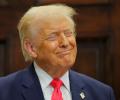
The Congress party has criticized Prime Minister Narendra Modi following repeated claims by former US President Donald Trump that he brokered peace between India and Pakistan.
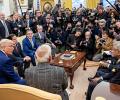
During the talks, India and the US decided to take a big leap in broad-basing their strategic ties in several critical areas.
Who accompanied Prime Minister Narendra D Modi to his Thursday meeting with US President Donald J Trump in the Oval Office, and who did POTUS bring along?

"It is still not too late. India must speak clearly, act responsibly, and use every diplomatic channel available to defuse tensions and promote a return to dialogue in West Asia," Gandhi asserted.
'Trump administration wanted a positive tone at this summit, but there was still some anxiety that there could be some awkward moments -- and there were not.'
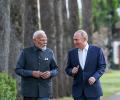
Speaking at a joint press conference with Belarus President Alexander Lukashenko on Thursday, Putin said that Russia agrees with the proposals to cease hostilities but "proceeds from the assumption that this cessation should lead to long-term peace and eliminate the root causes of the crisis."

United States President Donald Trump yet again claimed to have discussed with Prime Minister Narendra Modi about India's import of Russian oil, he told reporters on Tuesday after the Diwali celebrations at the Oval Office.
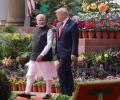
Prime Minister Narendra Modi will visit the US for a two-day working visit starting Wednesday. He will meet with President Donald Trump and engage in bilateral discussions on trade, investment, technology, defense cooperation, counterterrorism, Indo-Pacific security, and people-to-people relations. The visit is expected to further strengthen the India-US partnership.

Anticipating US action on tariffs, India seems to have made the first move by revamping its tariff structure by reducing the slabs to eight rates, points out Mukesh Butani.

Posing a series of questions to the prime minister, Congress general secretary in-charge communications Jairam Ramesh also asked if Modi would convey to the US president that India would send its own aircraft -- like Venezuela and Colombia did -- to bring back Indian deportees in the future.
'Personalities are temporary, policies provide for stability.' 'With the former, when personalities change so does the nature of the relationship.' 'Policies and structures, on the other hand, are idiot-proof, as well as maverick-resistant,' explains Saisuresh Sivaswamy.
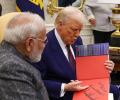
A Press Information Bureau photographer captures glimpses of the Modi-Trump meeting.

India-US relations, like Rome, were not built in a day, nor can they be demolished in a day.
All said and done, when the new global order emerges, India can only remain with the democracies, asserts Ambassador T P Sreenivasan.

Former US President Obama was featured wearing a number of ensembles some gladiator-inspired and a basketball one among others.

As Donald Trump registered a historic comeback in the US presidential election, many former Indian diplomats on Wednesday concurred that the India-US ties will "continue to grow" from strength to strength, even as some of them cautioned that Trump is "highly unpredictable" and New Delhi will have to "wait and watch" to see what position he adopts going forward.
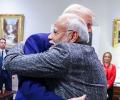
United States President Donald Trump welcomed Prime Minister Narendra Modi at the West Wing lobby in the White House in Washington, DC on Thursday.
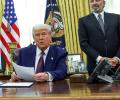
An hour before his bilateral meeting with Prime Minister Narendra Modi, Trump again commented on India's tariff structure, saying 'they have the highest tariffs' and 'it is a hard place to do business'.
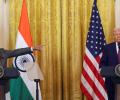
Prime Minister Narendra Modi spoke with President Donald Trump and set the record straight that India had paused strikes on Pakistan during Operation Sindoor following a request from Islamabad and not due to mediation or offer of a trade deal by the United States.

According to Misri's statement, Modi said he could not accept the invitation due to a pre-existing schedule, and invited Trump to visit India for the Quad Summit, likely later this year.
