
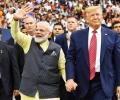
Trump and Modi enjoy a good friendly relationship. The two addressed thousands of people at two different rallies in Houston in September 2019 and in Ahmedabad in February 2020.
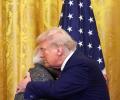
The talks between Prime Minister Narendra Modi and Donald Trump in Washington were marked by the US president's generous praise of the Indian leader and his consideration of India's stance on several issues, officials said on Friday.
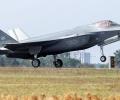
We need to equip the Indian Armed Forces, not 'commercial' as Trump wants, but 'operationally' looking at growing Chinese military capabilities, asserts Lieutenant General Prakash Katoch (retd).
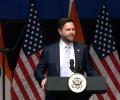
US Vice President JD Vance called on India to drop non-tariff barriers, give greater access to its markets and buy more American energy products and military hardware. Vance, in a speech in Jaipur, highlighted the need for a stronger US-India partnership for a prosperous and peaceful 21st century. He emphasized the importance of working together to address global challenges and praised Prime Minister Narendra Modi, describing him as a "special person." Vance also urged India to provide greater market access to American products and buy more defense platforms and energy from the US. He suggested that India consider dropping some of the non-tariff barriers for American access to the Indian market and highlighted the benefits of closer India-US defense collaboration, advocating for New Delhi to procure more military hardware from the US. He cited the example of American fifth-generation F-35s, arguing they would give the Indian Air Force the ability to defend its airspace and protect its people like never before. Vance also welcomed the Modi government's budget announcement to amend India's civil nuclear liability laws, paving the way for US producers to export small modular reactors and build larger US-designed reactors in India. He emphasized the importance of energy security for India's AI ambitions, stating "there is no AI future without energy security and energy dominance." Vance's visit comes amid growing global concerns over the US's tariff war.

World leaders, including US President Donald Trump, Russian President Vladimir Putin and Israeli Prime Minister Benjamin Netanyahu, condemned the terror attack in Jammu and Kashmir that killed 26 people, expressing solidarity with India. The attack was claimed by The Resistance Front (TRF), a proxy of the Pakistan-based Lashkar-e-Taiba (LeT) terrorist group. The attack came during US Vice President J D Vance's maiden visit to India. Prime Minister Modi, who had arrived in Saudi Arabia on a two-day visit earlier in the day, cut short his visit and departed for New Delhi on Tuesday night following the attack.
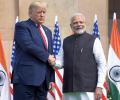
Lavishing high praise on Modi, Trump described him "great", "a friend", "nicest human being" and a leader who is tough in dealing with India's adversaries when required.

Prime Minister Narendra Modi concluded his visit to the United States after holding high-level bilateral talks with President Donald Trump on a wide range of subjects, including trade and technology, defence and security, energy and people-to-people ties. The two leaders decided to take a significant step in deepening their strategic ties, particularly in the areas of defence, energy, and critical technology. Modi also met with key American officials, including National Security Advisor Michael Waltz and Director of National Intelligence Tulsi Gabbard, and prominent business leaders like SpaceX CEO Elon Musk and Indian-American entrepreneur Vivek Ramaswamy.
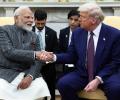
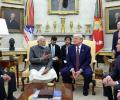
Prime Minister Narendra Modi met United States President Donald Trump at the White House in Washington, DC on Thursday.
Trump made these remarks after Elon Musk-led DOGE's (Department of Government Efficiency) disclosed that USAID contributed USD 21 million to Election Commission for boosting voter turnout.

'A less tense US-China relationship would make Beijing less likely to provoke India -- including on the border -- in retaliation for its close defence ties with the US.'
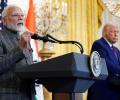
Prime Minister Narendra Modi said on Thursday that India and the United States have set a $500 billion target for bilateral trade by 2030 and added that the teams of two nations will work together to finalise a mutually beneficial trade agreement.
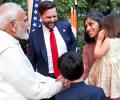
Prime Minister Narendra Modi and US Vice President JD Vance have expressed satisfaction with the progress made in negotiations for a bilateral trade agreement. The two leaders met in New Delhi and discussed a range of bilateral issues, including cooperation in energy, defense, strategic technologies, and other areas. They also exchanged views on regional and global issues of mutual interest.

'Trump is good news for us. Energy poverty is real, and fossil fuels are the answer.'
'He needs to see results while he is in office.'
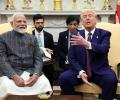
US President Donald Trump and Indian Prime Minister Narendra Modi met in Washington D.C. to discuss a range of issues including trade, defense, and energy. The two leaders announced plans to finalize "wonderful trade deals" for both countries, and Trump emphasized the need for India to purchase US oil and gas. Modi congratulated Trump on his second term and highlighted the importance of working together to further strengthen the India-US relationship. The meeting also addressed the ongoing conflict in Ukraine, with Modi reiterating India's commitment to peace.
Of Trump's reciprocal tariffs and trade deals
After being sworn in as the 47th president of the United States, Trump started his inaugural address with a sentence that echoed Modi's coinage some years ago, notes Modi biographer Nilanjan Mukhopadhyay.
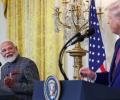
'By his words, actions, and body language during their joint press appearance wanted to convey his personal respect and, more broadly, his desire to work closely with India.'
From bhikshus of Ashokan 3rd century BC and medieval Sufis to Oxfam, Omidyar and Soros now, non-State actors have any real power only when they work in conjunction with a real State, asserts Shekhar Gupta.

'By the time he came out after nearly five hours, he had a one-to-one conversation with the President, a delegation-level meeting, a reception, a dinner, a tour of the White House and a joint statement of a kind none of his predecessors ever had,' says Ambassador T P Sreenivasan.
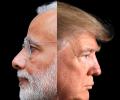
Here's why Rajeev Srinivasan believes there will be nothing particularly positive about the prime minister's US visit.
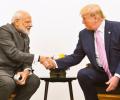
Trump congratulated Modi on his election victory and said that the two countries would work together in many areas including military.

While the Trump administration wants India to lower the trade barriers and embrace "fair and reciprocal" trade, India has raised tariffs on 28 items exported from the US in retaliation to America's withdrawal of preferential access for Indian products.
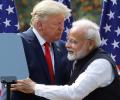
'Trump will absolutely back New Delhi on its position that Pakistan must do more to crack down on terrorists that threaten India.'
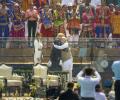
'While high-level interventions may help smoothen inter-State relationships, they cannot fundamentally change the alchemy of such relationships, which are firmly rooted in mutual benefits and mutual interests,' points out Ambassador M K Bhadrakumar.
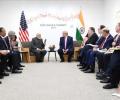
'The change of vocabulary in the India-US conversation was significant and refreshing.' 'It matched the styles of Trump and Modi.' 'The differences were not papered over, but there was determination to resolve them in the days ahead,' says Ambassador T P Sreenivasan.
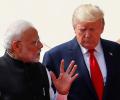
Delhi's appeasement strategy may now translate as more mega arms deals with the US, generating substantial business and job creation in the American economy. Make no mistake, Americans will use it to pressure India, predicts Ambassador M K Bhadrakumar.

Announcing the visit from June 25, the external affairs ministry on Monday said the Modi-Trump discussions will provide a new direction for deeper bilateral engagement.
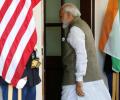
We see none of the euphoric build-up customary to India's encounter with US presidents in recent times. This gives Modi wriggle room to work on the much-needed reset of India-US ties.
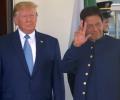
Trump spoke by telephone with Khan to discuss "the need to reduce tensions and moderate rhetoric with India over the situation in Jammu and Kashmir," the White House said in a readout of the call.

'... For the India-US relationship to continue its positive trajectory, it will require India to adapt to a different approach.' Nisha Desai Biswal -- who as the Obama administration's point person for South Asia was in the inner circle of all the Obama-Modi Summits -- tells Rediff.com's Monali Sarkar why she is hopeful that India and the US are on an irreversible forward course.
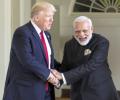
In the conversation, President Trump extended an invitation to Modi to attend the next G-7 summit to be held in the US, the Ministry of External Affairs said. On Saturday, Trump pitched for expansion of the G7 comprising the world's most advanced economies by including India and three other countries.

'We're going to see a defence relationship that really takes off -- now that India is a major defence partner of the US, the sky is the limit for arms sales.' 'The economic partnership will lag behind the security relationship, but the meeting and joint statement give cause to believe that it will progress more robustly than many of us would have expected.'
At no other time has a single meeting of the leaders of two democracies been so critical and hazardous.

Watch all the action from the national capital.
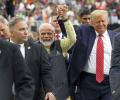
From "special person" to "close friend to "master of the art of the deal", were just some of the high praise that Prime Minister Narendra Modi and United States President Donald Trump lavished on each other during the Howdy Modi event in Houston, Texas. That the two heads of state share good relations was known to all and the event at the NRG stadium was a perfect opportunity for both to reacquaint the world with their love for one another. Take a look.
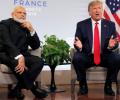
Modi said India and Pakistan were together before 1947 and he was confident that the two neighbours can discuss their problems and solve them.

The PM is well known for his vigorous hugs and handshakes with world leaders.

'He's a friend of his people because he was greeted incredibly warmly as was I in that stadium. That was an incredible event'

"The issue of CAA did not come up. However, with regard to religious freedom, there is an appreciation on both sides that pluralism and diversity are common binding factors in both the countries. US President Donald Trump yesterday in Ahmedabad said about the religious diversity and how it is evident in India," Shringla said during a press conference after India-US talks.
