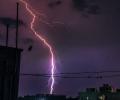
Two young men were killed by a lightning strike while travelling to a temple near Mahakala village in Jalna district, Maharashtra. Another person was injured in the incident. The tragedy occurred during unseasonal rains in the region.

Researchers at IIT Bombay have discovered that heatwaves in the Indo-Gangetic Plains are primarily caused by local land and weather conditions, rather than hot air originating from elsewhere, emphasising the need for location-specific early warning systems.

India is likely to witness a mixed temperature pattern along with wetter-than-usual conditions in May, with the India Meteorological Department (IMD) indicating that rainfall across the country is "most likely to be above normal" at over 110 per cent of the long period average (LPA).

High levels of ultraviolet (UV) radiation have been recorded across Kerala, prompting warnings from the Kerala State Disaster Management Authority (KSDMA). Residents are advised to take precautions to avoid prolonged exposure, especially during peak hours.
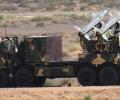
India's defence sector is on the cusp of a 'super cycle' of growth, driven by escalating geopolitical conflicts and a strong policy push towards indigenous manufacturing, with major players like BEL, HAL, and BDL poised for significant order inflows and technological advancements.

Unseasonal rainfall could damage standing wheat crops, especially late-sown fields nearing maturity and grain-filling stages.

'We should expect extreme heat, extreme rains, floods, landslides and maybe cyclones. Not just this year, in the coming year as well.'

JPMorgan has downgraded Indian equities to 'neutral' from 'overweight', citing elevated valuations, rising earnings risks, and limited exposure to next-generation technology like AI. The brokerage believes other emerging markets offer more attractive risk/reward propositions despite India's strong structural growth story.

Sri Lanka's Department of Meteorology issued a special bulletin on Friday morning, warning the public about possibility of rain in Colombo on Sunday.

Schools in Delhi are taking precautionary measures to protect students from the ongoing heatwave, including suspending outdoor activities, shifting assemblies indoors, and considering early closure for junior classes.
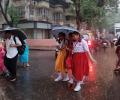
At least 19 people have died in Karachi, Pakistan, due to severe rainstorms, thunderstorms, and strong winds, causing building collapses and electrocution.
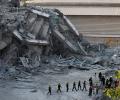
A 5.1 magnitude earthquake struck Sindh province in Pakistan, causing widespread panic but no reported casualties or major damage.

A tragic cruise boat accident at Bargi Dam in Jabalpur, Madhya Pradesh, has claimed nine lives after a sudden storm caused the vessel to capsize, prompting extensive rescue efforts.

Several states in north India, including Rajasthan and Himachal Pradesh, experienced varied weather conditions, including light to moderate rainfall, fog, and temperature fluctuations.

A poor monsoon could drag overall economic growth and compound the impact of the West Asia conflict on the Indian economy.

Following a fatal Learjet crash, the AAIB is urging the DGCA to implement stricter standard operating procedures for Visual Flight Rules (VFR) flights at uncontrolled airfields to improve aviation safety in India.

'During the hot season (April to June), above-normal minimum temperatures are likely over most parts of the country, except in some regions of Maharashtra and Telangana, where minimum temperatures are expected to be normal to below normal,' IMD said.

Delhi experienced a foggy morning with a dip in temperature and improved air quality following recent rainfall. The air quality index (AQI) reached 'satisfactory' levels for the first time in five months.

'Monsoon is the pran (life) of our water system.' 'A weak monsoon will have a very negative impact on crops and people's lives.'

Earthquake tremors were felt in Kolkata and adjacent districts of West Bengal after a 5.5 magnitude earthquake jolted parts of Bangladesh. People rushed out of buildings in panic, but there were no immediate reports of damage or casualties.
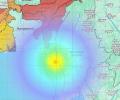
An earthquake of magnitude 6 with its epicenter in Myanmar jolted Kolkata and its adjoining areas, causing tremors and concern among residents.

A new western disturbance brought thunderstorms and rain to parts of northern India, with hailstorms and snow reported in several regions. The weather caused flooding in Jammu and Kashmir and prompted a yellow alert in Delhi.

A severe cold wave has gripped North India, with temperatures plummeting to near-freezing levels in several areas. The cold wave has disrupted daily life, with dense fog affecting visibility and forcing people to stay indoors.

Although extensive air attacks have been carried out to destroy most of Iran's defence capabilities, the latter's resilience and sustenance during the war clearly indicate that the US landing force would encounter severe resistance in the operation, explains Commodore Venugopal Vengalil (retd).
Even as the benchmark and broader indices were down sharply on Monday due to escalating tensions in West Asia, the Nifty Defence index ended the session in the green.

The national capital was in the grip of a cold wave, with the sun largely obscured by clouds and pollutants lingering in the atmosphere, leading to reduced visibility. At least 129 flights were cancelled at the Delhi airport on Saturday due to dense fog, according to an official.

A thick layer of toxic smog enveloped the national capital on Saturday as air quality deteriorated sharply, prompting the Commission for Air Quality Management (CAQM) to invoke the strictest curbs under Stage IV of the Graded Response Action Plan (GRAP) across Delhi-NCR.

Delhi recorded its coldest January morning in three years with the minimum temperature dropping to 3 degrees Celsius. Cold wave conditions are expected to persist, and air quality has deteriorated to the 'very poor' category.

Early morning rain in Delhi lowers temperatures. The weather office predicts cloudy conditions and thunderstorms for the day due to a western disturbance.

Fresh snowfall in Kashmir, including Srinagar, leads to flight cancellations and highway closures, disrupting normal life.

The India Meteorological Department (IMD) reports that ash clouds from volcanic activity in Ethiopia, which impacted flight operations in India, are drifting towards China and will move away from India by 7.30 pm on Tuesday.

A specialized team from the Aircraft Accident Investigation Bureau (AAIB) has arrived at the Baramati crash site to investigate the accident that killed Maharashtra Deputy Chief Minister Ajit Pawar and four others. The investigation will focus on the technical factors that led to the crash of the Learjet 45 aircraft during its second landing attempt.

"The aircraft was cleared to land on runway 11 at 0843 IST (8.43 am). However, they did not give a readback of the landing clearance (did not respond to ATC). Next, the ATC saw the flames around the threshold of runway 11 at 0844 IST (8.44 am)," the civil aviation ministry statement said.

Delhi's air quality deteriorated to the 'severe' category, prompting the implementation of Stage-IV GRAP measures and hybrid classes for schools.

India and Pakistan clash in a highly anticipated T20 World Cup match. India needs middle-order stability and a fit Abhishek Sharma, while Pakistan's spin attack poses a threat. The weather forecast predicts a high chance of rain.

Bencic and Paul coasted through the first set but won a total of just 12 points in the second set as the match went into a tiebreak.

On the weather front, dense fog led to a sharp drop in visibility, with Palam recording 50 metres visibility under dense fog conditions with west-southwesterly winds at 5 kmph at 8 am, while Safdarjung reported 100 metres visibility with calm winds at the same time.

Dense fog disrupted operations at Delhi airport, leading to cancellations and delays of hundreds of flights. Airlines are offering refunds and rescheduling options.

The civil aviation ministry is monitoring the impact of volcanic ash plumes from Ethiopia on flight operations, leading to cancellations and delays. The situation is being closely monitored, and necessary precautions are being taken.

These upcoming launches carry added significance in light of setbacks suffered in recent years.
