
A Naxalite was killed in an encounter with security forces in Chhattisgarh's Sukma district, just two days before the Centre's deadline to eliminate Maoism from the country.

Senior Congress leader P Chidambaram responded to Prime Minister Narendra Modi's "dimagi naxal" remark by stating he is "proud to be a dimagi naxal". Modi had warned against "dimagi naxals" who manipulate policies and promote violence, despite the success in curbing armed Naxalism. Chidambaram's comment came after Modi's Independence Day speech where he highlighted the threat posed by ideological supporters of Naxalism.

Prime Minister Narendra Modi has cautioned the nation about "intellectual Naxals" who he claims are embedded in the system, manipulating policies and posing a threat to society. Speaking on Independence Day, Modi urged citizens to identify and isolate these ideological supporters of Naxalism, highlighting their historical influence in power corridors and their role in promoting violence and anarchy.

Chhattisgarh Chief Minister Vishnu Deo Sai on Monday said Maoism was once considered difficult to eliminate, but the menace has now been wiped out, and this year the 'Tiranga Yatra' will also reach remote villages and schools in former Maoist strongholds of the state

Prime Minister Narendra Modi's 'dimagi Naxal' (intellectual Naxal) remark, made during his Independence Day address, has ignited a significant political debate, with Union Minister Kiren Rijiju clarifying that the comment targets those who support Maoists and separatists, not opposition leaders, while opposition figures like P Chidambaram have embraced the label in defiance.

Misir Besra, a banned CPI (Maoist) politburo member with a bounty of over Rs 1 crore and wanted in 141 cases, has been arrested from Jharkhand's Dhanbad district. His arrest is considered a significant achievement in anti-Maoist operations in the state.

The Lok Sabha witnessed a heated debate between BJP and Congress members regarding the handling of Naxalism, with the BJP accusing the previous UPA government of failing to contain left-wing extremism and the Congress defending its efforts to curb the threat.
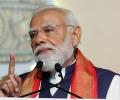
Prime Minister Narendra Modi has urged for restraint in the use of petro products due to the West Asia crisis, emphasising the need to save foreign exchange and reduce the impact of war. He also highlighted India's progress in solar power and ethanol blending, while assuring support to Telangana's development.

As the March 31 deadline arrives, a wave of Maoist surrenders suggests insurgency's end, but political and social concerns remain.

The Lok Sabha will hold a discussion on efforts to eliminate left-wing extremism (LWE) in India, ahead of the government's deadline. The debate will cover the government's strategy, review of affected regions, and future plans, including potential withdrawal of security forces and launch of welfare schemes.

A combination of security pressure and rehabilitation efforts has significantly weakened Naxalism in India, leading to numerous surrenders and the elimination of key leaders.
Prime Minister Narendra Modi launched a strong attack on the ruling TMC in West Bengal, accusing them of running the state through 'syndicates' and promising to address atrocities against women if the BJP gains power.

Prime Minister Narendra Modi launched a strong attack on the TMC in West Bengal, accusing them of corruption and syndicate rule, while promising to address atrocities against women if the BJP comes to power.

President Droupadi Murmu stated that government actions against Maoists have improved the atmosphere in Bastar, Chhattisgarh, leading to development. She encouraged those who have left violence to trust the Constitution.

'They are not abandoning their ideology. They now believe it is better to pursue their goals through the Constitution rather than from the barrel of a gun -- even if the ideology itself remains intact.'

Union Home Minister Amit Shah announces the surrender of 258 Maoists in Chhattisgarh and Maharashtra, reiterating the government's commitment to eradicating Naxalism by March 2026.

'For the remaining Maoist cadres, they shall soon confront one of two outcomes: Either surrender or face neutralisation.'

Union Home Minister Amit Shah rejects the ceasefire offer from Maoists, stating that surrender is the only option. He also addresses Naxalism's ideological roots and progress in Jammu and Kashmir and the Northeast.

'The Maoist leadership spread fear that surrender meant torture or death. Once that false narrative collapsed and our operations proved transparent and credible, the surrender momentum became irreversible.' 'From 42,000 square kilometres, Maoist activity is now confined to barely 500-600 square kilometres -- less than two per cent of Bastar. This is their last remaining base area.'

'The watershed moment was June 22, 2024, when the divisional in-charge of Gadchiroli, Giridhar Tumreti, who was their senior-most commander, along with his wife, came forward to surrender before the then deputy chief minister and home minister Devendra Fadnavis.'

After recent high-intensity operations in the Bastar region and the neutralisation of several senior Maoist leaders, officials say the insurgency has lost its ability to mount large-scale coordinated attacks.

'From every point of view, they have faced an extremely difficult couple of years, and the setback they have suffered is irreversible.' 'This reality has begun to set in even amongst the top-level cadres. That is why, in recent times, we have witnessed a huge number of senior-level cadres emerging from the jungle and deciding to renounce violence and join the mainstream.'

Senior Naxalite Mallojula Venugopal Rao, also known as Bhupathi, surrendered to police in Maharashtra's Gadchiroli district along with 60 other cadres. Bhupathi, a key strategist in the banned organization, carried a significant bounty.
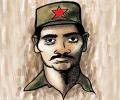
'The (Maoist) organisation is in visible decline. Their senior leaders are ageing. Forest life is unforgiving -- older leaders simply cannot cope physically.' 'Earlier, they attracted educated youth from cities. That stream has dried up. Today's recruits largely come from poor village backgrounds and lack ideological depth.'
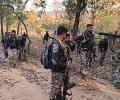
Bodies of three Maoists, including a woman cadre, were recovered from the site, along with a self-loading rifle (SLR), a .303 rifle, a 12-bore gun and other Naxalite-related materials, the SP said.

The Maoists in Bastar went from one village to another with kits providing badly needed medical intervention. The medical help was one key reason why the tribals were attracted to the Maoists, points out M R Narayan Swamy.

Chhattisgarh Chief Minister Vishnu Deo Sai announced that North Bastar and Abujhmad regions are now free of Naxal violence, with the fight against Naxalism in South Bastar reaching a decisive phase. He attributes this success to trust-building measures and the surrender of Naxal cadres.

A profile of B Sudershan Reddy, former Supreme Court judge and Opposition's vice presidential candidate, highlighting his career, judgments, and contributions to constitutional law.

The stage is set for a direct contest between NDA nominee C P Radhakrishnan and joint opposition candidate B Sudershan Reddy for the vice-presidential election. The BJP-led alliance has a clear edge in the poll necessitated due to the sudden resignation of Jagdeep Dhankhar.

National Democratic Alliance Convener and Janata Dal-United President, Sharad Yadav termed Maoism as a "deep-rooted" problem which cannot be solved merely by arms.
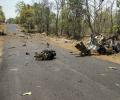
'As casualties go, Maoism has been exacting a heavy price, and with a sickening regularity.' 'Yet, it is the other threat that hog all the limelight, the headlines and the TV studio debates,' says Saisuresh Sivaswamy.
Prime Minister Narendra Modi on Monday said Parliament's Monsoon session is like a 'Vijay Utsav' as the Indian armed forces achieved their objectives under Operation Sindoor 100 per cent, and expressed confidence that the MPs will articulate this sentiment in one voice.
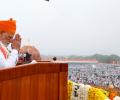
Prime Minister Narendra Modi addressed the nation on Independence Day, focusing on economic growth, self-reliance, and national security. He emphasized manufacturing quality products at affordable prices, supporting farmers, and combating terrorism and infiltration.

'...and that is good and honest governance and rule of law. There should be visible evidence that the government is determined to deal summary justice to the corrupt and the venal, rid legislatures and cabinets of persons involved in crimes, and inculcate sensitivity, empathy, responsiveness, commitment to values, dedication to the public weal and, most of all, humility in public servants from top to bottom.'

The challenge of Maoism can be met with equitable and inclusive socio-economic progress.

In a scathing attack on Aam Aadmi Party, Bharatiya Janata Party leader Nitin Gadkari on Wednesday dubbed the Arvind Kejriwal-led outfit's activities as "right-wing Maoism" and said its move to elicit views of people to form government in Delhi was a "mockery" of democracy.
Finance Minister Pranab Mukherjee on Wednesday said the wrong policy and non-functional police of the Left Front government in West Bengal were responsible for the rise of Maoism in the state. "The Left Front government should be blamed for the rise of Maoists in West Bengal. Their wrong policy and non-functional police have allowed the Maoists to enter the state and strengthen their base in Junglemahal," the senior Congress leader told an election rally at Harishchandrapur.

Poonam, daughter of Pramod Mahajan, a MP representing Mumbai North Central said, "They (farmers) are holding the flag of Communists, and urban maoists are misguiding them.
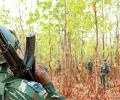
Earlier on Monday, two women Naxalites were killed and one CoBRA jawan was injured in an encounter during the same operation, they said.

'...still have lost the 2014 Lok Sabha polls but could have won 140 seats.'
