
After recent high-intensity operations in the Bastar region and the neutralisation of several senior Maoist leaders, officials say the insurgency has lost its ability to mount large-scale coordinated attacks.
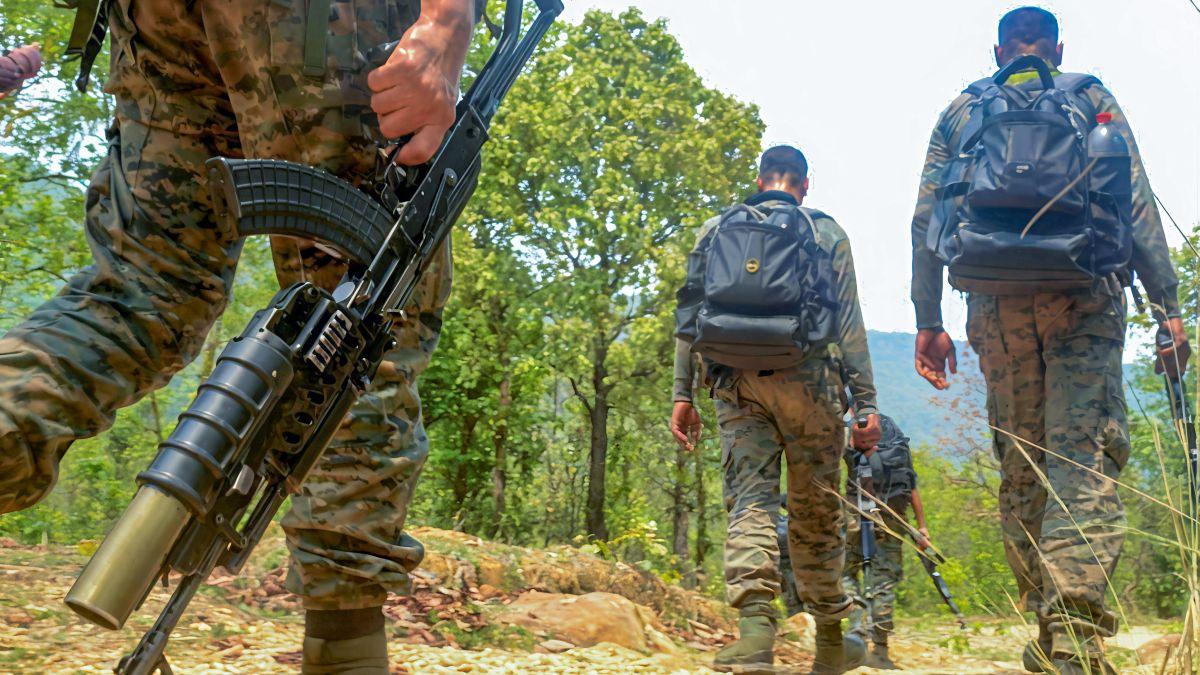
The long-standing campaign against Left-Wing Extremism appears to be entering a final phase, with fresh data indicating a significant shift in the country's counter-insurgency balance.
Over the past 11 years, security forces killed 1,751 Naxalites while 1,910 civilians and security personnel lost their lives during the same period.
"The figure includes 1,438 civilians and 472 security force personnel martyred in Maoist-related incidents," says Ajay Basudev Bose, a Right to Information Activist who obtained the figures from the Union home ministry.
Despite the heavy human cost, it looks like the Naxal movement which began in 1967 from Naxalbari in West Bengal is in the final phase of its grim existence with many Communist Party of India-Maoist leaders and cadres surrendering or getting killed.
Among the most prominent names to surrender is Mallojula Venugopal Rao, also known as Bhupathi or Sonu, a top-rung leader of the Maoist politburo.
Bhupathi surrendered in Gadchiroli in the presence of Maharashtra Chief Minister Devendra Fadnavis in October along with several cadres and a substantial cache of weapons, signalling a deep fracture within the organisation's core leadership.
Soon after his arrest Rao declared, 'Armed struggle has failed in India.'
In the same period, Rupesh alias Satish, a central committee member, also surrendered as part of a large-scale surrender involving over 200 Maoists in Chhattisgarh's Bastar region.
The group included senior 'commander' Bhaskar alias Rajman Mandavi, a member of the Dandakaranya special zonal committee, along with other divisional and area committee leaders.
In November, the Maoist movement suffered another major setback when Madvi Hidma, who was responsible for leading 26 armed attacks against security forces, was gunned down in an encounter in Alluri Sitharamaraju district, Andhra Pradesh.
The Union government has set an ambitious target of eliminating Maoism by March 2026, a deadline that has shaped the current phase of operations.
The drive is anchored in Operation SAMADHAN-Prahar, a long-term counter-extremism framework that has been expanded into an active offensive.
The operation marked a move from largely reactive deployments to sustained pressure along Maoist corridors, breaking up their supply lines and denying them space to regroup.
SAMADHAN was launched in 2017 by the Union home ministry, alongside different phases of Operation Prahar.
It was for the first time that the security forces entered Naxalite hideouts deep inside the forests in the affected states, particularly in Chhattisgarh.
A major area of improvement was the quality of intelligence inputs.
Earlier, security units often operated with limited information inside the dense forests, resulting in frequent ambushes.
In recent years, drone-based reconnaissance, satellite mapping and signal interception have been woven into daily security operations.
These tools provided real-time monitoring of Maoist movement, helped identify camps and weapons dumps, and enabled more accurate planning.
Officials say technology has significantly reduced risks to security personnel and has contributed to higher success rates in recent encounters with the Maoists.
Another change has come from a more structured human intelligence network. Surrendered Maoists, many familiar with the terrain and guerrilla tactics, have been integrated into district reserve units in several states.
Their involvement has allowed forces to navigate remote belts that were once impenetrable and to mount operations based on local inputs rather than broad assumptions.
The government's approach also places emphasis on encouraging surrenders.
Hundreds of lower-ranked Maoists have given up arms in recent years, and many have been absorbed into auxiliary policing roles.
However, challenges remain.
While the government says Maoist influence has been reduced to a handful of pockets, the terrain still complicates operations.
Security specialists point out that eliminating armed cadre is only part of the battle.
"At present, psychologically, Maoist cadres are shaken. They have seen their strongest commanders fall. Many will either melt away or surrender," retired Central Reserve Police Force director general K Durga Prasad told Rediff earlier.
Grievances over land, displacement and access to welfare schemes have historically fed the insurgency; without progress on these fronts, observers caution, the movement may fade but not disappear completely.
Even so, the government believes the current trajectory is irreversible.
After recent high-intensity operations in the Bastar region and the neutralisation of several senior Maoist leaders, officials say the insurgency has lost its ability to mount large-scale coordinated attacks.
Districts once considered strongholds are seeing the return of road-building teams and administrative officers after decades.
Whether the March 2026 deadline can be met will depend on sustaining both security pressure and development outreach.
For the first time in years, officers on the ground and policymakers in Delhi appear to share the view that India may be approaching the end of one of its most enduring internal security challenges.
"The Red Corridor, once spanning multiple states, has been reduced to isolated pockets," notes K Durga Prasad. "The movement has shifted from a national security threat to a manageable law and order issue."










 © 2025