
Iran has warned of consequences for any collusion between the United Arab Emirates and Israel, following reports of a secret meeting between Israeli Prime Minister Benjamin Netanyahu and UAE President Mohamed bin Zayed Al Nahyan during Operation Roaring Lion.

US President Donald Trump indicated that a peace deal with Iran is possible, but stressed that military action remains an option if talks fail. He emphasised the need for guarantees against nuclear weapons in any agreement.

Foreign portfolio investors (FPIs) have injected Rs 30,919 crore into Indian equities in August, marking their second consecutive month of net buying. This follows a Rs 20,200 crore investment in July, indicating a potential reversal after four months of significant outflows, driven by improving corporate earnings, resilient economic activity, and a stable rupee.

A top Iranian official has blamed the US and Israel for the disruption of global supply chains due to the West Asia conflict, stating that Tehran is not happy about the consequences faced by countries like India.

Indian benchmark indices, Sensex and Nifty, closed sharply higher, with the Sensex climbing 1,695.40 points and the Nifty surging nearly 2 per cent, driven by a global market rally and a decline in crude oil prices following US President Donald Trump's declaration that his country has ended the war with Iran.

US President Donald Trump revealed he was on the verge of ordering attacks on Iran but postponed the decision after receiving calls from Qatar and the UAE, citing progress in peace talks.

The US Senate has overwhelmingly approved a bill, the Lindsey O. Graham Sanctioning Russia and Iran Act of 2026, which aims to punish Russia and its major petroleum product buyers, including China and India. The legislation allows the US President to impose 100 per cent tariffs on goods from the top five importers of Russian oil and gas, and also extends sanctions on Iran's energy sector. The bill, championed by the late Senator Lindsey Graham, now moves to the House of Representatives for further approval.

Prime Minister Narendra Modi, addressing the SCO summit in Bishkek, called for a united front against terrorism and its financing, rejecting double standards. He emphasised resolving conflicts through dialogue and diplomacy, not battlefields. Modi also highlighted that connectivity projects must respect national sovereignty and territorial integrity, a veiled reference to China's Belt and Road Initiative. India's vision for SCO rests on security, connectivity, and opportunity.

India and China are in what experts call 'a cooperation-versus-competition situation'.

A Kishore Kumar song, a birthday cake, a prince's break from protocol to thank his driver, a Persian painting on the ceiling of the presidential residence -- the BRICS Summit had many memorable moments.

Indian stock markets, including the Sensex and Nifty, experienced their third consecutive day of declines, driven by a global selloff, escalating tensions in West Asia, and a subsequent rise in crude oil prices.

Dropped Iran striker Sardar Azmoun has posted a heartfelt message on social media proclaiming his love for his country and wishing the World Cup squad well at the tournament without him.
US President Donald Trump has claimed that Iran's missile capabilities have been severely degraded, saying Tehran now possesses only a fraction of the arsenal it had before recent hostilities.

Iran hosted a large send-off rally for its World Cup team in Tehran, despite ongoing concerns about visa issues for entry into the United States, where the team is scheduled to play its group matches.

Chinese President Xi Jinping's upcoming visit to India for the BRICS summit is a pivotal diplomatic event poised to significantly impact bilateral ties and global cooperation amidst ongoing international instability.
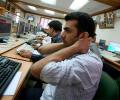
Indian equity benchmark indices Sensex and Nifty closed lower on Thursday, driven by escalating tensions between the US and Iran, persistent foreign fund outflows, and concerns over rising US inflation.
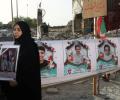
The United States and Iran are engaged in indirect talks aimed at developing a framework for a possible agreement, according to Iran's ISNA News Agency. Intensive mediation efforts are underway, but it remains uncertain whether a final agreement is within reach.

Iran's national soccer team attended visa appointments in Ankara, Turkey, applying for Canadian visas and some players also submitting applications for US entry ahead of the 2026 FIFA World Cup, which will be co-hosted by the United States, Canada and Mexico.

The Reserve Bank of India's Financial Stability Report indicates that the interim peace deal between the US and Iran has favourably shifted the balance of risks, reducing headwinds from the West Asia conflict. However, it cautions that exchange rate volatility could increase if crude oil prices spike due to delayed normalisation of supply chain disruptions.
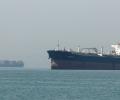
In a significant diplomatic development, US and Iranian negotiators have reportedly reached a tentative 60-day memorandum of understanding (MoU) aimed at extending a fragile ceasefire and paving the way for formal talks regarding Iran's nuclear programme.

A recently finalised peace deal between the US and Iran, set to be signed on June 19, is expected to significantly benefit India's economy by boosting exports to West Asia, stabilising the rupee, and easing inflationary pressures, according to exporters and experts.

Senior Congress leader Shashi Tharoor has articulated India's position on BRICS, advocating for it to be a "non-West, but not anti-West" platform, a stance he believes is crucial for India's national interest. He highlighted the prestige of hosting the BRICS summit, India's responsibility to represent the Global South, and the significance of bilateral meetings, particularly with China and Russia. Tharoor also addressed the strained India-China relations, citing border issues and trade leverage, and discussed the challenges within BRICS, including difficulties in achieving consensus on global issues and trade imbalances, while also considering the need for diversified international relations amidst unpredictable US sanctions.

Som Kumar Tamang, a 44-year-old Nepalese driver from Terhathu district, was killed in a drone attack in Kuwait. The attack, attributed to Iran, occurred amidst US military action against Iran. The Nepalese Embassy in Kuwait is arranging for the repatriation of his body and has advised Nepalese nationals in Kuwait to observe security protocols.

Iran has presented a multi-layered proposal to the US in an attempt to break the deadlock in peace talks, focusing on de-escalation and nuclear programme discussions.

Former Central Command chief David H Petraeus suggests the US and Iran are likely to extend their ceasefire beyond the initial two-week period, citing willingness from both sides to continue negotiations.

Prime Minister Narendra Modi urged US President Donald Trump to prioritise the safety of Indian seafarers in the Strait of Hormuz during the implementation of Washington's proposed Iran peace deal, as both leaders focused on repairing strained bilateral relations at the G7 summit.

Prime Minister Narendra Modi cautioned against the 'weaponisation' of technology and critical minerals at the BRICS summit, advocating for cooperation to foster shared prosperity. Concurrently, Chinese President Xi Jinping announced plans for an open-source AI ecosystem for BRICS nations, positioning Beijing as a key technology partner amid global AI competition.

Donald Trump has dismissed the ceasefire with Iran as being on 'massive life support', signalling continued tensions between the US and Iran amid ongoing negotiations.
Indian stock market benchmark indices, Sensex and Nifty, experienced declines in early trade due to escalating tensions between the US and Iran, which led to a surge in crude oil prices and weak global equity trends.

Pakistan Prime Minister Shehbaz Sharif on Friday said that the US and Iran have agreed on the text of a peace deal, kindling hope of a diplomatic breakthrough in the region.
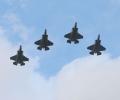
A Congressional Research Service report reveals that at least 42 US aircraft were lost or damaged during Operation Epic Fury, targeting Iran, with costs estimated to reach USD 29 billion.

We are back to the 1971 moment with both China and the US supporting Pakistan, asserts Colonel Anil A Athale (retd).

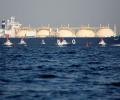
United States Central Command (CENTCOM) forces have conducted a 'heavy wave of strikes' against numerous Islamic Revolutionary Guard Corps (IRGC) targets in Iran. This action was a direct response to attempted Iranian missile strikes on US forces in West Asia, which were successfully intercepted. The strikes targeted IRGC military command centres, missile and drone facilities, coastal surveillance, and maritime capabilities, aiming to reduce threats posed by Iran and its proxies. US President Donald Trump also issued strong warnings to Tehran, linking the escalation to a recent drone strike on an LNG vessel in Egypt's Damietta Port.
Iranian Deputy Foreign Minister Kazem Gharibabadi has urged India to take the lead in bringing peace to West Asia, highlighting the UAE's role in stalling BRICS consensus on the conflict. Gharibabadi also discussed a new framework with Oman for merchant vessels passing through the Strait of Hormuz.
Indian information technology (IT) stocks, led by Infosys, experienced a significant selloff, dragging the Nifty to a two-month low, primarily due to escalating West Asian tensions pushing crude oil prices higher, and concerns over upcoming large IPOs diverting funds from secondary markets. The sector is also grappling with the long-term implications of AI disruption.

US President Donald Trump stated that military strikes against Iran could resume if they 'misbehave,' even as he reviews a new proposal from Tehran aimed at ending the paused conflict.

US Secretary of State Marco Rubio said that discussions aimed at halting the conflict with Iran have shown "some slight progress," while simultaneously echoing Washington's dissatisfaction with its NATO allies.

Indian benchmark indices, Sensex and Nifty, closed flat on Friday, with elevated crude oil prices due to geopolitical uncertainties and a rebound in US Treasury yields making investors cautious and preventing a decisive market rally.

Passenger traffic Y-o-Y fell 26.8 per cent in April and 24.6 per cent in May, while capacity declined 9.6 per cent and 11.3 per cent, respectively.

Indian stock markets are set to be influenced by developments in US-Iran negotiations, crude oil prices, and foreign investor activity in the upcoming holiday-shortened week, according to market analysts.
