
He said both sides reaffirmed to sincerely work towards complete disengagement of the troops along the LAC.
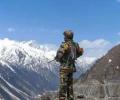
'China has forcibly occupied territory it had never occupied before, blocked Indian patrols' access to areas they had patrolled for decades and, most provocatively, killed 20 Indian soldiers.' 'Most countries would regard these as acts of war.' 'New Delhi has apparently taken off the table the option of evicting the PLA with force,' observes Ajai Shukla.

By jettisoning the vision of multilateral world in favour of a Han Empire, China has posed a major long term challenge to India. India must stand firm against Chinese expansionism but also keep a door open for future detente by making a clear distinction between Chinese people and the current Chinese leadership, observe Lieutenant General Ashok Joshi (Retd) and Colonel Anil Athale (Retd).
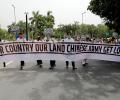
'Even those who do not like him will rally to his call if he says that the country's sovereignty is being threatened by China,' notes Aakar Patel.

The time is ripe to extend the confrontation with the Chinese to the maritime domain, says former RA&W officer Krishan Varma.
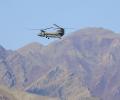
For both India and China, the most likely option -- and the most challenging -- appears to be a freezing of the status quo.

Army Spokesperson Colonel Aman Anand said troops from China's People's Liberation Army (PLA) 'violated' the consensus arrived at during military and diplomatic engagements on the ongoing standoff in eastern Ladakh, and carried out provocative military movements to change the status quo.
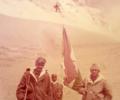
'The Chinese -- up to the highest leadership -- will avoid a conflict because they know they will be badly licked.' 'The reputation they have painstakingly built over the last two-three decades of being a global power will be destroyed.'

Indian Army officers, serving and retired, will tell you that the one thing that makes the Indian soldier singularly unique is his josh and jazba.

Jaishankar is the first foreign secretary to head the Ministry of External Affairs as minister.

India and China are trying to develop effective mechanisms to prevent the "embarrassing" face-offs between their troops along the "disputed" points of the Line of Actual Control, Defence Minister A K Antony said in New Delhi on Friday.

'He is psychologically preparing the PLA and the Chinese public to avoid a loss of face.'

'Intrusions by PLA troops in the Ladakh sector are more in number than elsewhere and this region is now likely to remain an area of enhanced Chinese interest,' warns China expert Jayadeva Ranade.

The incident occurred on March 8 when a platoon of at least 11 PLA men led by a colonel-rank officer crossed over the imaginary LAC.

'All the government needs to do is to identify clear political and strategic objectives and to give the military planners a free hand,' asserts Ajai Shukla.

'At the previous 18th party congress, Xi vowed to protect China's 'core' interests.' 'As a result, India faced a barrage of serious incidents on the borders with China -- at Depsang, Chumar, Pangong Tso and Doklam.' 'New Delhi will watch closely the political signals emanating from Beijing this week,' says China expert Srikanth Kondapalli.
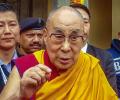
'The logical step is to challenge the very legitimacy of the Chinese claim over Tibet,' recommends Inspector General Gurdip Singh Uban (retd).
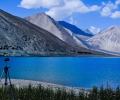
'The use of military power to settle disputes is not always preferred and is the last preferred option, but it certainly remains an option.'
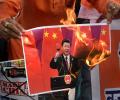
'And this mirror imaging is the most dangerous thing because it leads to tremendous misunderstandings.'

'Chinese troops are not geared to fight Indian troops who are battle hardened and acclimatised and are far more hardy.'
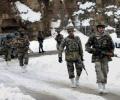
'The Indian Army's surveillance had noticed the Chinese movements.' 'There was no intelligence failure.'
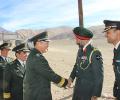
Amidst reports of Chinese incursions, the Peoples Liberation Army and the Indian Army on Sunday decided to uphold treaties and agreements signed between the governments of the two sides to maintain peace and tranquility along the Line of Actual Control.
India has experienced hands and will emerge with flying colours, declares Inspector General Gurdip Singh Uban (retd).
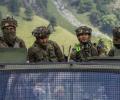
Today, the Ladakhis and Tibetans have been joined by the Sikhs, the Madrassis, the Garhwalis, the Rajputs, who are well trained psychologically and otherwise, to defend the nation, observes Claude Arpi.

'Given the way in which the PLA operates today, I don't believe local commanders were necessarily acting without approval of higher levels.' 'They were acting in a way which they believed they were carrying out the intent of the higher levels.'
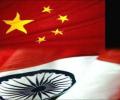
China wants a code of conduct for troops on the India-China border areas. While the Indian side has reacted cautiously, it is not clear what effective additional protocols that the current proposed code will bring forth to usher stability in the border areas, says Srikanth Kondapalli.
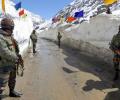
'They cannot use firearms.' 'They have to be restrained.' 'It is a game of patience and chess board moves.' 'It is not like India and Pakistan where bullets get fired and people get killed.'
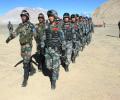
'They have done in Eastern Ladakh what we did in Dokalam in 2017.'

'We are facing the most critical military situation with China in the last 50 years.'

'Everytime the Chinese raised the issue of our patrol crossing the line, I told them let's not fight over a line that does not exist yet.' 'Commanders resolved such situations sitting across the table, sometimes we posed veiled threats about creating problems elsewhere along the 800 km frontier as a tit-for-tat.'

'I am not minimising either the seriousness or the complex nature of the current situation.' 'Naturally, we have to do what it takes to secure our borders.' 'We are talking to the Chinese, both through military channels and diplomatic ones.'
'In fact, they work in tandem.' 'When it comes to finding a solution, this must be predicated on honouring all agreements and understandings.' 'And not attempting to alter the status quo unilaterally.'

Soldiers of the People's Liberation Army tried to enter the Indian side in two areas--Finger Four and Finger Five-- twice.
China on Tuesday dismissed reports of fresh incursions by its troops into India as "routine patrolling" and asserted that both countries have a very effective and smooth mechanism to handle border incidents.

'How and if India retaliates will go a long way toward determining the trajectory of this crisis.'
We should have anticipated it on August 5 last year, when we made the big changes in J&K. Amit Shah left nothing to chance when he told Parliament that 'we will bring back Aksai Chin even at the cost of our lives'. 'Then, there were the new maps, objections to the CPEC going through Indian territory, the weather reports.' A broad territorial status quo had existed in Ladakh-Aksai Chin since 1962. India made its intention to change this public, notes Shekhar Gupta.
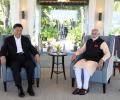
'China physically occupies about 45,000 sq km of J&K as claimed by India, including 3,000 sq km captured in the 1962 War and never returned; and 5,180 sq km ceded to China by Pakistan in 1963.' 'It is hard to justify remaining silent about the return of China occupied Ladakh,' observes Ajay Shukla.

Major General Sujan Singh Uban, a legendary veteran of the Second World War, was a natural choice to raise, train and command the Special Frontier Force and mould them into a well oiled fighting machine, recalls his son Inspector General Gurdip Singh Uban (retd), who led SFF troops during the Kargil War.

'Open conflict would be a disaster for both China and India.'

After the denial of visa to the then Northern Army Commander Lt Gen B S Jaswal by China in 2010, New Delhi had frozen all bilateral defence exchanges with Beijing
In yet another face-off with Indian soldiers, Chinese troops had come more than 20 kilometres inside the Indian territory in Chaglagam area of Arunachal Pradesh on August 13 and stayed there for over two days.
