
'It is nobody's contention that uncomfortable questions regarding national security should not be raised. But that is a topic for another day and another time when the immediate threat has faded,' argues Vivek Gumaste.

Just like China wants Trump to lose the US presidential poll, it may want Modi to lose the Lok Sabha polls. So months before the 2024 elections, China may take possession of an important area, say one of the Char Dhams, warns Sanjeev Nayyar.

The Border Defence Cooperation Agreement with China needs closer scrutiny, says Rup Narayan Das.

India and China decided to seek a fair and rational solution to their border dispute on Saturday as they focused on the proposed border defence cooperation agreement to avert incursions like the one witnessed in Leh region last month.

'Tibetans will participate in future conflicts with India (in all probability, some were already present in Galwan).' 'As nobody in India would like to have a deadly fight with Tibetan soldiers and officers, the issue needs to be closely followed,' observes Claude Arpi.

Overall, the People's Liberation Army Air Force (PLAAF) has focused on building ground-based air defense networks and network-centric operations rather than trying to match the Indian Air Force (IAF) in terms of straight fighter numbers along the border. All air assets fall under the Western Theater Command of the PLA, the largest geographic region of China's five military theater commands.

General Zhao Zongqi is well known in India for having commanded the Chinese troops during the Dokalam episode. Zhao knows every inch and corner of the Indian border, at least the Eastern and Central sectors, including the Naku La area which witnessed fist-fights between Indian and Chinese troops in April/May. Claude Arpi introduces us to the PLA generals masterminding the Chinese aggression in Ladakh.

Border incursion, the finalisation of the Border Defence Coordination Agreement (BDCA), a new mechanism suggested by China last year for improving security at the borders, pending the final settlement of the territorial dispute, top Antony's agenda for talks.
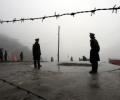
India is concerned about periodic provocative incursions by Chinese troops that have resulted in "eyeball-to-eyeball confrontations", but was hopeful that the border issues will eventually be settled.
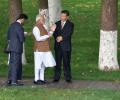
'The meeting marks the first tentative step in the effort to understand whether the two largest Asian nations can co-exist peacefully while realising their aspirations.' 'Caution and watchful wariness will dominate the effort of both sides,' says Jayadeva Ranade, former RA&W officer and China expert.

'Clearly, there is a wide gap between the stated intentions of China's top leadership to improve relations with India and the PLA's aggressive border management,' says Brigadier Gurmeet Kanwal (retd).

'Problems will keep recurring unless China vows to resolve all outstanding issues between the two sides,' says Sana Hashmi.

Chinese People's Liberation Army recently made a two-pronged simultaneous incursion by sending its troops into Indian waters in the Pangong lake as well as five km deep into Indian territory through the land route in the same area, according to reports.

In a subtle show of strength to China, the Indian Air Force on Tuesday landed its C-130J Super Hercules transport plane at the world's highest and recently-activated Daulat Beg Oldie airstrip in Ladakh near the Line of Actual Control, the scene of a stand-off with Chinese troops in April.
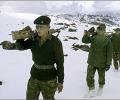
The fact that the PLA patrol came nearly 20 km deep into what India perceives as its own territory and stayed put -- for four days -- has made the Eastern Command a little more cautious about Chinese intentions, reports RS Chauhan

'The border standoff, if not properly addressed by both sides, could escalate to a conventional or sub-conventional conflict between India and China,' predicts Srikanth Kondapalli, one of India's leading China experts.
The 16th round of India-China border talks will be held in Beijing on June 28 followed by the visit of Defence Minister A K Antony a week later as the two countries are set to resume top level contacts to build on the recent visit of Chinese Premier Li Keqiang to New Delhi.
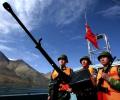
After making incursion bids in Ladakh through land route, Chinese troops have made several attempts to enter Indian waters at Pangong lake nestled in the higher reaches of Ladakh with the latest incident reported on Friday.

The Border Defence Cooperation Agreement inked between India and China on Wednesday facilitates establishment of a hotline between the military headquarters of the two countries, besides border personnel meeting sites in all sectors receiving broad directive not to tail each others' patrols along the disputed borders.
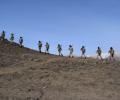
India brought in more troops after the destruction of two of its bunkers and "aggressive tactics" adopted by the Chinese People's Liberation Army
Virtually defending the latest incursion by the People's Liberation Army in the Chumar sector in Ladakh, China on Thursday said its troops were patrolling on its side of the Line of Actual Control and asserted that "status quo" should not be changed pending a final settlement.

India and Russia are involved in talks to sort out the nuclear liability issues before they sign an agreement for setting up Units III and IV of the Kudankulam power plant in Tamil Nadu during Prime Minister Manmohan Singh's annual summit with President Putin in Moscow next week.

'China knows the best way of twisting the knife in its dealings with India: By launching a major incursion into Indian territory,' says Rajeev Sharma.

'The Chinese mindset and approach to India is far different from that in Pakistan.' 'This reality makes it possible for us to follow an engagement policy with one, while militating against engagement with the other.'

Special Representatives of India and China will hold the 16th round of boundary talks in Beijing on Friday, the first such meeting under the new Chinese leadership, to make another bid to move forward on the resolution of the vexed dispute.

While China is bigger and feels mightier at the moment, Beijing's rulers would be well advised not to be tempted to provoke India, for that would only trigger a chain reaction around the world that would not serve anyone's interests, says Sanjaya Baru.

Amid a spate of incursions by China in Ladakh, its troops are also resorting to tactics like preventing the Indian army from patrolling posts in this sector along the border, which is well within India's territory.

'We should not flatter ourselves that China is fixated on encircling India. She has greater goals, becoming the pre-eminent power in the world, and India as a major power is dealt with as part of that strategy.'
'The intrusion in Chumar, during and beyond the Chinese president's visit, is unprecedented and has qualitatively changed the tone of the India-China relationship,' says Jayadeva Ranade, a member of the National Security Advisory Board.
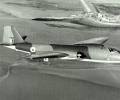
'If we had sent a few airplanes (into Tibet), we could have wiped the Chinese out.' 'And everything could have been different in the 1962 War.' 'They did not believe me there was no Chinese air force.' 'Can you imagine what would have happened if we had used the IAF at that time?' 'The Chinese would have never dared do anything down the line.'

Nevertheless, border dispute will feature prominently on Modi's agenda but the matter won't be discussed at length. Nayanima Basu reports

When Vietnam's India born Foreign Minister Pham Binh Minh arrives in New Delhi on Wednesday evening, he will have many areas of similar interest to discuss with his counterpart, External Affairs Minister Salman Khurshid.

'The focus on countering terrorism brings to the issue Beijing's non-serious approach in this regard. India's permanent representative at the UN has raised in vain the issue of funding and the release of 26/11 suspect Zaki-ur Rehman Lakhvi. But China has blocked these objections since December 2014 at the UN even after 'highest levels' in India intervened,' notes Srikanth Kondapalli, reviewing the India-China military exercises in Kunming.

Prime Minister Manmohan Singh on Sunday left for a five-day visit to Russia and China.
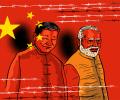
'As China rises and India grows to reclaim their earlier positions on the world stage as two of the largest economies and most important countries, there will indeed be some contention between these two powers.' 'There will also be plenty of space and room for cooperation amongst the two of us.' 'As our economic size increases to match the fact that we are the two most populous nations on earth, it will be all the more important for us to keep the interests of our peoples as well as those of the rest of the world in mind.' 'We shall have to grow together rather than as separate and disparate entities,' points out Ambassador Gautam Bambawale -- who served as India's ambassador to China -- in the 7th annual lecture of the Indian Association of Foreign Affairs Correspondents on March 1, 2019.

Unlike in the past, Modi made candid, frank and direct remarks on his hosts by suggesting that the Chinese side is holding back on further improving relations, says Srikanth Kondapalli.

Playing down the continuing standoff at the Ladakh border region, China's military on Thursday said such incidents are "sometimes inevitable" but the situation is under "effective control" with the joint efforts of the two sides.
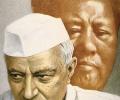
'Delhi was not concerned.' 'It would continue sleeping for several more years, with the result that Indian territory is still occupied by China today,' says Claude Arpi.

All the three issues raised by China at the Modi-Xi meeting are either intractable or peripheral to the bilateral relations and suggest conventional methods to placate the other side without yielding much, says Srikanth Kondapalli.
Playing down recent border stand off in Ladakh ahead of Premier Li Keqiang's visit to India, China on Thursday said the two sides have the ability to prevent such issues from affecting overall growth of ties, while working "very hard" to find a solution at an "early date".
