
Government sources indicate a potential increase in petrol and diesel prices due to rising global crude oil costs and losses incurred from a prolonged freeze on retail rates.

The popularity of US President Donald Trump is waning with approval ratings at its lowest, according to former diplomat Mahesh Sachdev, who notes that with two-thirds of Americans not approving of a continuation of the war on Iran, Trump faces the risk of being impeached.
Trump's remarks came amid heightened US messaging about the Iran situation and a series of White House statements indicating that multiple options remain under review.

The Iranian military has asserted that its forces successfully targeted and downed a US A-10 aircraft, according to a report by Al Jazeera.

Chaffing under public ridicule in the US as well as internationally for having 'lost' the war, Trump is under immense pressure to do something, cautions Ambassador M K Bhadrakumar.

US forces have launched search and rescue efforts for a US fighter jet, which several news outlets, including the Wall Street Journal and CNN, said had been shot down over Iran.

National Security Advisor Ajit Doval met UAE President Mohamed bin Zayed Al Nahyan to discuss deepening strategic partnerships and the regional situation, following meetings with Saudi Arabian leaders earlier in April.

'In such a scenario, Iran could proclaim itself victor, rebuild, re-enforce its diminished regional proxies to further destabilise neighbouring nations and take control of the Persian Gulf and Strait of Hormuz.'

Each time a deadline almost runs out, President Trump hands out a new one.

The Islamic Revolutionary Guard Corps (IRGC) on Sunday issued a stark warning that American and Israeli universities in West Asia could be treated as 'legitimate targets' in retaliation for alleged United States and Israeli strikes on Iranian academic institutions and cultural infrastructure.

Millions of soccer fans in the world's two most populous nations may not be able to watch the World Cup that starts next month, due to a deadlock over broadcast rights in India and no official decision in China.

Is the current rally telegraphing a durable peace plan in West Asia, boosted by United States (US) President Donald Trump's incoherent and contradictory posts on social media?

'What we have yet to see on either the US or the Iranian side is willingness to compromise on their ultimate demands and the flexibility to reach an agreement to end the war.

US President Donald Trump threatened to bomb Iran if a deal is not reached before the ceasefire ends, while Pakistan urged both sides to extend the truce and pursue diplomacy.

Representative of Iran's Supreme Leader in India, Abdul Majid Hakeem Ilahi, expressed doubts about the United States' intentions regarding negotiations, citing conflicting actions and a desire to force Iran into accepting US demands.

Iran has formally turned down a proposal from the United States for a 48-hour ceasefire, according to Al Jazeera, citing reports from the semi-official Fars news agency.

India has expressed strong concerns over attacks on commercial ships in the Strait of Hormuz, citing its importance to India's energy and economic security. Ambassador Yojna Patel highlighted the need to respect international law and ensure the safety of seafarers, while also addressing broader Middle East issues including the situation in Gaza and Lebanon.

Iran has reportedly allowed select "friendly nations" including India and Pakistan limited access to the Strait of Hormuz amid ongoing conflict, easing some energy supply concerns. Here's what the move means for global trade and oil routes.

The US Central Command (CENTCOM) announced the start of operations to clear mines in the Strait of Hormuz, a claim swiftly denied by Iran, leading to increased tensions in the region amidst stalled negotiations between the two countries.

United States President Donald Trump has welcomed the declaration from Tehran regarding the restoration of maritime access through the Strait of Hormuz.
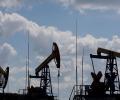
Global energy markets saw a significant correction as oil prices nosedived following Iran's announcement that the Strait of Hormuz has been fully reopened, dismantling the 'war-risk' premium that had gripped the market.

The container ship SELEN, en route to Karachi, was denied passage by the Islamic Revolutionary Guard Corps (IRGC) Navy due to lack of permission and failure to coordinate with Iranian maritime authorities.

US Secretary of War Pete Hegseth on Wednesday claimed that Tehran "begged" for a truce, maintaining that Washington achieved a "decisive military victory" during 'Operation Epic Fury.'

Pakistan's Foreign Office has refuted media reports suggesting that its efforts to facilitate peace talks between the US and Iran have stalled, calling the reports baseless and speculative.

Iran on Monday described the 15-point proposal from the United States to end the conflict in West Asia and reopen the strategic Strait of Hormuz as 'excessively demanding', stating that it has prepared its own set of demands to end hostilities, which have now entered their second month.

An India-bound container vessel, the 'Epaminondes', was seized by Iran's Islamic Revolutionary Guard Corps in the Strait of Hormuz, with an Indian merchant navy officer from Rajasthan among the crew, his family reported. The family has appealed to the Indian government for assistance in ensuring the safe return of the crew.

The clock on the ceasefire is running out. But everyone's already whispering about round two, possibly as soon as this weekend.

Trump seems to have estimated that Ghalibaf is a pragmatic politician who is receptive to close relations with the US and is enthusiastic about fostering business and economic ties in particular, points out Ambassador M K Bhadrakumar.

Despite a ceasefire agreement between Iran and the United States, the Strait of Hormuz remains blocked due to Iran's inability to locate and remove all the mines it laid during the conflict, hindering global oil and gas supplies.

According to an official Iranian military statement, Qader anti-ship cruise missiles were launched at the carrier, forcing it to alter its position in the region.

Iran's Islamic Revolution Guards Corps (IRGC) has issued a chilling ultimatum to 18 major American corporations, warning that their regional infrastructure will be targeted following allegations of their involvement in hostile operations.

Crude oil prices have surged to record highs due to escalating tensions between the US and Iran, raising concerns about supply disruptions and market volatility.
Russian Foreign Minister Sergei Lavrov will visit Beijing to discuss the West Asia conflict, the Strait of Hormuz blockade, and bilateral relations with Chinese leaders.

In a statement issued by Iran's consulate in Mumbai, it said, "At present, Iran essentially has no floating crude or surplus available for international markets. The US Treasury Secretary's remarks appear aimed at reassuring buyers and managing market sentiment."

Both sides have now revealed a preference for escalation over strategic defeat, and each new provocation narrows the space for the next pause. The Touska seizure, Iran's refusal to negotiate under blockade, Israel's strikes on Iranian oil infrastructure -- all of these add up to an increasingly untenable situation. This makes the wild card -- Trump and his motormouth -- more consequential than ever, notes Prem Panicker in his must read blog on the Iran War.

Donald Trump has extended the deadline for Iran to reopen the Strait of Hormuz, amid escalating tensions between the two countries. Trump issued a harsh warning to Tehran, threatening to target Iran's energy and civil infrastructure if the Strait is not opened.
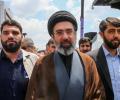
Iran's supreme leader Mojtaba Khamenei on Wednesday extolled the sacrifice and martyrdom of senior Iranian armed forces leaders as the conflict in West Asia enters into its second month.

If Trump wants peace with Iran, Pakistan will offer to help. If Trump seeks Pakistan's aid to spy on Iran, then too Munir will not hesitate to chip in. At the same time, the ISI will not hesitate to tip off Iran now and then, points out M R Narayan Swamy.
'In a volatile global market, India is pursuing a low-risk, low-return policy, akin to a SIP -- slow, steady investment.' 'Pakistan is following a high-risk, high-return policy.'

The Iranian terrorist regime launched a long-range missile for the first time since the start of Operation Roaring Lion that could reach a distance of ~4,000 km, Israel said.
 © 2026 Rediff.com - Advertise with us - Disclaimer - Privacy Policy - Sitemap - Feedback - About us - Terms of use - Grievances