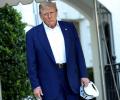
Trump said he had a series of phone calls on trade with both India and Pakistan.

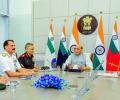
Modi has been chairing regular meetings with the top government functionaries involved in the country's military and diplomatic response to the Pahalgam terror attack of April 22.

Singh reached Udhampur on a two-day visit on Friday, his second trip to Jammu and Kashmir post-Operation Sindoor. He visited Kashmir on May 15, days after India and Pakistan reached an understanding to stop military actions against each other.

Trump's new rules for how countries should treat him have led to the current breakdown in India-US relations, explains Ambassador T P Sreenivasan.

Rahul Gandhi accuses PM Modi of prioritizing his image over national security after the Pahalgam attack, challenging him to refute Trump's claims of brokering a ceasefire between India and Pakistan.

Army Chief General Upendra Dwivedi visited Kashmir to review the security situation following the Pahalgam attack earlier this week that left 26 people dead, mostly tourists. The visit comes less than 24 hours after Pakistan resorted to small arms firing along the Line of Control (LoC) in Jammu and Kashmir.

The Congress party launched a scathing attack on the central government regarding the Pahalgam terror attack and Operation Sindoor, demanding accountability from Home Minister Amit Shah and clarification on the number of Indian jets downed during the operation.

The aircraft crashed into the Milestone School and College campus in Dhaka's Uttara area.

BCCI secretary Devajit Saikia said that an invitation has been extended to chiefs of all three Armed forces, top-ranked officers and soldiers for the IPL 2025 final on June 3.
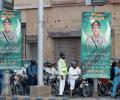
Speculation swirls in Pakistan regarding potential changes in the political landscape, fueled by rumors of the army chief's possible presidential aspirations and discussions between top civilian and military leaders.
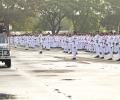
'I was preparing for JEE, NDA came as a blessing.'
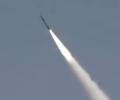
Pakistan successfully conducted a training launch of the 'Fatah series' surface-to-surface missile with a range of 120 kilometers. The launch comes amid heightened tensions with India following a terror attack in Jammu and Kashmir. The Inter-Services Public Relations (ISPR) said the test was part of the ongoing exercise 'INDUS' and was aimed at ensuring the operational readiness of troops and validating key technical parameters, including the missile's advanced navigation system and enhanced accuracy.
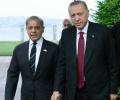
Pakistan Prime Minister Shehbaz Sharif met with Turkish President Recep Tayyip Erdogan to review bilateral relations and reaffirm their commitment to strengthening their strategic partnership. The two leaders discussed joint ventures and enhanced bilateral investment in key sectors, aiming to achieve a $5 billion annual bilateral trade target. They also expressed gratitude for mutual support during recent tensions with India. The meeting was described as "warm and most cordial," highlighting the deep-rooted historical ties between Pakistan and Turkey.

A senior leader of the ruling Pakistan Muslim League-Nawaz (PML-N) on Wednesday claimed that the military operation against India was designed under the supervision of the party president Nawaz Sharif.

The central government has empowered the Army Chief to call out 'every officer and every enrolled person' of the Territorial Army (TA) to provide for essential guard or to be embodied to support or supplement the regular Army.

India has to fill in all the critical gaps in missiles, ammunition, sensors and stockpile in the fastest possible manner, focusing on the critical instruments that worked this time, asserts Shekhar Gupta.
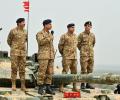
'Munir hopes to solidify his hold on power.'
'India has been preparing for the last 15 days... it won't be easy for Pakistan if it tries to dominate escalation.'

The Indian Army has released a booklet on Operation Sindoor, which was launched to avenge the April 22 ghastly Pahalgam attack in which Pakistan-backed terrorists brutally killed 26 civilians, mostly tourists, and left many injured.

The Indian government has dismissed claims of a suicide attack on an Army brigade in Jammu and Kashmir and a drone attack in Punjab as "fake news." The Press Information Bureau's Fact Check Unit found the claims to be false and attributed the spread of disinformation to coordinated efforts by certain social media handles and mainstream media in Pakistan. The government urged citizens to rely on verified sources and refrain from sharing unverified content.

Two 'very smart' leaders of India and Pakistan decided to end last month's conflict that could have turned into a nuclear war, United States President Donald Trump said after holding a rare luncheon meeting with Pakistan army chief Field Marshal Asim Munir at the White House.
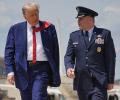
He then went on to say that, however, he won't get a Nobel Peace Prize for any of his efforts.
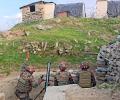
A bench of Justices Navin Chawla and Shalinder Kaur rejected the petition by the Indian Army Lieutenant, who served as a 'Troop Leader' of a squadron, against the termination order passed on March 3, 2021, that dismissed him from the Indian Army without pension and gratuity.

'I am pleased to announce the Governments of India and Pakistan have agreed to an immediate ceasefire and to start talks on a broad set of issues at a neutral site.'
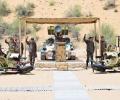
'War is not an answer. War is not a solution.' 'Deterrence is a solution. We should have the stick with us with which we can beat Pakistan.'

The CII Business Summit 2025's inaugural session witnessed a rousing standing ovation and a felicitation ceremony for the defence top brass sending a strong message about India's rising military industrial complex and hghlghting that security is a top-of-the-mind issue for India Inc.
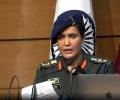
In a composed and clear presentation, Colonel Sofiya Qureshi announced that nine terrorist facilities had been destroyed in the tri-services operation.
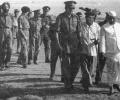
In what was perhaps the most critical meeting before full-scale war broke out, Shastri defined India's immediate war objectives to his defence minister, army, and air force chiefs: 'To defend against Pakistan's attempts to grab Kashmir by force and to make it abundantly clear that Pakistan would never be allowed to wrest Kashmir from India; To destroy the offensive power of Pakistan's armed forces...' A fascinating excerpt from Shiv Kunal Verma's must-read 1965: A Western Sunrise India's War With Pakistan.
'Looking at how quickly the hostilities were escalating, the nuclear threshold did not seem that far.'
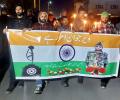
Union Home Minister Amit A Shah held a high-level security review meeting in New Delhi on Tuesday, Februay 4, attended by Jammu and Kashmir Lieutenant Governor Manoj Sinha and senior officials to discuss counter-terrorism measures and strengthening intelligence.
He went on to say that even though this has not been discussed, he is going to 'increase trade substantially with both of these great Nations.'

'We've moved from thousands killed yearly in Jammu and Kashmir to 127 last year.' 'Cross-border terrorism in Kashmir is being solved. We are winning it.'
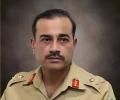
Pakistan's Chief of Army Staff Gen Syed Asim Munir visited Balochistan on Saturday amid clashes in the restive province in which 18 security personnel and 23 terrorists have been killed in the last 24 hours. The army chief was given a comprehensive brief on the prevailing security situation in the province and offered prayers at the funeral of the slain soldiers. He also visited the injured soldiers in the Combined Military Hospital Quetta. The military said the terrorists were killed in different areas of troubled Balochistan in the last 24 hours. Terror attacks have increased since the banned militant Tehreek-e-Taliban Pakistan group broke a fragile ceasefire agreement with the government.

General Upendra Dwivedi, the chief of the army staff, drove to the Army Hospital Research & Referral from his home in the capital to meet an elderly Sikh gentleman who is recovering at the hospital.

Field Marshal Sam Manekshaw Field Marshal K M Cariappa Marshal of the Indian Air Force Arjan Singh The three highest-ranking military heroes of the Indian Armed Forces. They were the rarest of the rare. The bravest of the brave.
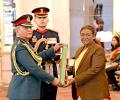
Three Thursdays after Nepalese President Ram Chand Poudel conferred the rank of honorary general of the Nepalese army on General Upendra Dwivedi in Kathmandu, President Droupadi Murmu conferred the honorary rank of general of the Indian Army on General Ashok Raj Sigdel, Nepal's army chief, at a special investiture ceremony at Rashtrapati Bhavan.

'Fears in Washington began to intensify when it was realised that subsequent Pakistani and Indian attacks on major military facilities -- which were significant in terms of geographic scope and intensity -- could rapidly take both sides to where neither actually wanted to go.' 'The US objective was to stop the fighting as soon as possible. Everything else was secondary.'
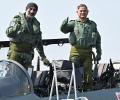
This was the first time two chiefs of the armed forces undertook a flight together.
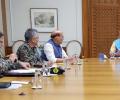
India has called Pakistan's nuclear bluff with Operation Sindoor and sent a psychological message to state-sponsored terrorists: nobody is untouchable and no place in Pakistan is safe for you, government sources said on Sunday.
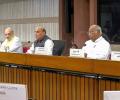
When the country has been at war, the Opposition has buried its differences with the government, points out Aditi Phadnis.
 © 2026 Rediff.com - Advertise with us - Disclaimer - Privacy Policy - Sitemap - Feedback - About us - Terms of use - Grievances