
Before he visited forward posts to review security and operational readiness on Monday, June 9, 2025, Indian Army chief General Upendra Dwivedi visited Kedarnath Dham in Rudraprayag on Sunday.

Take a look at our leaders taking to the yoga mats on this special day.
Munir said that the entire nation stands in resolute solidarity with every member of its Armed Forces.
Indian army chief General Upendra Dwivedi on Saturday said that the surgical strikes carried out during Operation Sindoor were a clear message to Pakistan that supporters of terrorism will not be spared.
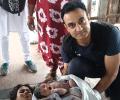
An army doctor used a hair clip and pocket knife to deliver a baby girl on a train platform in Jhansi, India, after a pregnant woman went into labor. The doctor, with the help of railway staff, ensured the safe delivery of the child.
Sections in the US State Department and Pentagon have always felt more comfortable dealing with all powerful Pakistani generals instead of elected civilians, points out Rana Banerji, who headed the Pakistan desk at RA&W.
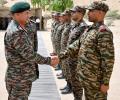
The army chief reviewed the joint operations carried out by the Indian Army, Indian Air Force and Border Security Force in response to Pakistani drone and military attacks that followed India's retaliatory strike on May 7 for the horrific Pahalgam terror attack.
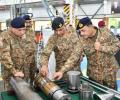
'If you fire two missiles at Jamnagar or ten missiles there, what do you think India will do?' 'India will fire 500 missiles on Tarbela and Mangla, destroy the Sukkur Barrage, destroy Karachi port.' 'When you start issuing threats, it should be with some sense and sensibility.' 'You shouldn't just shoot your mouth off just because you have appointed yourself field marshal.'

Army Chief General Upendra Dwivedi asserted that Operation Sindoor was unlike any conventional mission and that it was akin to playing a game of chess as 'we did not know' what would be the enemy's next move.

'America holds about 16% of IMF voting rights, giving it crucial influence over Pakistan's desperately needed bailout loans.'

Former Indian Army chief General Shankar Roychowdhury (Retd) has blamed "intelligence failure" for the recent terror attack in Pahalgam, Jammu and Kashmir, which claimed the lives of 26 civilians. He demanded accountability at the highest levels, stating that there must be someone responsible for the negligence and they must be held accountable for the consequences.
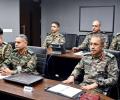
Army Chief General Upendra Dwivedi has given full authority to the Army commanders for counter-action in the kinetic domain to any violation of the understanding reached between the Indian and Pakistani militaries.
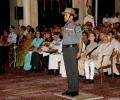
'People are enjoying freedom in everyday life because of their sacrifice.'

Army Chief General Upendra Dwivedi visited Kashmir to review the security situation following the Pahalgam attack earlier this week that left 26 people dead, mostly tourists. The visit comes less than 24 hours after Pakistan resorted to small arms firing along the Line of Control (LoC) in Jammu and Kashmir.
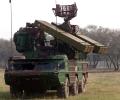
The Indian Army is conducting field trials of several cutting-edge defence systems under 'near-combat conditions', integrating electronic warfare simulations, to assess their performance rigorously, officials said on Saturday.
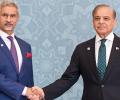
Shehbaz made the comments during a visit to the Kamra air base in the country's Punjab province where he interacted with officers and soldiers involved in the recent military confrontation with India.
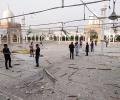
'Munir is clearly insecure and hence he needs the prop of a field marshal.'
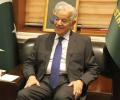
Last week, Information Minister Atta Tarar had said that 24-36 hours were important, fearing a possible strike by India. However, the time passed and there was no action by India.
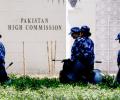
Pakistan has expressed condolences over the deaths of tourists in a terror attack in Pahalgam, Jammu and Kashmir, that killed 26 people. The Foreign Office spokesperson said Pakistan is concerned at the loss of tourists' lives and wished the injured a speedy recovery. The attack, claimed by The Resistance Front (TRF), a proxy of the banned Pakistan-based Lashkar-e-Taiba (LeT), is the deadliest in the Valley since the Pulwama strike in 2019.

The central government has empowered the Army Chief to call out 'every officer and every enrolled person' of the Territorial Army (TA) to provide for essential guard or to be embodied to support or supplement the regular Army.

The Indian Army has released a booklet on Operation Sindoor, which was launched to avenge the April 22 ghastly Pahalgam attack in which Pakistan-backed terrorists brutally killed 26 civilians, mostly tourists, and left many injured.
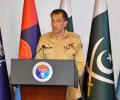
Lt Gen Ahmed Sharif Chaudhry, the spokesperson for the Pakistan Army, is the son of a nuclear scientist who was sanctioned by the United Nations and the US for providing information and expertise to al-Qaeda, according to Indian officials. Chaudhry's father, Sultan Bashiruddin Mahmood, allegedly provided insights into nuclear weapons infrastructure and raised funds for a fundamentalist organization linked to the Taliban. Mahmood was arrested in 2001 after admitting to meeting Osama bin Laden but was later released.

Security checks have been intensified in Paltan Bazaar, a well-known market in Dehradun, following concerns about the unauthorised sale of military uniforms on Friday.
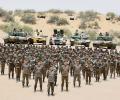
He also reviewed the joint actions undertaken in coordination with the Indian Air Force and the Border Security Force, they said.
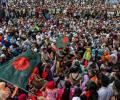
Government employees in Bangladesh locked down the main gate of the Bangladesh Secretariat in Dhaka, protesting a new service law that allows for easier dismissal of officials for misconduct. The protest, which lasted for about half an hour, disrupted government operations. The employees also threatened to continue their protests until the ordinance was scrapped. Meanwhile, the protest by employees of the Dhaka South City Corporation, demanding the installation of BNP leader Ishraque Hossain as its mayor, has brought administrative services to a halt. These protests, coupled with concerns raised by the business community and the military, highlight a growing sense of unease in Bangladesh over the policies of the interim government.
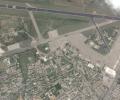
Pakistan's Prime Minister Shehbaz Sharif admitted that India's ballistic missiles hit Nur Khan Airbase and other sites on May 10, a rare acknowledgement that contradicts Pakistan's usual stance of denial when it comes to Indian military action.

'I am pleased to announce the Governments of India and Pakistan have agreed to an immediate ceasefire and to start talks on a broad set of issues at a neutral site.'
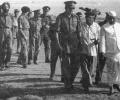
In what was perhaps the most critical meeting before full-scale war broke out, Shastri defined India's immediate war objectives to his defence minister, army, and air force chiefs: 'To defend against Pakistan's attempts to grab Kashmir by force and to make it abundantly clear that Pakistan would never be allowed to wrest Kashmir from India; To destroy the offensive power of Pakistan's armed forces...' A fascinating excerpt from Shiv Kunal Verma's must-read 1965: A Western Sunrise India's War With Pakistan.
Following the deadly Pahalgam attack, Michael Rubin, a former Pentagon official and senior fellow at the American Enterprise Institute, issued a strong statement and said that 'it is now the duty of India to do to Pakistan and to Pakistan's Inter-Services Intelligence (ISI) what Israel did to Hamas', calling for decisive action against Pakistan's intelligence agency for its alleged role in supporting terrorism.
'Pakistan is economically very weak and will not be able to sustain a war for long.'
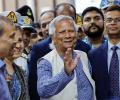
Bangladesh's interim government chief Professor Muhammad Yunus is considering resigning after political parties failed to reach a common ground, according to the National Citizen Party (NCP) chief. Yunus, appointed after a student-led uprising toppled the previous government, expressed concerns about his ability to function in the current political climate.
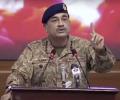
Asim Munir and his brand of short-sighted army officers give no inkling of paying heed, changing course or learning lessons from the past, observes Rana Banerji, who headed the Pakistan desk at RA&W.

Defence Minister Rajnath Singh has assured the nation that India will respond strongly to the recent terror attack in Kashmir's Pahalgam, which killed 26 people. He stated that India will not be intimidated by such acts and will take every necessary step to trace those responsible and those who conspired behind the scenes. Singh described the attack as "extremely inhuman" and reiterated India's zero-tolerance policy against terrorism.

'Still, people are asking why we have not gone for a full-out war. As a military man, if ordered, I will go to war, but that will not be my first choice'
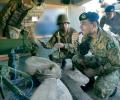
'It could take the form of sporadic LoC violation through heavy artillery and mortar fire, focusing on border villages where the Hindu Dogra population is predominant.'
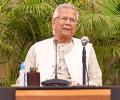
The chief adviser's decision to stay in office came two days after he told student-led National Citizen Party (NCP) leaders that he was mulling resignation as he felt "the situation is such that he cannot work", citing difficulties in working amid the failure of political parties to find common ground for change.
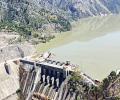
Pakistan has halted the construction of contentious canals in Punjab province after India suspended the Indus Waters Treaty following a deadly terrorist attack in Kashmir. The decision to suspend the canals project was made after Prime Minister Shehbaz Sharif met with PPP chairman Bilawal Bhutto-Zardari and agreed to address the concerns of Sindh province, where the project had sparked protests. The canals project, aimed at irrigating the desert region in Punjab, was seen as a threat to water resources in Sindh. Both sides have agreed to seek consensus on the issue in the Council of Common Interests (CCI), a high-powered inter-provincial body. Meanwhile, Pakistan has reiterated the importance of the Indus Water Treaty for its water security and economy, and condemned India's move to suspend it.

Former Army Chief General K V Krishna Rao was on Sunday cremated with full military honours in New Delhi.

These transfers can be seen as part of a continuing process on General Asim Munir's part to keep his senior generals happy, notes Rana Banerji, who headed the Pakistan desk at RA&W.
'Surgical strikes or air strikes, or both, are likely on the table.'
 © 2026 Rediff.com - Investor Information - Advertise with us - Disclaimer - Privacy Policy - Sitemap - Feedback - About us - Terms of use - Grievances