

Sections in the US State Department and Pentagon have always felt more comfortable dealing with all powerful Pakistani generals instead of elected civilians, points out Rana Banerji, who headed the Pakistan desk at RA&W.

Much is being made of the 'unexpected resurgence' in relations between Islamabad and Washington after Pakistan's chief of army staff, Field Marshal Asim Munir's second visit in three months to the United States, where he was received (external link) in high-level settings.
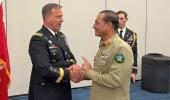
In Tampa, Florida, Munir attended the retirement ceremony of General Michael Kurilla, head of the US Central Command and also met his successor, Admiral Charles 'Brad' Cooper and General Dan Caine, chairman of the US joint chiefs of staff.
Pakistan's Deputy Prime Minister and Foreign Minister Ishaq Dar was also in Washington, DC on a eight day-long sojourn (July 21-28) where he met US Secretary of State Marco Rubio and several other senior dignitaries of the Trump administration.
On August 11, the US State Department extended its Special Designation as a Global Terrorist to the Baloch Liberation Army's Majid Brigade.
Taking due note of these developments, Michael Kugelman, Director, South Asia at the Wilson Centre, Washington DC, observed, 'Pakistan has very successfully understood how to engage with such an unconventional president (Trump)'.
Other analysts too attributed the change to a diplomatic strategy by senior Pakistani officials, combining outreach to individuals in Mr Trump's business network with counter-terrorism cooperation.
The April 2025 agreement with the World Liberty Financial, a Trump-backed crypto currency firm, and Pakistan's crypto council was a case in point.
President Trump publicly commended Pakistan for the arrest in March 2025 and transfer to US custody of Mohd Sharifullah @ Jafar of the ISIS-Khorasan, who is alleged to have organised the 2021 Kabul airport ('Abbey Gate') bombing.
What rankled however, was Munir's theatrical bragging before a Pakistani diaspora audience in Florida about using the nuclear option to destroy new Indian dams on the Indus, not worrying about taking half the world down with it if Pakistan faced an existential crisis.
The speech expectedly drew a strong protest from the external affairs ministry, regretting irresponsible nuclear behaviour by Pakistani generals, flagging also their past links with terrorists nurtured within.
It seemed as if Munir got somewhat carried away by recent US wooing.
While headlined in most Pakistani media, his words attracted a tongue in cheek comment on 'X' from Cyril Almeida, intrepid Dawn journalist, now bridled, suggesting Munir surely needed 'a public speaking coach' while addressing such gatherings abroad.
On August 8, before Munir's talk to this gathering of expatriate Pakistanis, US Joint Staff spokesperson Joseph Holstead issued a statement noting that Caine and Munir discussed 'successful US-Pakistan counter-terrorism cooperation efforts', emphasising 'the strong relationship between the two militaries', which was deemed 'necessary for advancing shared security goals, promoting regional stability, and supporting peace and nuclear security in South Asia.'
Sections in the US State Department and Pentagon have always felt more comfortable dealing with all powerful Pakistani generals instead of elected civilians.
A historic look back reinforces this direct link between the two militaries despite all the suspicions that were bred during earlier decades about Pakistan's duplicity in supporting the Afghan Taliban's resistance against the US presence in Afghanistan, which the Trump administration is now choosing to conveniently forget or put aside.
Shuja Nawaz, brother of a former Pakistani army chief, now a respected American academic, painstakingly outlined in his book, The Battle for Pakistan - A Bitter US Friendship (Rowman & Littlefield, 2020), how the Pakistan army leadership always tried to find 'a right corner' to stand while pursuing its own goals in the evolving strategic relationship.
In the period between 2008 to 2016, several 'policy papers' were exchanged over the course of 27 meetings (!) between then Pakistan army chief General Ashfaq Pervez Kayani, regarded as 'a thinking general' and Admiral Mike Mullen, then chairman of the US joint chiefs of staff, the USA's chief interlocutor then, responding to each other's concerns.
Kayani handed over 'a final paper' in October 2010 to President Obama in the White House.
These exchanges did little to significantly reduce America's 'low degree of trust' because of continued harbouring of the Quetta Shoora, the Haqqani Network, al-Qaeda, ISIS remnants inside Pakistan.
US interlocutors remained well aware of the ISI's nexus with such elements.
On their part, the Pakistani military leadership strongly believed that the US was being 'disrespectful of Pakistan's efforts and its support.'
They were 'being made a scapegoat' often in a 'transitional' or 'transactional' relationship while remaining 'hesitant to crystallise the end state' of ties.
Though the Pakistan army was undergoing a massive shift in its capacities as a conventional army to one fighting an existential battle against internal militancy and terrorism, the US generals had to be repeatedly reminded of 'the India factor' in Pakistani generals' concerns.
With the setting up of the Special Investment Facilitation Council (SIFC) in Pakistan, under the army's direct supervision, Asim Munir could now be hoping the Trump administration's new-found bonhomie could presage direct US influence through international financial institutions to bail out Pakistan's economy from its present morass.
If a concerted effort to invite US private investment into the country works out, opportunities could open up to revive special economic zones and privatise lagging units in the private sector.
Apart from finance, such investment could bring advanced management techniques and production technologies to Pakistan.
While the USA may want to wean away Pakistan's defence establishment from excessive or almost total dependence on Chinese weaponry, no consensus seems visible yet on any large scale renewal of the old armaments relationship.
US military assistance amounting to $397 million was provided (2024-2025) for maintenance and repair equipment connected to Pakistan's F-16 aircraft.
Military training programmes and a trickle of assignments for mid-level officers from the Pakistan army may have started again.
These developments need not all be viewed from the prism of the USA's hyphenation of responses to India and Pakistan but analysts in India will need to carefully watch any subsequent intensification of US-Pak ties on the trade front.
Feature Presentation: Aslam Hunani/Rediff




 © 2026