A court in Pratapgarh, Uttar Pradesh, has sentenced five individuals to life imprisonment for the murder of a Dalit man in 2001. The verdict was delivered after the court found the accused guilty based on presented evidence.
Cricket legends Harbhajan Singh, Venkatesh Prasad, Zaheer Khan, and Sourav Ganguly reminisced about India's historic 2001 Test victory against Australia at Eden Gardens.

Sukanya Verma quizzes you to find out just how much you know about the movies.

Former India captain Sourav Ganguly supports the BCCI's decision to host Test matches in new venues like Guwahati and Ranchi, alongside traditional centres.

Tamil Nadu's AIADMK, leading the NDA in the state, has released its first list of 23 candidates for the upcoming Assembly elections, renominating key leaders and fielding experienced legislators from their traditional strongholds.

Thrissur Rural Police in Kerala have arrested over 100 convicts who had been absconding for years after being sentenced by courts for various crimes. The arrests were made during a special operation called 'Operation Iron Grip'.
V V S Laxman reflects on his historic partnership with Rahul Dravid during the 2001 Kolkata Test, which helped India recover from a follow-on to win the Test match against a dominant Australian team.

Chennai Super Kings have appointed former England wicketkeeper-batter James Foster as their fielding coach for the upcoming IPL season. Foster brings a wealth of experience from international and franchise cricket.

After more than four decades, Chhattisgarh's Bastar region has been declared free of Left-Wing Extremism (LWE), marking the end of the armed Maoist rebellion in the area. The decline is attributed to sustained security operations, improved governance, and socio-economic development initiatives.

Rajinikanth has praised Aditya Dhar's Dhurandhar The Revenge, starring Ranveer Singh, declaring it a 'must-watch film' as it continues its impressive run at the box office.

As Aamir Khan turns 61 on March 14, Subhash K Jha looks at the 10 turning points in his career through the years.

Tiger Woods was arrested for driving under the influence in Florida after his vehicle rolled over. He was later released and faces multiple charges.

The Enforcement Directorate has filed a chargesheet against former Reliance Communications president Punit Garg and another individual in connection with a money laundering probe linked to an alleged Rs 40,000 crore bank loan fraud.

Lakshya Sen's quest to become the third Indian to win the All England Open badminton title ended in defeat against Lin Chun-Yi in a closely contested final.

With 8,931 days in office as head of government covering his tenure as Gujarat Chief Minister and as Prime Minister, PM Modi has overtaken Chamling's record of 8,930 days.
To prevent accidents and security breaches, Parliament issues a new advisory urging MPs to limit their vehicle speed to 10 kmph within the complex.

Since 1945, the United States has carried out aerial bombing operations in an alarming number of countries.

If the stories are food for the mind then our digestive system has changed. If they are a piece of art, our gaze has altered. This calls for a change not in stories, but in the grammar of storytelling so that it can cut through the deluge and gluttony and force people to savour, appreciate and re-visit it. That is what the creators of Taskaree or Dhurandhar are trying, points out Vanita Kohli-Khandekar.

Eminent historian and academic K.N. Panikkar, known for his Marxist interpretation of history and advocacy for secularism, has passed away at the age of 90. His contributions to historical research and defence of secular values are widely recognised.
Lakshya Sen overcame painful blisters and severe cramps to defeat Victor Lai and reach the All England Open final, bringing him closer to ending India's 25-year wait for the title.

Eminent journalist HK Dua, who led editorial operations at three of India's leading newspapers, has died at the age of 88. He was also a nominated member of the Rajya Sabha and served as media advisor to two prime ministers.

'Our diplomacy should have been focused on preventing war and avoiding the inevitable disruptions it would cause, posing a real risk to India's growth story,' asserts former foreign secretary Shyam Saran.

'We will give Rs 25,000 to parents having a second child or more at the time of delivery itself.'

Venus Williams lost in the first round of Indian Wells but expressed gratitude for the home crowd support. She also addressed speculation about a possible comeback for her sister, Serena Williams.

India has the world's highest Nipah fatality-case ratio at 72 per cent -- reported during 2001-2025.

Olympic medallists Abhinav Bindra and PV Sindhu have praised Lakshya Sen for his performance at the All England Open badminton championship, highlighting his courage and resilience despite his runner-up finish.
Former mentor Vimal Kumar praises Lakshya Sen's resilience and courage in reaching the All England Open final, highlighting his determination despite physical challenges.
Lakshya Sen's quest for the All England Open title ended in a final defeat to Chinese Taipei's Lin Chun-Yi, extending India's wait for a champion in the prestigious tournament.

Purnendu Maji and Srinivas Bhogle present Rediff's Most Valuable Player Index of T20 World Cup 2026.

Lakshya Sen ends runner-up at All England Open, loses men's singles final 15-21 20-22 to Lin Chun-Yi.
Lakshya Sen battled through painful blisters and severe cramps to defeat Victor Lai and reach the All England Open final, bringing him one step closer to ending India's 25-year wait for the title.
Lakshya Sen's quest for the All England title ended in a narrow defeat to Chinese Taipei's Lin Chun-Yi in a thrilling final marked by high-intensity rallies and attacking play.

Two-time Olympic medallist PV Sindhu is likely to miss the All England Championships due to travel disruptions caused by airspace closures in the Gulf region.

'I suspect that Bangladesh being given permission stuck in India's official craw, and this story was an attempt to balance the scales by giving the impression that a similar waiver had been given to India as well.'

Telangana Police's Special Intelligence Branch, led by officer B Sumathi, successfully negotiated the surrender of top Maoist commander Thippiri Tirupati alias Devuji and other Maoist leaders, marking a significant victory for the state.

Top Maoist commander Thippiri Tirupati, known as Devuji, surrendered to Telangana police after over four decades of underground life, citing health issues and a desire to continue his political career within the legal framework.

'The unexpected turn of events and assertion of sovereignty by the Taliban has baffled the Pakistan security establishment.'

Two-time Olympic medallist PV Sindhu is set to miss the All England Championships after being stranded in Dubai due to travel disruptions. Other Indian shuttlers face challenges reaching the tournament.
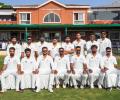
Pace spearhead Auqib Nabi was the standout performer for Jammu and Kashmir but the triumphant Ranji Trophy campaign was a team effort.

India's main inflation measure, the Consumer Price Index (CPI), is set for another major update, even though it has been in its current form for only about 15 years.
 © 2026 Rediff.com - Advertise with us - Disclaimer - Privacy Policy - Sitemap - Feedback - About us - Terms of use - Grievances