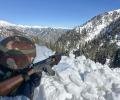
The exchange of fire occurred even though the directors general of military operations of India and Pakistan spoke over the hotline on Tuesday amid rising tensions between the two countries over the Pahalgam terror attack on April 22.

India has warned Pakistan against its unprovoked firings along the Line of Control (LoC) in Jammu and Kashmir as the directors general of military operations of the two armies spoke on the hotline amid the escalating tensions over the Pahalgam terror attack.
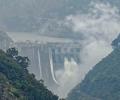
India's measures announced against Pakistan on April 23 will remain effective, the sources said.

The Indian government has revoked 14 categories of visas for Pakistani nationals, including business, conference, visitor, and pilgrim visas, following the terror attack in Pahalgam, Jammu and Kashmir. The decision was made after a Cabinet Committee on Security meeting, and the Home Minister has instructed state governments to ensure that all Pakistani nationals leave India by the set deadlines. The order does not apply to Long Term Visas (LTVs) and diplomatic and official visas issued to Pakistani nationals.

India has suspended the Indus Waters Treaty with Pakistan, citing sustained cross-border terrorism and security concerns. The treaty, brokered by the World Bank in 1960, governs the distribution and use of the Indus river and its tributaries between the two countries. India's decision follows a recent terror attack in Jammu and Kashmir, and has been met with strong condemnation from Pakistan.

UN Secretary-General Antonio Guterres has called for maximum restraint between India and Pakistan following a deadly terror attack in Jammu and Kashmir. Guterres' spokesperson, Stephane Dujarric, said that the UN chief is following the situation "very closely and with very great concern." Dujarric also stated that any issues between the two countries "can and should be resolved peacefully, through meaningful, mutual engagement." India has downgraded diplomatic ties with Pakistan and announced a raft of measures, including expulsion of Pakistani military attaches, suspension of the Indus Water Treaty of 1960 and immediate shutting down of the Attari land-transit post in view of the cross-border links to the terror attack.

Aziz said unilateral revocation of the treaty can pose a threat to Pakistan and its economy.
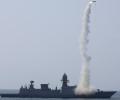
The visuals show the BrahMos anti-ship and anti-surface cruise missiles being launched from a fleet of warships, including Kolkata-class destroyers and Nilgiri and Krivak-class frigates, reaffirming the Navys operational prowess.

The Centre is planning to undertake a study to look into ways to maximise the use of the quantum of water from the three rivers that Pakistan had earlier used under the Indus Water Treaty, now that the agreement has been suspended, officials said.
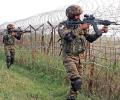
Pakistan troops have violated the ceasefire agreement for the 11th consecutive night, firing on Indian posts along the Line of Control (LoC) in Jammu and Kashmir. The firing began in Kupwara and Baramulla districts and spread to other sectors, including Poonch, Rajouri, Mendhar, Naushera, Sunderbani, and Akhnoor. The Indian Army responded promptly and proportionately. The ceasefire violation comes despite a recent phone call between the Directors General of Military Operations (DGMOs) of India and Pakistan on April 29. This marks the latest escalation of tensions between the two countries, following a terror attack in Pahalgam in April.
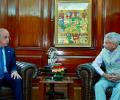
India briefed envoys of around 45 nations on the Pahalgam terror attack and its link to cross-border terrorism. The envoys were briefed in two batches by senior officials of the Ministry of External Affairs (MEA). India also announced punitive measures against Pakistan, including expulsion of Pakistani military attaches, suspension of the Indus Water Treaty of 1960 and immediate shutting down of the Attari land-transit post. Pakistan responded by shutting its airspace to all Indian airlines and suspending trade with New Delhi.

Because of the treaty, no big dams or power projects can be built by India on Jhelum, Indus or Chenab.
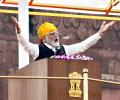
The invitation cards for the 79th Independence Day celebration also carry the Operation Sindoor logo, and the water mark of Chenab bridge to exemplify the rise of 'Naya Bharat'. Floral decorations at the venue will also be based on 'Operation Sindoor'.
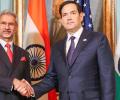
The phone conversation came amid escalating tensions between India and Pakistan over the April 22 terror attack that killed 26 civilians.

Puri said Pakistan was a country in "terminal decline" periodically using terrorism as an instrument of state policy.
As tensions escalated between India and Pakistan following the deadly Pahalgam terror attack, Iran reached out to both countries, urging de-escalation. Saudi Arabia also expressed concern, with its foreign minister engaging in phone conversations with his Indian and Pakistani counterparts. Iran's foreign minister, Seyed Abbas Araghchi, emphasized the importance of bilateral relations, stating Tehran's willingness to "forge greater understanding" at this critical time. Saudi Arabia's foreign minister, Faisal bin Farhan Al Saud, spoke with both India's External Affairs Minister S Jaishankar and Pakistan's Foreign Minister Mohammad Ishaq Dar. Amidst heightened tensions, India has taken a series of punitive measures against Pakistan, including suspending the Indus Waters Treaty and downgrading diplomatic ties. Pakistan responded by shutting its airspace to Indian airliners and suspending all trade. Both countries exchanged warnings, with Pakistan emphasizing its commitment to "respond firmly to any aggression."

India to exploit to the maximum the capacity of Pak-controlled rivers -- Indus, Chenab, Jhelum as per the Indus Treat, source said.
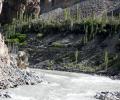
Emergency legal and constitutional consultations were held in response to India's unilateral move, and preliminary groundwork has been completed after which it has been decided to formally serve a diplomatic notice to India over the suspension of the treaty

The US has issued a 'Do Not Travel' advisory for Jammu and Kashmir citing potential for terrorist attacks and violent civil unrest. The advisory, issued on Wednesday, comes a day after a deadly terror attack in Pahalgam that killed 26 people, mostly tourists. The advisory also warns against traveling within 10 kilometers of the India-Pakistan border.
The United States on Thursday said it supports India's right to defend itself and its fight against terrorism as US Defence Secretary Pete Hegseth dialled Defence Minister Rajnath Singh amid rising tensions between India and Pakistan over the Pahalgam terror attack.

The Indus Waters Treaty, brokered by the World Bank, has governed the use of the Indus River and its tributaries between India and Pakistan since 1960.

The MiG-21 episode demonstrates that procurement is always strategic.
Choices about what aircraft to acquire, who builds them, who supplies the spares, who trains the pilots and technicians are decisions with political consequences lasting for decades.

Pakistan's former foreign minister Bilawal Bhutto-Zardari on Monday said his country will go to war if India denies Islamabad its fair share of water under the Indus Waters Treaty (IWT).
Regarding the possibility of talks, the minister said he was not aware of any such potential engagements.

'Operation Sindoor is still ongoing. The Prime Minister himself said that blood and water cannot flow together, that talks and terrorism cannot go together. So how can we have a cricket match with a country that indulges in terrorism?'

External Affairs Minister S Jaishankar discusses India's approach to cross-border terrorism following the Pahalgam attack, emphasizing a firm response and no compromise on nuclear blackmail.

India's Air Chief Marshal A P Singh met Prime Minister Narendra Modi on Sunday to discuss the security situation arising from escalating tensions with Pakistan. The meeting comes after a similar briefing by the Navy Chief on the situation in the Arabian Sea. This follows a deadly terror attack in Pahalgam, which India has blamed on Pakistan. India has taken several retaliatory measures, including suspending the Indus Waters Treaty and banning imports from Pakistan.
Pakistan has offered to join any neutral and transparent probe into the Pahalgam terrorist attack that killed 26 people. Prime Minister Shehbaz Sharif also warned India against any attempt to stop, reduce or divert the flow of water belonging to Pakistan, saying any such action would be responded to with full force and might. Sharif said Pakistan has always condemned terrorism in all its forms and manifestations and has endured immense loss of over 90,000 casualties and economic losses exceeding USD 600 billion. He also reiterated Pakistan's support for the right of self-determination of the Kashmiri people.

Main imports from the neighbouring country during April-January 2024-25 included fruits and nuts (USD 0.08 million), certain oil seeds and medicinal plants (USD 0.26 million), and organic chemicals.

The Pakistan Army has vowed to respond to Indian air strikes that targeted locations in Pakistan-occupied Kashmir and Punjab. The strikes were carried out from within Indian airspace, according to the army spokesman, who said that Pakistan will respond at a time and place of its choosing. The army is currently assessing the damage caused by the strikes.
The Bharatiya Janata Party on Wednesday slammed Rahul Gandhi for his 'surrender' barb at Prime Minister Narendra Modi, saying it is not only a grave insult to the armed forces and country but also no less than treason.

India has revoked all visas issued to Pakistani nationals effective April 27, advised Indian nationals in Pakistan to return home, and suspended visa services to Pakistani nationals. The move comes in retaliation to the Pahalgam terror attack that killed 26 people and alleged cross-border links to the attack. This escalation follows India's previous actions against Pakistan, including expelling Pakistani military attaches, suspending the Indus Water Treaty, and shutting down the Attari land-transit post.

'Trump's sons, and the son of Trump's Mideast envoy Steven Witkoff, are in the crypto business and recently signed deals with Pakistan's crypto council.' 'It may not be coincidental that not long before the Trump-Munir meeting, the head of Pakistan's crypto council met with Trump's White House crypto policy czar.'
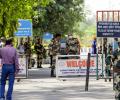
Abdul Waheed was brought from Srinagar by the Jammu and Kashmir police for his repatriation to Pakistan.

The statement came hours after Prime Minister Narendra Modi on Tuesday told the top defence brass that the armed forces have "complete operational freedom" to decide on the mode, targets and timing of India's response to the Pahalgam terror attack, government sources said.
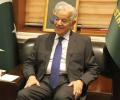
Last week, Information Minister Atta Tarar had said that 24-36 hours were important, fearing a possible strike by India. However, the time passed and there was no action by India.

Villagers living near the International Border and Line of Control in Jammu are on high alert following the recent terror attack in Pahalgam, preparing underground bunkers and accelerating crop harvesting. The incident has heightened security concerns despite a renewed ceasefire agreement between India and Pakistan in 2021. Residents are demanding swift action against the perpetrators and their handlers.

Former Pakistan foreign minister Bilawal Bhutto had acknowledged his country's tango with terror operatives, saying that Pakistan has a past.

The highlight of Tuesday's debate on Operation Sindoor was the speech by Prime Minister Narendra Modi, with the rebuttal by Congress's Wayanad MP Priyanka Gandhi coming a close second.
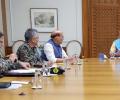
India has called Pakistan's nuclear bluff with Operation Sindoor and sent a psychological message to state-sponsored terrorists: nobody is untouchable and no place in Pakistan is safe for you, government sources said on Sunday.
 © 2026 Rediff.com - Advertise with us - Disclaimer - Privacy Policy - Sitemap - Feedback - About us - Terms of use - Grievances