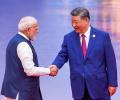
'When the Galwan incident took place, that was a big break in the trust factor between India and China.'

'China continues to perceive its relations with India through the prism of India-US relations, with the US using India to counter balance against China in the Indo-Pacific and beyond.'
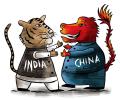
India and China have announced a series of measures aimed at improving their relationship, including maintaining peace along the border, reopening border trade, and resuming direct flights.

India and China will resume direct flight services by the end of this month after a five-year gap, signaling an effort to rebuild ties strained by the border standoff in eastern Ladakh.

The Indian government has relaxed foreign direct investment (FDI) norms for countries sharing land borders with India, including China, a move that amends press note 3 of 2020.
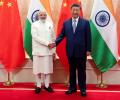
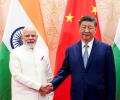
Prime Minister Narendra Modi and Chinese President Xi Jinping vowed to work towards a "fair, reasonable, and mutually acceptable" resolution of the festering boundary issue and pledged to work towards stabilising global trade.

Piyush Goyal on Friday rejected reports suggesting that India is planning to hold off trade deal with the United States for several months.

India and China have reached new common understandings agreeing to conduct normalised management and control of the boundary during Foreign Minister Wang Yi's visit to New Delhi, Beijing said.
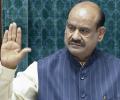
Lok Sabha Speaker Om Birla addressed concerns about fairness and speaking privileges in the House, emphasising that all members, including the Prime Minister, must adhere to parliamentary rules and procedures.

Echoing United States President Donald Trump's stance on imposing economic sanctions against countries maintaining trade ties with Russia if Moscow doesn't put an end to the conflict in Ukraine, North Atlantic Treaty Organisaiton (NATO) Secretary General Mark Rutte on Tuesday (local time) urged India, China, and Brazil to reconsider their economic relations with Russia, warning of potential secondary sanctions, reported Reuters.
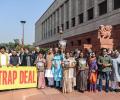
Opposition MPs, including members of the Congress party, staged a protest in the Parliament House complex over the India-US trade agreement, controversy surrounding former Army chief MM Naravane's unpublished memoir, and the suspension of eight MPs.

Gandhi held up Naravane's unpublished "memoir" and said he would like the youngsters in India to know that this 'book' exists despite the government claiming otherwise.

Following the BNP's victory in recent elections, Bangladesh is seeking to reset its relationship with India, emphasizing mutual benefit and a recognition of the changed political landscape.

Leader of Opposition Rahul Gandhi has written to Lok Sabha Speaker Om Birla, protesting being disallowed from speaking on a matter of national security, calling it a 'blot' on democracy.

'Nehru was an idealist, he was certainly a visionary in one way, but Mao Zedong was not. Mao Zedong was a very down-to-earth strategist. He wanted to take Tibet, to take the plateau, to take the rivers, to take the minerals.'
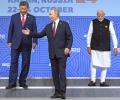
Russian Foreign Minister Sergey Lavrov alleged that NATO is blatantly trying to lure India into anti-China intrigues.
'No, India and China were not about to go to all-out war over a few rocks of Galwan.' 'The full picture of what went on at the highest level between two heads of State will not be known for a very, very long time and rightly so,' points out Colonel Anil A Athale, former head of the history division, ministry of defence.

Just ahead of Prime Minister Narendra Modi's reply to the debate on Motion of Thanks on the President's Address, the Chair adjourned the House for the day soon after it reassembled at 5 pm.
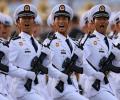
China's latest defence budget surges to $275 billion, fueling its ambitious military modernisation program and intensifying geopolitical dynamics in the region.
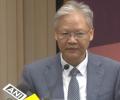
China firmly opposes the Trump administration's 50 percent tariffs on India as it is "unfair and unreasonable" and New Delhi and Beijing should scale up economic ties to jointly counter the challenge, Chinese ambassador Xu Feihong said on Monday.

When Gandhi started quoting the from unpublished book, Defence Minister Rajnath Singh questioned as to how material which is not published can be cited in the House.

BJP's women MPs have requested Lok Sabha Speaker Om Birla to take strict action against opposition MPs for disruptive behavior in Parliament, including protests that prevented Prime Minister Modi from addressing the House.

Union Minister Kiren Rijiju has accused Congress MPs of abusing Lok Sabha Speaker Om Birla in his chamber, alleging that senior Congress leaders were present and encouraging the behavior. The accusation follows days of disruptions in the Lok Sabha over Rahul Gandhi's attempt to discuss excerpts from a former Army chief's unpublished memoir.
Chinese President Xi Jinping described India and China as "good neighbours, friends and partners", saying that achieving "dragon and elephant dancing together" is the right choice for both countries.

India may adopt a "calibrated" and a "step-by-step" approach to easing norms on investments originating from China, Union Commerce and Industry Minister Piyush Goyal said on Tuesday. He was in a conversation with A K Bhattacharya on Day 1 of Business Standard's two-day annual event, Manthan 2026. The minister said foreign direct investment (FDI) from China was certainly not "banned", but it goes through an approval process. "The government's approach at the moment is to accelerate the approval process."

JSW MG Motor India will launch four new models this year, and is planning to invest between 3,000 crore-4,000 crore in the country over the next couple of years. The new models include a plug-in hybrid, an electric vehicle, the Majestor SUV and one additional model yet to be disclosed.

In a region increasingly shaped by competition and coercion, such collaboration strengthens security without confrontation, builds capacity without dependency and promotes order without domination, points out Dr Kumar.
'What's currently underway is not a 'reset'.' 'What needs to be arrived at is a new balance.'

Lavrov's comments came two days after Russia accused the US of attempting to prevent India and other countries from buying Russian oil, saying Washington was using a wide range of 'coercive' measures, including tariffs, sanctions and direct prohibitions.
Prime Minister Narendra Modi and Chinese President Xi Jinping held talks focusing on rebuilding bilateral relations, emphasizing border peace and addressing cross-border terrorism.
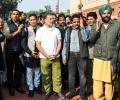
The House has been witnessing uproar after Rahul Gandhi was disallowed to cite an article based on excerpts from an unpublished 'memoir' of former Army chief General M M Naravane (retd).

The first leg of the Budget session concluded with debates over the India-US trade deal and a former army chief's memoir, and will reassemble on March 9.

Rahul Gandhi said he never wanted to speak on the particular issue, but decided to do so after BJP's Surya questioned the patriotism of the Congress party. Singh maintained that the book had not been published.

Opposition leaders are set to decide on giving notice for a resolution to remove the Lok Sabha Speaker after a meeting with Om Birla, following disputes over speaking rights and MP suspensions.
Lavrov said that the US has set itself the objective of 'achieving economic domination', adding further to it that Americans want to control the routes to leading countries to provide its energy sources to them.

India and China reviewed the situation along the Line of Actual Control (LAC) in eastern Ladakh and prepared for the next Special Representatives' dialogue on the boundary question.

Union Parliamentary Affairs Minister Kiren Rijiju announces the debate and vote on the no-confidence motion against Lok Sabha Speaker Om Birla will occur on March 9. The Budget Session's second part will also address important legislation and critical bills.
A senior Chinese Communist Party official stated that the meeting between Prime Minister Narendra Modi and President Xi Jinping was fruitful, leading to a new consensus on developing bilateral relations. Both countries aim to enhance cooperation and manage differences.

The incident took place right outside Parliament's Makar Dwar, the main entrance which MPs take to enter the new Parliament building, where Gandhi was standing in solidarity with suspended Congress MPs, mostly from Punjab.
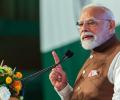
Prime Minister Narendra Modi on Friday said it is important for India and China to work together to bring stability to the world economic order as he asserted that New Delhi is ready to advance bilateral ties from a strategic and long-term perspective based on mutual respect, mutual interest and mutual sensitivity.
