

'Nehru was an idealist, he was certainly a visionary in one way, but Mao Zedong was not. Mao Zedong was a very down-to-earth strategist. He wanted to take Tibet, to take the plateau, to take the rivers, to take the minerals.'

Key Points
- The Panchsheel Agreement formally recognised Tibet as the 'Tibet region of China', marking India's official acceptance of Chinese sovereignty over Tibet.
- Before 1954, there was thriving cross-border trade between Indian border villages (Uttarakhand, Himachal) and Tibet.
- Tibet had its own flag, army, currency, stamps, passports, and conducted foreign dealings directly with British India.
Chief of Defence Staff General Anil Chauhan recently spoke about Panchsheel, saying it was believed that Panchsheel would settle the India-China border dispute.
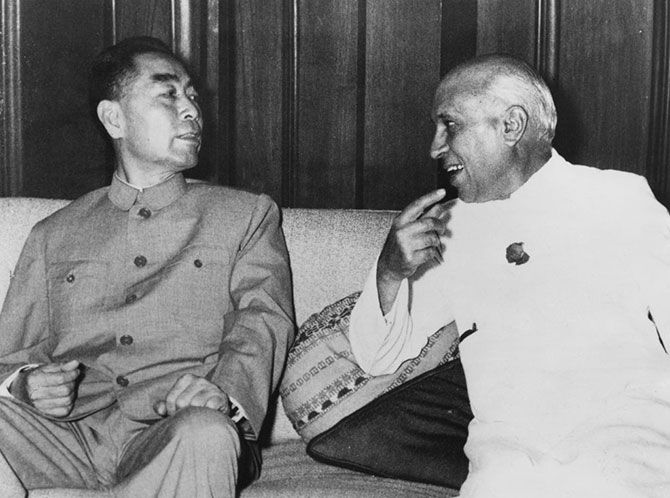
The Panchsheel Agreement, or the Five Principles of Peaceful Coexistence, was the framework that defined India-China relations from 1954 to 1962.
This agreement, signed between India and China, is seen as having paved the way for Beijing to gain control over Tibet, after the Chinese invaded and overran Tibet in 1950-1951.
Long-time Rediff Columnist Claude Arpi has written several books and articles on Tibet and on India-Tibet-China, and has been a critic of the Panchsheel Agreement.
"Nehru was very influenced by K M Panikkar, who was the ambassador in China. Panikkar really believed that if India and China can be friends, it was worth sacrificing Tibet," Mr Arpi tells Amberish K Diwanji in the first of a two-part interview.
Chief of Defence Staff General Anil Chauhan recently spoke about Panchsheel, saying it was believed that Panchsheel would settle the India-China border dispute.
Why do you think he would suddenly bring up this issue?
I think usually the army senior officers or the MEA (ministry of external affairs) do not like to speak about Panchsheel.
Panchsheel was basically an agreement on trade and intercourse between the Tibet region of China and India.
Now in the title itself, Tibet has become the 'Tibet region of China'. It was the first time that officially, in a signed agreement, India agreed that Tibet was part of China. Till 1954, there was a doubt (about the status of Tibet).
China came in 1951 and in 1952, the PLA [People's Liberation Army] started spreading over the (Tibetan) plateau.
But officially, it remained an independent nation. So, by that title only, it was a surrender of all the Indian rights in Tibet.
But the Agreement is usually mixed up with the fact that there was a preamble (to the Panchsheel Agreement), which was added at the last minute.
It's not clear who had the idea of preamble, whether it was Chinese Premier Zhou Enlai or Jawaharlal Nehru.
It was a very beautiful preamble, five principles, we could say Buddhistic principles [the principles were i. mutual respect for each other's territorial integrity; ii. mutual non-aggression; iii. mutual non-interference in each other's internal affairs; iv. equality and mutual benefit, and v. peaceful coexistence].
Now, the important part is mutual non-interference in each other's internal affair. The title accepted that Tibet is part of China for the first time on an official document.
And the third of the five principles say that mutual non-interference in each other's territorial internal affairs.
The Government of India has published 15 White Papers on China between 1954, from the time of the Panchsheel Agreement till 1965-66, which is three years after the (1962) war.
In every letter, China is telling Delhi that you have accepted that you will not interfere in our internal affair.
Today in India, we believe that Panchsheel is something that was very nice. Nehru even said in Parliament in May of 1954 that 'It's the best thing I've done in my political career.'
But at the same time, it's the last nail in the coffin of an independent nation.
So, I think General Anil Chauhan, the CDS, wanted to remind us about it, because, after all, he is native from that area. He is from Pauri, Garhwal, in Uttarakhand state.
He wanted to remind people that before 1954, there was free trade between India and Tibet, between all these areas in the central sector of the India-Tibet boundary, which is Himachal Pradesh and Uttarakhand. Okay.
All these villages [in the Central Sector] were trading with Tibet.
You have visited these villages.
About two-three months ago, I went to Niti village and Mana village (both located at altitudes of over 3,000 metres, on the border with Tibet).
Mana village is called the first village in India. There I met and interviewed some old people. They traded with Tibet in the past.
I want to add that the Panchsheel Agreement was for eight years and existed from 1954 to 1962. After it lapsed in April 1962, at that time, all trade stopped.
And many of these border villages have today become ghost villages, with very few people left there.
'The 13th Dalai Lama was a very, very great leader'
Let's go back to the question of Tibet's independence. In 1945, the UN was formed but Tibet did not become a member. It was independent from 1912 but was not internationally recognised as such.
How independent was it really?
I think on the ground, it was independent since 1912.
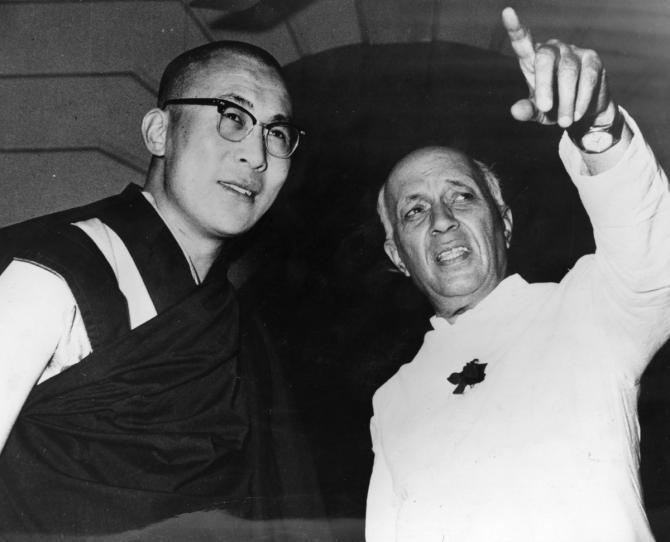
The (13th) Dalai Lama [the predecessor of the current Dalai Lama who resides in Dharamshala, Himachal Pradesh, India] was in exile in India between 1910 and 1912.
And he returned to Tibet and he made a declaration of independence at that time. But it was not recognised internationally.
There were a lot of forces involved. Mainly the main one, the big monastery, didn't want to have any foreign relation at all.
Now the 13th Dalai Lama was a very, very great leader. And he foresaw that Tibet needed to be recognised, he wanted it to be recognised in the League of Nations [which existed from 1920 to 1946] before the United Nations.
And this was opposed by the conservative forces in Tibet. That was a huge blunder.
That was one of the many blunders that the Tibetan nation did, that the Tibetan government did.
The 13th Dalai Lama passed away in 1933. The 14th [and present] Dalai Lama was born in 1935. When the Chinese invasion came, he was just 15 years old!
The Tibetan government and the oracles and the national assembly decided to make him the political leader, but he was a kid of 15 years old.
At the same time, Tibet had all the signs of an independent country: Tibet had its own flag, its own army, its own decoration, its own coinage, its own stamps, its own passport.
And I think more importantly, Tibet, for its foreign affair, was dealing directly with the Government of India, mainly through the political officer (Sir) Basil Gould [who was political officer for Sikkim, Bhutan, and Tibet from 1935 to 1945].
And you have thousands of files showing that Tibet between 1912 and 1954 was dealing directly with the government [of India], it included the relations with Bhutan and Nepal also.
But you know, even prior to the Chinese invasion of 1950, the Qing dynasty of China had always asserted that Tibet was a part of China.
When there was the Nepal-Tibet war in the 19th century, it was the Chinese who helped the Tibetans.
If you are so dependent on another power, surely that doesn't augur well for the country, does it?
Tibet is a small country in terms of population. It has a very large landmass but the country is small in terms of power and population. It's not the monks who could defend Tibet.
The (Tibetan) army was three- or four-thousand strong, ill-equipped, not trained. So, you depend on a sponsor or a patron.
Buddhism has always depended on someone else to be defended. Now, till 1911/1912, when the Manchu Empire [another name for the Qing dynasty] collapsed, there was some sort of a protection from the Manchu empire.
But the 13th Dalai Lama wanted also to get the protection from the British.
That's why when he was in India (1910-1912), he came and met Lord Minto, the viceroy, in Calcutta, and talked about getting British protection.
A State like Tibet cannot survive without a protector, without a protection. It's like small countries like Bhutan which is also in the same position.
What do you think was the reason that Nehru would even agree to Panchsheel and give up all of India's rights in Tibet? What do you think was the factor that drove Nehru to do this?
He believed that India and China should be brothers. And I think when you see all the correspondence, which is in the Nehru Memorial Library at Teen Murti [now the Prime Ministers' Museum and Library in New Delhi].
I went through all these files for four years. He was very influenced by K M Panikkar, who was the ambassador in China.
Panikkar really believed that if India and China can be friends, it was worth sacrificing Tibet.
He realised that he was sacrificing Tibet, but he thought it was worth for world peace.
Actually, when the issue, when the dilemma appealed in November 1950 to the UN, the Indian ambassador, India's representative in the UN said, let's keep the issue pending because many of the Western nations wanted to condemn China.
He said, we are friends with China, we will deal with China, we will explain to them, we will sort out the issue amicably with China.
But Mao Zedong [chairman of the Chinese Communist Party] did not have the same mindset as Nehru.
Nehru was an idealist, he was certainly a visionary in one way, but Mao Zedong was not. Mao Zedong was a very down-to-earth strategist.
He wanted to take Tibet, to take the plateau, to take the rivers, to take the minerals. So, you have two leaders with different mindsets.
They don't think the same. But India wanted so much to be friends with China, it resulted in India surrendering all the rights.
Can you imagine that in 1954, before Panchsheel, India was looking after the Tibetan postal services.
Tibet had a series of 13 very beautiful Dak [postal] bungalows on the road to Lhasa -- from Sikkim to Lhasa.
And they had the telegraph, they had the three trade agencies in Yatung (Chumbi Valley, southern Tibet), in Gyantse in western Tibet, and in Gartok (western Tibet).
And there was a consulate general in Lhasa. All these were just surrendered in 1954 and the consulate in 1962.
That's why Acharya Kripalani, that socialist leader, said that the Panchsheel was born in sin.
Feature Presentation: Aslam Hunani/Rediff


 © 2026