

'No, India and China were not about to go to all-out war over a few rocks of Galwan.'
'The full picture of what went on at the highest level between two heads of State will not be known for a very, very long time and rightly so,' points out Colonel Anil A Athale, former head of the history division, ministry of defence.

The ruckus in Parliament over General Manoj Mukund Naravane's version of the Indian actions during the Galwan crisis of 2020 are distressing to say the least. It is happening precisely at a time when the world order is in turmoil due to American actions.
All the countries affected by American economic/strategic threats have shown remarkable national unity. In democracies like the UK, France or Germany, the political class is united in the national interest. India is the only exception to this rule.
Here the principle Opposition party, instead of co-operating with the government, has raked up the issue of the 2020 Galwan clash with China in order to muddy the waters. This is happening at a time when India is trying to cope with a serious security threat posed by the US by discretely re-seting ties with China.
Every thinking citizen tracking world events is seriously concerned about the turmoil caused by the US president and his daily economic policy twists and naked use of American conventional power to grab territory and resources (Venezuelan oil, Greenland and designs on Canada, Cuba etc).
The US not only slapped 50% tariff on Indian exports but in parallel, began hobnobbing with Pakistan and its military dictator and the anti-India regime of Bangladesh to further poke India in the eye.
The US did not confine itself to mere words but backed it up with supply of F-6 fighter spares and advanced weapons to Pakistan. India, in the post Operation Sindoor scenario, faces a grave security situation.
India was not the only victim of this American power play. Countries across the world from Canada, France, Germany to even the UK were similarly targeted. The whole world has begun a process of re-alignment and world leaders made a beeline to China.
The European Union, that had been dragging its feet for 20 years on a trade deal with India, quickly concluded the agreement last month.
India also reacted to the world turmoil and began repairing its ties with China, strained since the 2020 Galwan military clash. All this nimble footwork resulted in the US finally accepting the Indian demand to reduce tariff.
India's firm handling and the US need for an ally against China played a role. The out of control US is seen not just as an economic but military threat. Many of these sensitive negotiations are going on behind closed doors.
Of all the possible measures, it appears that the BRICS countries (Brazil, Russia, India, China, South Africa) are possibly engaged in de-dollarisation of their trade. The US fears this and will go to any length to stall it. Even the trade deal with India may well be a carrot to stop the de-dollarisation.
Lack of political unity in the face of a grave external threat is the greatest challenge faced by India today.
But this was not always the case. At times of national peril, the political parties showed remarkable unity in the 1962, 1965 and 1971 wars. In 1971, the Opposition showered fulsome praise on Indira Gandhi for her handling of the war. In 1974 when India conducted a nuclear test and was subjected to Western sanctions, the Opposition supported the Indira Gandhi government.
In the 1990s, under then prime minister P V Narasinha Rao, the leader of the Opposition asserted our case on Kashmir at the United Nations.
Post the Emergency, the Janata Party came to power in 1977. The then prime minister, Morarji Desai, on a visit to the US, was asked by an American reporter that since the 'discredited' Indira Gandhi was no longer ruling the country should India not discard its old foreign policy of non-alignment?
Mr Desai's response was direct and to the point. Regime change in India was due to our internal issues, India's foreign and defence policies remains unchanged. Indian democracy showed a remarkable consensus on foreign policy and unity in face of security threats.
The current actions by the Opposition parties to corner the government that cannot disclose sensitive information of the behind the scene parleys may earn it 2 minutes of television time and in the short run mislead the gullible public. The reopening of the wounds of the 2020 conflict between India and China can jeopardise national interest.
As a student of the India-China border conflict, one is struck with a sense of déjà vu. Neville Maxwell's (otherwise biased) account in his book India's China War has accurately described it as a 'conflict caused by ignorant public opinion goaded on by a reckless Opposition'. Even Professor J K Galbraith -- the US ambassador to India in 1962 -- told me in 2003 that the conflict of 1962 was 'accidental'.
In the present time by creating anti-China sentiment some Indian politicians are playing with fire. This lack of understanding between the Opposition and ruling party is a genuine threat to national security. It shows the government's failure to reach out to and convince the Opposition to desist from certain action.
As a military historian one has observed that this trend of lack of political unity set in 1998. In that year, the Atal Bihari Vajpayee government took the monumental decision to test a nuclear device and go in for an overt and open nuclear weapon posture. India faced criticism and sanctions from most Western countries.
In this hour of peril, the Congress party did not unequivocally support the decision. There were predictions of economic doom and gloom, all proved wrong eventually. Imagine the Indian security situation today if we were to be a non-nuclear power?
The trend of opposing on issues of national security continued through 1999 when Vajpayee was accused by some to have engineered the Kargil conflict to win elections! I once shared a stage with one such worthy (a former deputy home minister of Maharashtra) who accused the Vajpayee government of collusion with the army to create this conflict!
George Fernandes, one of the most honest politicians of the country, was falsely accused of buying coffins at a higher price and hounded out of the ministry of defence.
Ever since that time, the Opposition parties have been consistent in questioning every operation and military action from the surgical strikes of 2016, the air strikes of 2019, the action at Doklam 2017 and the Galwan clash of 2020. The results of Operation Sindoor have also been similarly doubted.
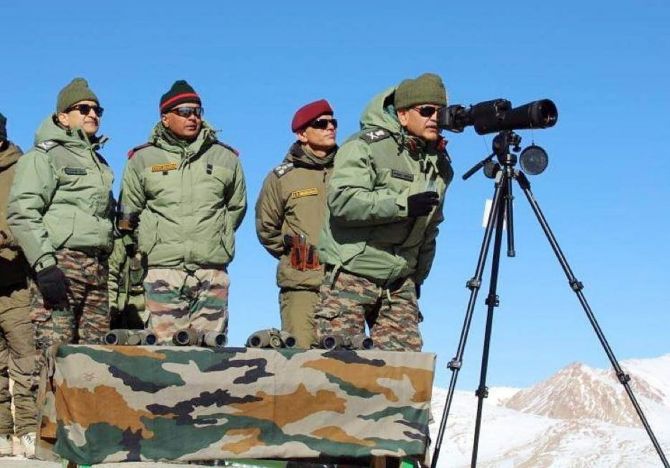
On the ground in Ladakh, the situation is much improved since 2020. Both sides have restored status quo ante. Though the large deployment of troops continues from both sides. The Galwan clash was a unique event. Two well-armed clashed, but not a sngle bullet was fired. There is no comparable example of such restraint in military history.
Credit for this goes to both the Indian and Chinese militaries and their sense of discipline.
Contrast this with what happens on the Line of Control with Pakistan. As recently as last year the two countries had a serious clash with a danger of full scale escalation. The threat of use of nuclear weapons was ever present.
In contrast, the India-China confrontation did not have the danger of escalation. It was a limited military clash confined to just one theatre.
General Manoj Mukund Naravane has dramatised it in his narrative of the events. Credit goes to the Indian Army under his leadership to have outsmarted the Chinese with deft manoeuvres of occupying the Kailash Range.
No, India and China were not about to go to all-out war over a few rocks of Galwan. The full picture of what went on at the highest level between two heads of State will not be known for a very, very long time and rightly so.
Transparency and democracy does not mean you construct a bath with glass walls!
These are Colonel Anil A Athale's personal views.
You can read Colonel Athale's earlier columns here.


 © 2026