
S Mahendra Dev, chairman of the Economic Advisory Council to the Prime Minister (EAC-PM), stated that India needs to increase the manufacturing sector's share in its GDP from the current 16-17 per cent to 25 per cent by 2047 to achieve developed economy status. This goal requires an average real GDP growth of around 8 per cent annually over the next 21 years, supported by a 34-35 per cent investment rate and diversified long-term financing.

Pragya Misra, OpenAI's first India hire and former head of strategy and global affairs, has been promoted to Head of Business Development for India and South Asia. She announced her new leadership role on Tuesday, highlighting India's status as ChatGPT's largest country. Misra's new focus will be on building partnerships to drive AI transformation for businesses and expand technology access across the region.

Three Buddhist monks staging a fast-unto-death protest in Anuradhapura, Sri Lanka, were arrested on Thursday. They were demanding the withdrawal of an India-aided government development plan for the sacred Buddhist site. The arrests followed a clash at the protest site, which also led to the detention of a defrocked monk and four civilians. India had announced grant assistance for the project in April 2025, aiming to improve infrastructure and facilities in the UNESCO World Heritage Site.

IIT Madras researchers have developed 'SEANAV', a real-time digital twin platform for autonomous maritime navigation. This platform allows for the testing, validation, and training of autonomous systems in a realistic virtual environment, addressing the challenges of real-world testing. SEANAV aligns with India's Sagarmala Programme and Maritime India Vision 2030, aiming to enhance safety and efficiency at Indian ports and reduce environmental risks.

Prime Minister Narendra Modi creatively used the popular video game Grand Theft Auto (GTA) to illustrate India's remarkable transformation from a "fragile five" economy to the world's fastest-growing nation, highlighting significant advancements in various sectors over the last 12 years.

Prime Minister Narendra Modi, addressing the nation from the Red Fort on Independence Day, declared that India is undergoing a rapid transformation across various sectors and is firmly on track to become a developed nation by 2047.

Union Minister Jitendra Singh stated that human-led artificial intelligence will be the defining force in India's journey to becoming a developed nation by 2047. Speaking at the 29th National Conference on e-Governance, he emphasised that technology must strengthen governance without replacing human accountability, advocating for responsible AI deployment with citizens at the centre. The conference concluded with the adoption of the Jaipur Declaration on e-Governance 2026, outlining a roadmap for AI-enabled, data-driven, and secure digital governance.

The climate finance battle once again exposes the deep divide between rich and developing nations.

Cortex DC, a company of The Chatterjee Group (TCG), announced its entry into the data centre market with plans to develop 2 GW of AI-ready capacity across India over the next seven years. The initiative aims to meet the growing demand for high-performance computing, targeting hyperscalers, cloud service providers, and advanced AI workloads with a focus on speed, scale, and sustainable power.

'We are open to all countries around the world as long as we get a fair deal, as long as we are ensured continuity in the engagement.'
Researchers at NIT Rourkela have developed a novel material from discarded jackfruit peels, capable of removing over 90% of fluoride from contaminated water in about 10 minutes under laboratory conditions. This patented technology, which uses activated carbon modified with zirconium, offers a promising, cost-effective, and sustainable solution for decentralised water treatment, particularly in fluoride-affected regions of India.

Suzuki Motor Corporation is set to revolutionise its operations by halving vehicle development times and significantly boosting efficiency by 2030, while committing to a diverse multi-powertrain strategy that includes BEVs, hybrids, and carbon-neutral fuels.
Pune-based deep-tech firm olee.space has won a contract from DRDO to develop an indigenous laser-link drone communication system. This system will provide secure, high-speed, jam-proof data transfer between ground stations and drones, addressing vulnerabilities seen in conflicts like the Russia-Ukraine war. The project aims to deliver ground-based and airborne free space optical communication terminals within 18 months.

Prime Minister Narendra Modi launched the 'We Will Do It' slogan, aiming for India to become a developed nation by 2047 through visionary policies and hard work, while also addressing the challenge of societal division.

Reports claiming that India has proposed allowing military aircraft to use Nepal's Bagdogra entry point are false, sources said on Sunday, dismissing media reports suggesting any such move.

The Sports Authority of India (SAI) and Indian Oil Corporation have signed an MoU for Rs 40 crore over two years to bolster boxing in India. This partnership, leveraging CSR funds and SAI's expertise, aims to enhance talent identification, athlete development, coaching, and international exposure for boxers, aligning with the revamped Khelo India Scheme.

India, speaking on behalf of the Like-Minded Developing Countries (LMDC), on Sunday flagged concerns over the lack of adequate reflection of equity and the principle of Common But Differentiated Responsibilities and Respective Capabilities (CBDR-RC) in the negotiated text at COP31, as the climate summit concluded in Antalya, Trkiye, without a final climate pact following disagreements over fossil fuel language.

Japan's military will use Indian firing ranges for live-fire training, with drills scheduled to begin next year. The exercises will include surface-to-ship missiles for the first time, marking a significant expansion of bilateral defence cooperation.

India's Indo-Pacific approach has traditionally emphasised strategic autonomy, ASEAN centrality, freedom of navigation, respect for international law and an inclusive regional order. Its growing defence and maritime partnerships with Australia, Japan, Indonesia, Vietnam and other Southeast Asian countries provide additional depth to this approach, point out Dr Kumar and Dr Jasmeet Kaur.

Nepal Prime Minister Balendra Shah is on a two-day visit to India, focusing on energy, economic cooperation, and infrastructure development. This marks his first official bilateral foreign visit since taking office. Discussions will cover expanding connectivity, trade, and investment, with several MoUs expected to be exchanged. The visit aims to strengthen the deep-rooted ties between the two nations.
Microsoft India and South Asia President Puneet Chandok highlighted at the Bengaluru Tech Summit that while AI adoption is straightforward, achieving tangible impact on the ground presents the greater challenge. He urged leaders not to delay embracing AI, drawing parallels with ISRO's innovative approach to space exploration. Chandok also stressed India's crucial role in global AI development, stating that if AI works for India's diverse population, it will work for the world.
Indegene has been announced as the inaugural industry partner for the India-UK Life Science Corridor, a collaborative initiative between the Centre for Cellular and Molecular Platforms (C-CAMP) and Imperial College London. This partnership aims to foster cross-border innovation, knowledge exchange, and talent development in critical areas like digital health and antimicrobial resistance, leveraging Indegene's expertise in life sciences.

A World Bank report, 'The Promise of Artificial Intelligence', states that AI presents a historic opportunity for low- and middle-income countries to overcome development challenges, despite many being unprepared. It advises these nations to adopt and adapt existing AI tools rather than focusing on building frontier models immediately. The report also notes a significant gap in AI adoption and job automation between high-income and developing countries.

India has voted in favour of multiple resolutions concerning Palestine at the UN General Assembly, including those affirming the Palestinian people's right to self-determination, supporting the UNRWA, and condemning Israeli settlements. These votes underscore India's consistent stance on the Palestinian issue and its historical relationship with Palestine.

Following Prime Minister Narendra Modi's strong criticism of India Inc for not creating enough jobs and hiking salaries despite corporate tax cuts, industry leaders and business associations have responded, detailing their efforts and highlighting challenges in boosting employment and reducing import dependence.

Real Madrid president Florentino Perez has announced plans to launch a free streaming platform in India from 2027, in partnership with UEFA and European Football Clubs (EFC). This initiative aims to provide Indian fans with free access to top UEFA club competition matches and foster direct engagement between clubs and their supporters.

Defence Minister Rajnath Singh has called for India to become a global leader in advanced technologies, particularly in strengthening its non-destructive testing (NDT) ecosystem. He emphasised the need for indigenous capabilities, consistent quality assurance, and the integration of advanced digital technologies like AI and ML to ensure reliability and self-reliance in defence applications.
Defence Minister Rajnath Singh advised students at Babu Banarasi Das University to not be confined by their academic degrees, encouraging them to follow their interests and adapt to emerging technologies like AI. He emphasised the importance of skills over qualifications, drawing examples from successful individuals who ventured beyond their initial fields. Singh also touched upon spirituality, India's cultural heritage, and the true essence of politics, urging students to contribute to national progress and secure borders.
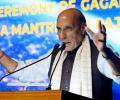
Defence Minister Rajnath Singh has urged India to become a global leader in advanced technologies, particularly in non-destructive testing (NDT), to bolster self-reliance and defence preparedness. He highlighted the critical need for indigenous capabilities in inspection technologies, quality assurance, and reliable testing results for strategic applications, emphasising that NDT is vital for ensuring the integrity of defence systems without causing damage.

Indian firm Bharat Forge and US defence major Pratt & Whitney Canada have announced a collaboration to support the development of India's high-altitude, long-endurance (HALE) unmanned aerial vehicle. This partnership involves integrating advanced turboprop engines into a DRDO-designed UAV, bolstering India's indigenous defence capabilities under the Aatmanirbhar Bharat initiative.
IBM Chairman and CEO Arvind Krishna details the company's substantial annual investment in India and its global USD 10 billion commitment to quantum computing over the next five years. He addresses the potential for AI to displace 10-20 per cent of jobs, particularly in the BPO sector, while also highlighting India's significant opportunity in the AI ecosystem. Krishna urges India to accelerate AI adoption, scale existing tech initiatives, and build its semiconductor manufacturing, advocating for a light-touch approach to AI regulation and emphasizing critical thinking in an AI-driven economy.

Former IPL Commissioner Lalit Modi has rejected allegations that he left India to evade legal proceedings, stating he moved out in 2010 due to "credible threats" to his life.

The Union Cabinet has approved the Khelo India Sports Goods Manufacturing Scheme with an outlay of Rs 1,856.67 crore for 2026-2033-34. This initiative aims to strengthen India's position in the global sports goods sector through dedicated manufacturing zones, research, skill development, and market expansion, fostering self-reliance and creating employment opportunities.

Sporting Club Delhi's midfielder Lalrinliana Hnamte has been called up to the Indian senior men's national football team for two upcoming international friendlies against New Zealand on November 12 and 15. This marks a significant step in his career, having previously represented India at the U-23 level.

Railway Minister Ashwini Vaishnaw announced that India's first high-speed rail service will begin in the last quarter of 2027, with the Surat to Vapi section opening first. He provided updates on significant construction progress, including pier and viaduct work, noise barrier installation, and tunnel excavation. The minister also highlighted the country's first undersea rail tunnel and indigenous manufacturing efforts for bullet train sets and infrastructure components, while addressing past project delays.

Prince William and Princess Catherine of Wales are set to conclude their three-day visit to India next week with a meeting with Prime Minister Narendra Modi in New Delhi. Their trip will also include attending the 2026 Earthshot Prize ceremony in Mumbai, focusing on climate action, innovation, and strengthening UK-India ties across various sectors.

Former New Zealand cricketer Dion Nash reflects on his career with the Black Caps during the 1990s, a period of significant transition for the team. He discusses the challenges of being part of a young, inexperienced squad, the turning point under coach Steve Rixon, and the eventual success. Nash also shares his memories of touring India, playing against legends like Sachin Tendulkar and Rahul Dravid, and his views on how the IPL has transformed modern cricket, particularly for New Zealand batters and Indian fast bowlers.

International Hockey Federation (FIH) president Tayyab Ikram stated that the Pakistan Hockey Federation (PHF) was informed well in advance about India hosting the Asian Champions Trophy. He expressed concern that global hockey suffers when India and Pakistan do not play each other regularly, despite Pakistan's decision to pull out of the recent tournament due to government policy. Ikram emphasized the importance of their rivalry for the sport's growth and viewership.

India has banned the export of lithium-ion battery black mass with immediate effect to ensure domestic availability of critical minerals and strengthen its battery recycling industry. This move aims to address the underutilisation of domestic recycling capacity due to inadequate feedstock and reduce reliance on imports for essential minerals like lithium, cobalt, nickel, and manganese.

New Zealand all-rounder Glenn Phillips anticipates the Basin Reserve pitch will become slower and lower as the first Test against India progresses, increasing the role of spinners. He also highlighted Jasprit Bumrah as India's biggest threat and discussed his own refined batting approach, focusing more on defence.
